Executive Summary & Cloud Data Pipeline Threat Context
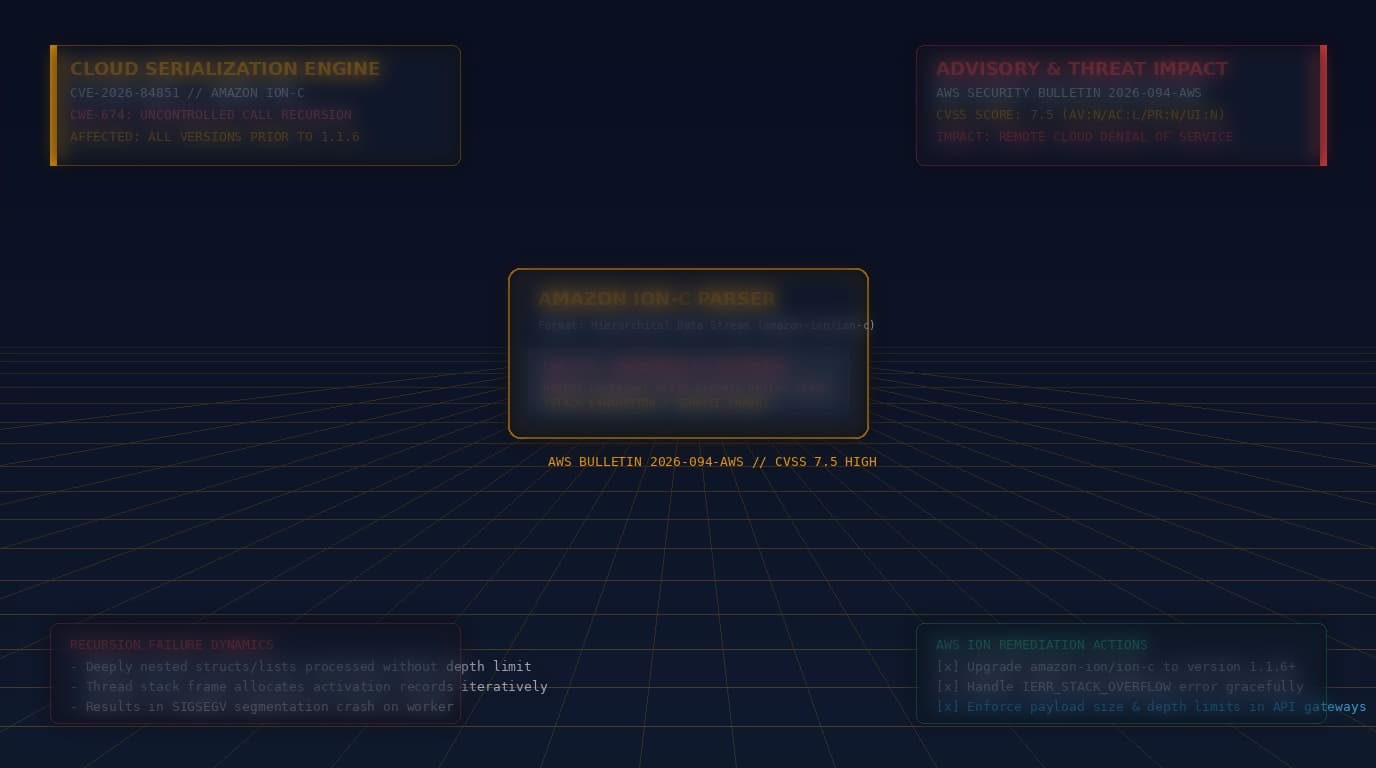
Amazon Web Services (AWS) has published security bulletin 2026-094-AWS documenting a high-severity vulnerability in Amazon Ion-C, the official C implementation of the Amazon Ion data serialization format. Cataloged as CVE-2026-84851 with a CVSS v3.1 base score of 7.5 (High) (CVSS:3.1/AV:N/AC:L/PR:N/UI:N/S:U/C:N/I:N/A:H), the vulnerability is classified under CWE-674: Uncontrolled Recursion.
Amazon Ion is a rich, hierarchical, self-describing data format developed by Amazon to address performance, typing, and schema evolution limitations inherent in JSON. Ion is embedded extensively within AWS internal service meshes, client SDKs, Amazon QLDB (Quantum Ledger Database), DynamoDB Streams, and high-performance C/C++ backend microservices.
Because CVE-2026-84851 allows an unauthenticated remote adversary to trigger instant segmentation faults (SIGSEGV) or unhandled stack exhaustion crashes in any cloud service parsing untrusted Ion data streams, the vulnerability poses a serious denial-of-service risk to cloud application availability.
Vulnerability Taxonomy & Root Cause Analysis (CWE-674)
The defect exists within the recursive tree traversal and writer functions of amazon-ion/ion-c prior to version 1.1.6, specifically when executing functions such as ion_writer_write_one_value() and ion_writer_write_all_values().
Ion supports complex, deeply nested container data types—including Structs, Lists, and S-expressions (Sexps). Under standard operation, when the Ion parser encounters a nested container, the processing function recursively invokes itself to process child elements:
// Vulnerable recursive pattern in ion_writer.c:
iERR ion_writer_write_one_value(hWRITER hwriter, hREADER hreader) {
    ION_TYPE type;
    ION_CHECK(ion_reader_get_type(hreader, &type));

    if (ion_type_is_container(type)) {
        ION_CHECK(ion_writer_step_in(hwriter));
        ION_CHECK(ion_reader_step_in(hreader));

        while (/* has next child */) {
            // FLAW: Recursive invocation without tracking or capping call depth!
            ION_CHECK(ion_writer_write_one_value(hwriter, hreader));
        }

        ION_CHECK(ion_reader_step_out(hreader));
        ION_CHECK(ion_writer_step_out(hwriter));
    }
    return IERR_OK;
}
Because the library lacked a configurable or hard-coded recursion depth counter, an adversary can craft a compact Ion payload (in either text or compact binary format) consisting of thousands of nested opening brackets:
[[[[[[[[[[[[[[[[[[[[[[[[[[[[[[[[... 10,000 nested lists ...]]]]]]]]]]]]]]]]]]]]]]]]]]]]]]]]
A payload measuring only a few kilobytes can force the C call stack to allocate thousands of consecutive stack frames. In modern operating systems (Linux, Windows, macOS), thread stacks are allocated fixed virtual memory bounds (typically 1 MB to 8 MB). Once the recursion exceeds available guard pages, the CPU triggers a native stack overflow, causing the OS kernel to terminate the worker process immediately with SIGSEGV.
Blast Radius Across Hyperscale Cloud Microservices
In containerized cloud environments (such as Amazon ECS, Amazon EKS, and AWS Lambda):
- Cascading Pod Restarts: When worker threads crash abruptly on stack overflow, container orchestrators register exit code 139 (128 + 11 SIGSEGV). If an attacker repeatedly transmits malicious payloads, pods enter an irrecoverable
CrashLoopBackOffstate. - Stateless API Service Denial: Public REST and RPC endpoints that accept Ion data streams (e.g., IoT data collectors, financial transaction processors) become entirely unavailable to legitimate traffic.
- Zero Memory Leak or RCE: Extensive analysis by AWS security engineers confirmed that the defect is strictly confined to uncontrolled recursion; no heap corruption, memory disclosure, or arbitrary code execution is possible.
Remediation Blueprint & Mitigation Strategies
Organizations utilizing the Amazon Ion-C library must deploy the following remediation measures:
1. Upgrade to amazon-ion/ion-c Version 1.1.6
The upstream release 1.1.6 introduces an explicit recursion depth limit in the parser and writer modules. When the nesting level exceeds the defined threshold, the library terminates traversal gracefully and returns error code IERR_STACK_OVERFLOW:
# Upgrade C library via Git submodule or package manager
git clone https://github.com/amazon-ion/ion-c.git
cd ion-c
git checkout v1.1.6
cmake -B build
cmake --build build --target install
2. Handle IERR_STACK_OVERFLOW in Application Logic
Update application error handlers to catch the stack overflow error code and reject the request with HTTP 400 (Bad Request) instead of crashing:
iERR err = ion_writer_write_one_value(writer, reader);
if (err == IERR_STACK_OVERFLOW) {
    log_security_warning("Rejected deeply nested Ion payload from client");
    send_http_response(session, 400, "Invalid payload: Excessive nesting depth");
    return;
}
3. API Gateway / WAF Nesting Depth Inspection
Configure ingress API Gateways and WAF rules to reject requests with excessively deep JSON/Ion hierarchy or payload sizes exceeding operational baselines before data reaches backend parsing nodes.