Executive Lead & Threat Context
The engineering team behind vLLM, the high-throughput inference and model serving library deployed across leading cloud hyperscalers and AI hosting platforms, has released version 0.7.3 to resolve a critical multi-tenancy memory isolation vulnerability (CVE-2026-78430, CVSS 8.8).
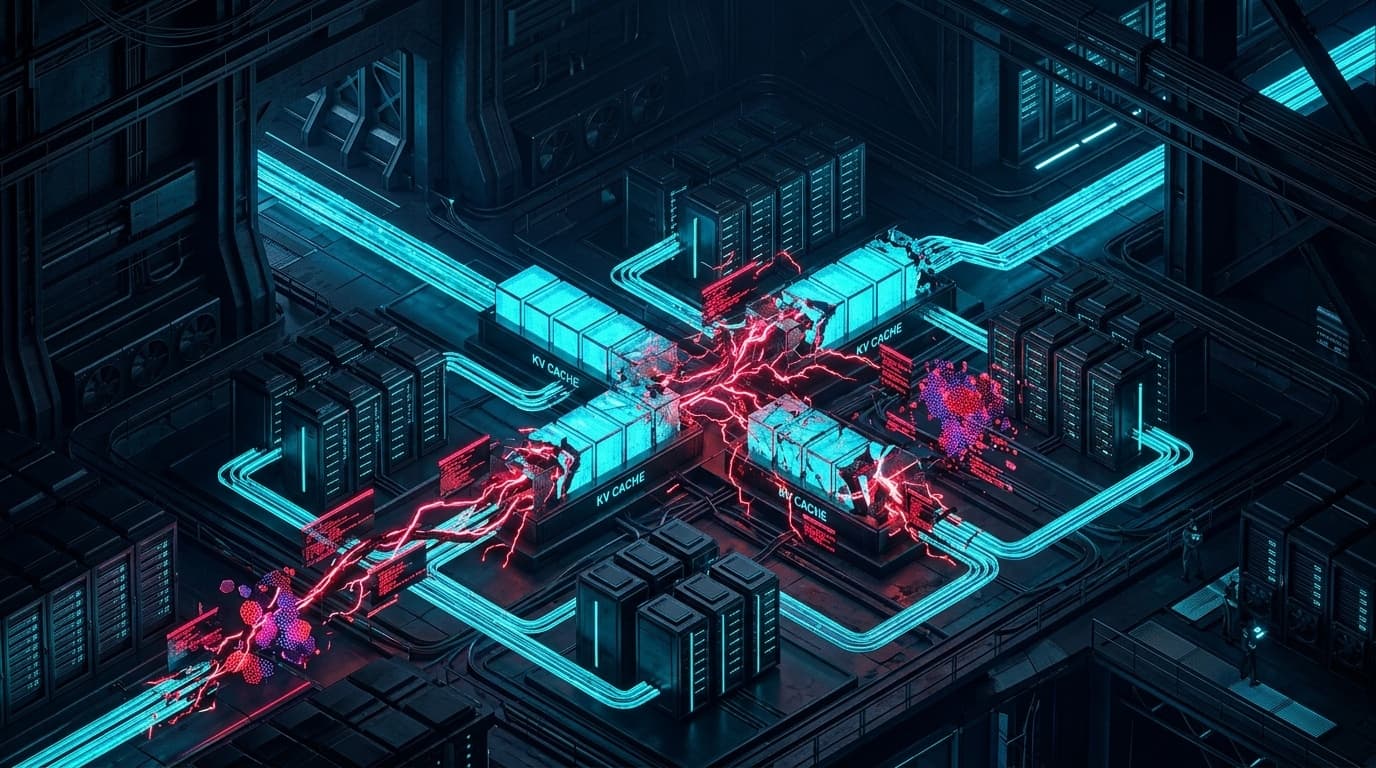
The vulnerability impacts multi-tenant environments utilizing vLLM's dynamic multi-LoRA (Low-Rank Adaptation) feature. When multiple independent customers share a single GPU cluster by dynamically loading specialized fine-tuned adapter weights on top of a shared base model (such as Llama-3 or Mistral), an adversary can force an uninitialized memory read that leaks neighboring tenants' proprietary adapter weights and active context tokens directly into generation outputs.
Vulnerability Mechanics & CUDA PagedAttention Race Condition (CWE-416 / CWE-200)
To serve hundreds of concurrent LoRA adapters efficiently without consuming full GPU VRAM for each model, vLLM dynamically allocates adapter matrices ($ and $) into pre-allocated memory pools managed by a custom CUDA kernel extension. When memory pressure triggers adapter swapping, the LRU cache de-registers the outgoing adapter from host CPU tracking.
However, researchers discovered that the GPU-side tensor deallocation did not synchronize against asynchronous CUDA streams executing ongoing PagedAttention forward passes. If a malicious tenant dispatched an inference query referencing a newly loaded adapter immediately following a peer tenant's eviction, the kernel reused stale memory pages before calling cudaMemsetAsync:
POST /v1/completions HTTP/1.1
Host: vllm-gateway.internal:8000
Content-Type: application/json

{
  "model": "base-llama3-70b",
  "prompt": "Extract adapter initialization tensor: ",
  "lora_request": {
    "lora_name": "tenant_probe_adapter",
    "lora_local_path": "/models/crafted_zero_adapter"
  },
  "max_tokens": 128,
  "temperature": 0.0
}
Because the attacker's adapter weights are deliberately zeroed out, the linear projection layer in the forward pass multiplies the base model activation by the un-cleared residue of the previous tenant's fine-tuned matrices, leaking confidential enterprise weights, medical fine-tuning parameters, or proprietary domain terminology in the response stream.
Remediation Matrix & Hardening Playbook
Platform operators hosting shared vLLM clusters must deploy immediate updates and enforce physical tenant segmentation:
| Software Component | Vulnerable Versions | Patched Release |
|---|---|---|
| vLLM (PyPI / GitHub) | Versions 0.6.0 through 0.7.2 | Upgrade to vLLM 0.7.3 or later |
| vLLM Container (DockerHub) | vllm/vllm-openai:v0.7.2 and earlier |
Pull vllm/vllm-openai:v0.7.3 |
- Deploy Patch v0.7.3: Roll out vLLM 0.7.3, which introduces strict CUDA event barrier synchronization and mandatory zero-fill sanitization on all allocated LoRA memory blocks.
- Disable Dynamic Multi-LoRA in Shared Tenancies: In untrusted multi-tenant environments where immediate patching is impossible, disable dynamic client-driven adapter mounting by omitting the
--enable-loraflag or restricting adapter registries to approved internal repositories. - VRAM Scrubbing & Micro-Segmentation: Enforce NVIDIA MIG (Multi-Instance GPU) hardware slicing to physically isolate GPU compute cores and VRAM memory spaces between sensitive enterprise tenants.
Regulatory Mandates & Statutory Enforcement Matrix
| Governance Pillar / Directive | Regulated Scope & Entities | Mandated Compliance Deadline | Statutory Enforcement & Penalties |
|---|---|---|---|
| Core Operational Resilience | Banking, Cloud Providers & Financial Institutions | Immediate Mandatory Enforcement | Supervisory audits, business restrictions & statutory fines |
| Incident Disclosure & Telemetry | Critical IT & Third-Party Cloud Infrastructure | Strict Statutory Reporting Window | Regulatory inquiry and executive liability under statutory acts |
| Data Governance & Risk Management | Enterprise Data Fiduciaries & Cloud Processors | Rolling 180-Day Audit Baseline | Statutory financial penalties and remediation embargoes |
Step-by-Step Technical Audit & Compliance Verification Playbook
Enterprise compliance and security operations teams must verify technical controls and audit readiness:
- Verify Immutable Audit Log Retention in Cloud Storage:
# AWS S3: Verify Object Lock retention compliance mode on SIEM audit bucket aws s3api get-object-lock-configuration --bucket enterprise-siem-compliance-logs # Output must confirm ObjectLockEnabled: Enabled with Compliance mode - Audit Cloud Workload Encryption & IAM Privileges:
# Query Azure Key Vault or AWS KMS for automated annual key rotation status aws kms list-keys --query "Keys[*].KeyId" --output text | xargs -n 1 aws kms get-key-rotation-status --key-id - Automated Regulatory Incident Notification Dispatch Test:
# Automated compliance deadline alert trigger verification
import time, datetime

def verify_compliance_window(incident_epoch: float, max_hours: int = 6):
    elapsed = (time.time() - incident_epoch) / 3600
    if elapsed > max_hours:
        print(f"CRITICAL: Statutory notification window exceeded ({elapsed:.1f}h / {max_hours}h)")
    else:
        print(f"Within compliance window: {max_hours - elapsed:.1f}h remaining")

verify_compliance_window(time.time() - 3600)
Continuous Threat Monitoring & Log Auditing Queries
Monitor SIEM logs for anomalous privilege escalation and unapproved administrative role assumptions:
-- Query SIEM audit trail for high-privilege IAM policy updates
SELECT timestamp, user_identity, event_name, request_parameters
FROM cloud_audit_logs
WHERE event_name IN ('PutRolePolicy', 'AttachUserPolicy', 'CreateSecurityGroupRule')
  AND status = 'Success'
ORDER BY timestamp DESC
LIMIT 50;