Executive Summary & AI Infrastructure Threat Landscape
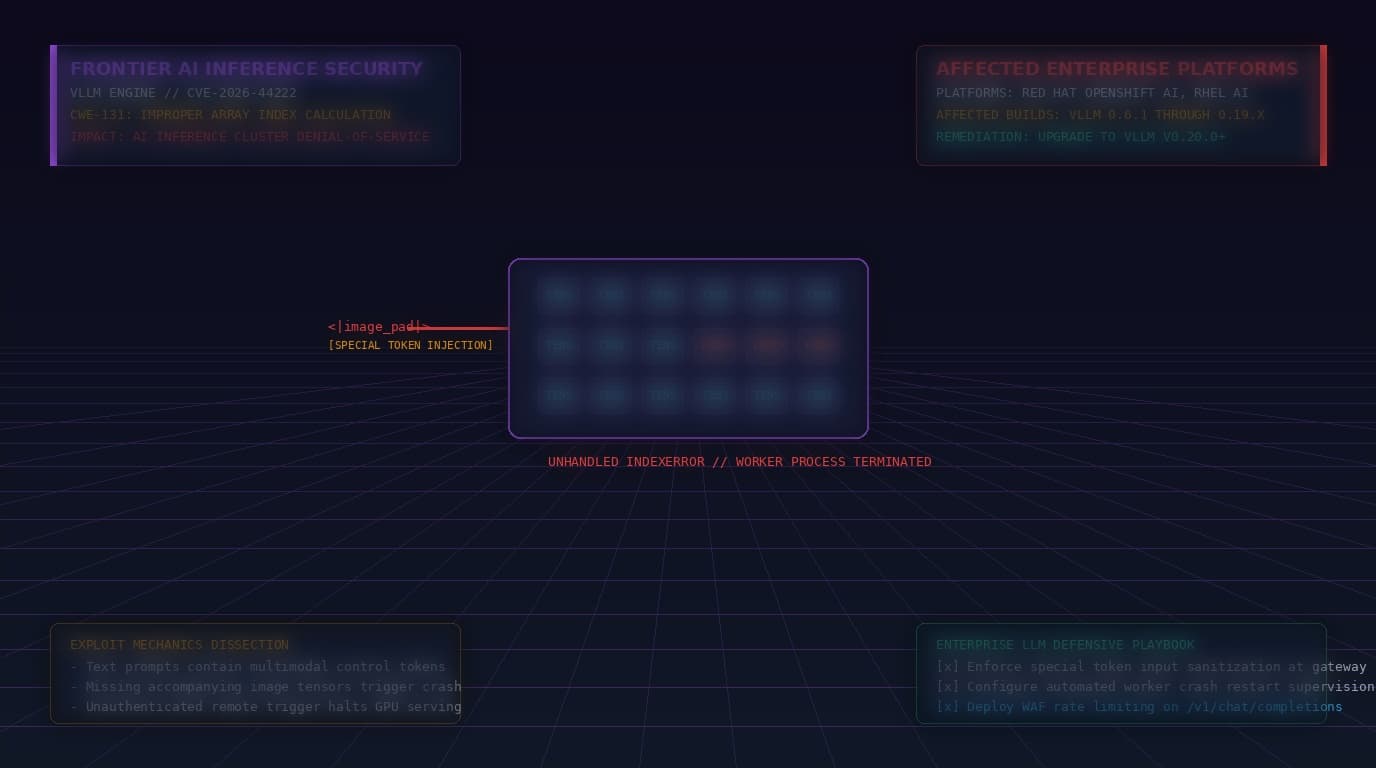
Security researchers and open-source maintainers have uncovered a critical denial-of-service vulnerability in vLLM, one of the most widely deployed open-source serving engines for large language models (LLMs) and vision-language models (VLMs). Designated as CVE-2026-44222 with a CVSS v3.1 base score of 7.5 (High), the defect enables unauthenticated remote users to crash the underlying model inference worker processes by transmitting specially crafted prompt sequences containing multimodal control tokens.
vLLM powers massive production AI inference deployments across enterprise platforms, hyperscale cloud environments, and containerized architectures such as Red Hat OpenShift AI and RHEL AI. Because vLLM relies on distributed Ray or multiprocessing execution pools to manage high-throughput PagedAttention tensor memory, the abrupt, unhandled termination of a single worker process causes an irrecoverable pipeline failure across the entire GPU cluster node. This terminates all concurrently processing user inference batches and forces manual or orchestrator-level pod restarts, representing a textbook implementation of OWASP LLM04: Model Denial of Service.
Technical Root Cause Analysis: Array Index Calculation Flaw (CWE-131)
The vulnerability is rooted in vLLM's multimodal input preprocessing pipeline, specifically within the model executor modules responsible for aligning text tokens with vision embeddings (such as in architectures based on LLaVA, Qwen2-VL, and Pixtral).
In standard vision-language models, the tokenizer uses reserved special tokens (e.g., <|image_pad|>, <|image|>, or <|vision_start|>) to represent the insertion positions of visual embeddings generated by the vision encoder. The model executor expects each occurrence of an image token to correlate with an item in the accompanying multimodal data dictionary (containing normalized tensor arrays of image pixels).
# Vulnerable pseudo-code pattern in multimodal input processing:
def _process_multimodal_inputs(self, prompt_tokens, image_data):
    image_token_indices = [
        idx for idx, token in enumerate(prompt_tokens)
        if token == self.image_token_id
    ]

    # Flawed assumption: Assumes len(image_data) matches occurrences of image_token_id
    # No boundary check validating that image_data is non-empty or matches token count
    vision_embeddings = []
    for i, idx in enumerate(image_token_indices):
        # When image_data is None or empty list, indexing triggers IndexError
        feature = image_data[i]
        vision_embeddings.append(self.vision_encoder(feature))

    return self._merge_embeddings(prompt_tokens, vision_embeddings)
When an adversary submits a text-only prompt through the OpenAI-compatible API endpoint (/v1/chat/completions or /v1/completions) that explicitly injects the model's raw image pad token string without attaching any image binary or Base64 payload, the tokenizer faithfully translates the string into the reserved image_token_id.
When the input reaches the model executor worker, the function computes the list of indices where image tokens appear. However, because the request contained no accompanying image payload, the image_data array is empty (or None). When the processing loop attempts to reference image_data[0] or calculate slice offsets based on an assumed 1:1 parity, Python raises an unhandled IndexError: list index out of range.
Worker Crash Cascades Across Distributed Ray Clusters
In standard web microservices, an unhandled exception results in a transient HTTP 500 error for the requesting client. However, in high-performance GPU serving architectures like vLLM:
- Engine Pipeline Deadlock: vLLM utilizes worker processes bound to physical GPUs via NVIDIA NCCL and Ray actors or Python multiprocessing. When an uncaught exception bubbles up in a worker thread during forward-pass tensor preparation, the worker process exits abruptly with a non-zero exit code.
- Communicator Desynchronization: Because tensor-parallel model execution requires strict lock-step synchronization across all participating GPUs, the death of one worker leaves remaining GPU workers hanging indefinitely waiting for barrier synchronization over NCCL.
- Cluster Node Failure: The central vLLM engine detects the loss of worker communication and raises an irrecoverable
EngineDeadError. All ongoing batched generations belonging to other legitimate users are terminated immediately, and subsequent API requests fail with HTTP 503 (Service Unavailable) or connection resets until the entire service pod is restarted.
Proof-of-Concept Exploit Vector
The attack can be executed using a trivial HTTP POST request against any exposed vLLM API server hosting a multimodal model:
curl -X POST "http://ai-cluster.internal:8000/v1/chat/completions"   -H "Content-Type: application/json"   -d '{
    "model": "llava-hf/llava-1.5-7b-hf",
    "messages": [
      {
        "role": "user",
        "content": "Please analyze this token: <|image_pad|><|image_pad|><|image_pad|>"
      }
    ],
    "temperature": 0.0
  }'
Within milliseconds of receiving the payload, the vLLM engine log registers the fatal traceback:
[ERROR] Exception in worker process:
Traceback (most recent call last):
  File "vllm/worker/model_runner.py", line 421, in execute_model
    multimodal_inputs = self._process_multimodal_inputs(seq_group)
  File "vllm/model_executor/models/llava.py", line 189, in _process_multimodal_inputs
    feature = image_data[i]
IndexError: list index out of range
[FATAL] Ray actor worker died unexpectedly. vLLM engine is shutting down.
Enterprise Platform Impact & Version Scope
The vulnerability affects multiple production distributions and model execution backends:
| Distribution / Product | Vulnerable Versions | Fixed Release Baseline | Impact Severity |
|---|---|---|---|
| vLLM Open Source Core | 0.6.1 through 0.19.x | vLLM 0.20.0+ / Patch PR #8921 | CVSS 7.5 (High) — Complete Service Denial |
| Red Hat OpenShift AI | Builds deploying vLLM multimodal serving images | RHSA-2026:7142 (Security Errata) | High — Cluster Pod Crash & Auto-Restart Loop |
| Red Hat Enterprise Linux AI (RHEL AI) | vLLM serving runtime container bundles | RHEA-2026:7143 | High — Production GPU Node Disruption |
Defensive Playbook & Mitigation Strategies
Organizations deploying vLLM in enterprise or customer-facing environments should implement the following multi-layered mitigations:
1. Upgrade to vLLM v0.20.0 or Apply Upstream Patch
The permanent resolution implemented in upstream vLLM introduces strict input validation in the tokenizer preprocessing pipeline. The updated logic verifies that special multimodal control tokens cannot be injected via cleartext user prompts without corresponding validated tensor objects:
# Upstream fix snippet:
if len(image_token_indices) != len(image_data):
    raise ValueError(
        f"Mismatched number of image tokens ({len(image_token_indices)}) "
        f"and provided image tensors ({len(image_data)})."
    )
This ensures that mismatched requests raise a controlled ValueError caught by the HTTP request handler, returning a graceful HTTP 400 Bad Request to the malicious client while keeping the engine and worker actors fully operational.
2. Deploy API Gateway / WAF Prompt Sanitization
Prior to reaching the inference server, configure an API gateway (e.g., Kong, Envoy, or Cloudflare AI Gateway) to strip or reject reserved control tokens from the input text body:
# Example Envoy Lua filter or Python gateway regex check:
RESERVED_AI_TOKENS = [
    r"<|image_pad|>",
    r"<|image|>",
    r"<|vision_start|>",
    r"<|vision_end|>"
]

def sanitize_chat_prompt(prompt_text):
    for token_pattern in RESERVED_AI_TOKENS:
        if re.search(token_pattern, prompt_text):
            raise HTTPException(status_code=400, detail="Disallowed special token detected.")
    return prompt_text
3. Configure Kubernetes Pod Supervision & Rate Limiting
Ensure that Kubernetes / OpenShift deployments for inference workloads enforce:
- Aggressive IP Rate Limiting: Enforce token-bucket rate limiting on
/v1/chat/completionsendpoints to throttle rapid exploit replay attacks. - Circuit Breakers: Configure Envoy or Istio circuit breakers to automatically reroute traffic to standby replicas if an engine worker enters an unhealthy state.
- Liveness Probes: Implement lightweight
/healthliveness probes with short failure thresholds (e.g., 3 consecutive failures over 15 seconds) to ensure crashed workers trigger immediate pod eviction and automated redeployment.