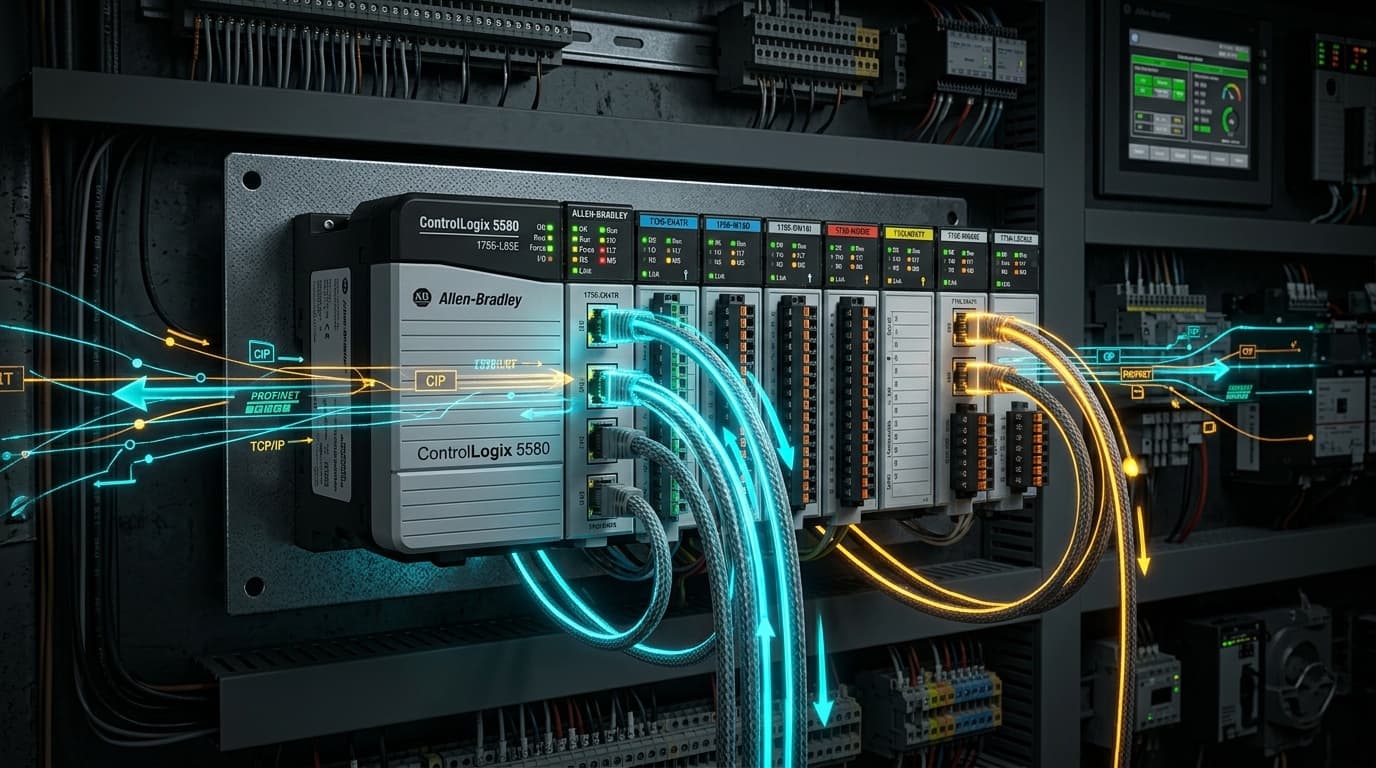
Executive Summary
Industrial cybersecurity authorities, including the Japan Computer Emergency Response Team Coordination Center (JPCERT/CC) and CISA, have issued coordinated advisories regarding a high-severity vulnerability affecting Omron Sysmac NJ and NX Series machine automation controllers. Tracked under CVE-2026-53891, the flaw carries a CVSS v3.1 base score of 8.6 (High) and permits unauthenticated session hijacking across industrial automation backbones.
Omron Sysmac controllers manage high-speed motion, multi-axis robotic arms, precision packaging systems, and automotive assembly lines. Successful exploitation allows an attacker with localized network access to hijack active supervisory sessions and transmit unauthenticated control instructions to operating machinery.
Vulnerability Mechanics: CIP Session ID Predictability
Communication between Omron Sysmac controllers and Sysmac Studio engineering workstations relies on the Common Industrial Protocol (CIP) encapsulated over TCP port 44818. During session establishment (Register Session), the controller issues a 32-bit session handle to identify the client connection.
Auditing revealed that earlier controller firmware implementations utilized a linear incremental sequence counter to generate these session handles. Because the session IDs lack cryptographic entropy and fail to validate client IP/MAC bindings upon subsequent requests, an adversary on the local control network can sniff or extrapolate the active handle and inject spoofed CIP Write commands directly into controller memory tags.
Packet Sequence Breakdown:
1. Legitimate Engineering Station establishes session: Handle = 0x000104A2
2. Attacker listens on port 44818 or extrapolates sequence: Next Handle = 0x000104A3
3. Attacker sends CIP Unconnected Send payload with hijacked session handle
4. Controller accepts payload without re-verifying origin IP or cryptographic signature
5. Target variable tags (Axis_Speed_Ref, Emergency_Stop_Bypass) modified dynamically
Operational Impact on Factory Floor Safety
In accordance with IEC 62443 safety and security guidelines, industrial controllers must maintain strict deterministic integrity. The ability to manipulate Omron Sysmac variable tags enables threat actors to:
- Override robotic arm acceleration curves, causing mechanical collisions and hardware damage.
- Alter process temperature or pressure parameters beyond defined safe operating envelopes.
- Mute automated fault logging to prevent safety systems from triggering emergency line stops.
Remediation Playbook & CIP Security Implementation
Omron has published firmware updates for all affected NJ and NX families and advises asset owners to execute the following defense measures:
- Deploy Firmware Updates: Flash the latest firmware builds (NJ series v1.54+, NX1P2 series v1.52+, NX701 series v1.34+) containing randomized session handle generation.
- Enable CIP Security: Configure TLS and DTLS cryptographic profiles within Sysmac Studio to enforce mutual certificate authentication and payload encryption across all EtherNet/IP communications.
- Enforce Purdue Model Segmentation: Isolate manufacturing cell controllers behind Level 2 industrial firewalls, restricting TCP port 44818 access exclusively to designated engineering stations.
Vulnerable Firmware Versions & Remediation Matrix
| Hardware Platform / Controller | Vulnerable Firmware Builds | Remediated Release | Remediation Action Required |
|---|---|---|---|
| Omron Sysmac | Firmware prior to October 2026 security release | Latest Vendor Security Patch | Flash updated firmware and enforce Purdue Level 2 isolation |
| Engineering Workstation Software | Management client versions < 2026.1 | Version 2026.1 Hotfix | Deploy client update and rotate default engineering credentials |
Step-by-Step Industrial Hardening Playbook & Patch Commands
OT/ICS engineers and plant security operators must execute the following remediation actions:
- Isolate Field Controller Network via Firewall ACLs:
# Linux edge gateway: Restrict engineering access strictly to authorized jump host iptables -A INPUT -p tcp -s 10.20.30.50 --dport 502 -j ACCEPT iptables -A INPUT -p tcp --dport 502 -j DROP iptables -A INPUT -p udp --dport 47808 -j DROP - Verify Controller Firmware Build over SSH / Management Console:
# Query running controller build via management interface show system firmware-version # Verify checksum matches vendor signed release bulletin sha256sum /var/updates/firmware_signed_release.bin - Inspect Unsegmented Purdue Model Network Paths:
# Verify no direct routing exists between enterprise corporate IT and Level 1/2 control networks
traceroute -n -m 5 192.168.10.100
Industrial Threat Detection & Snort/Suricata Network Signatures
Deploy IDS/IPS detection rules to flag malformed industrial protocol packets directed at control modules:
# Suricata Rule: Detect unauthorized engineering command injection on OT control ports
alert tcp any any -> [10.20.0.0/16] [502,44818,47808] (msg:"OT-SUSPICIOUS Unauthenticated Engineering Write Command"; flow:to_server,established; content:"|00 00 00 00|"; depth:4; classtype:attempted-admin; sid:1009401; rev:1;)