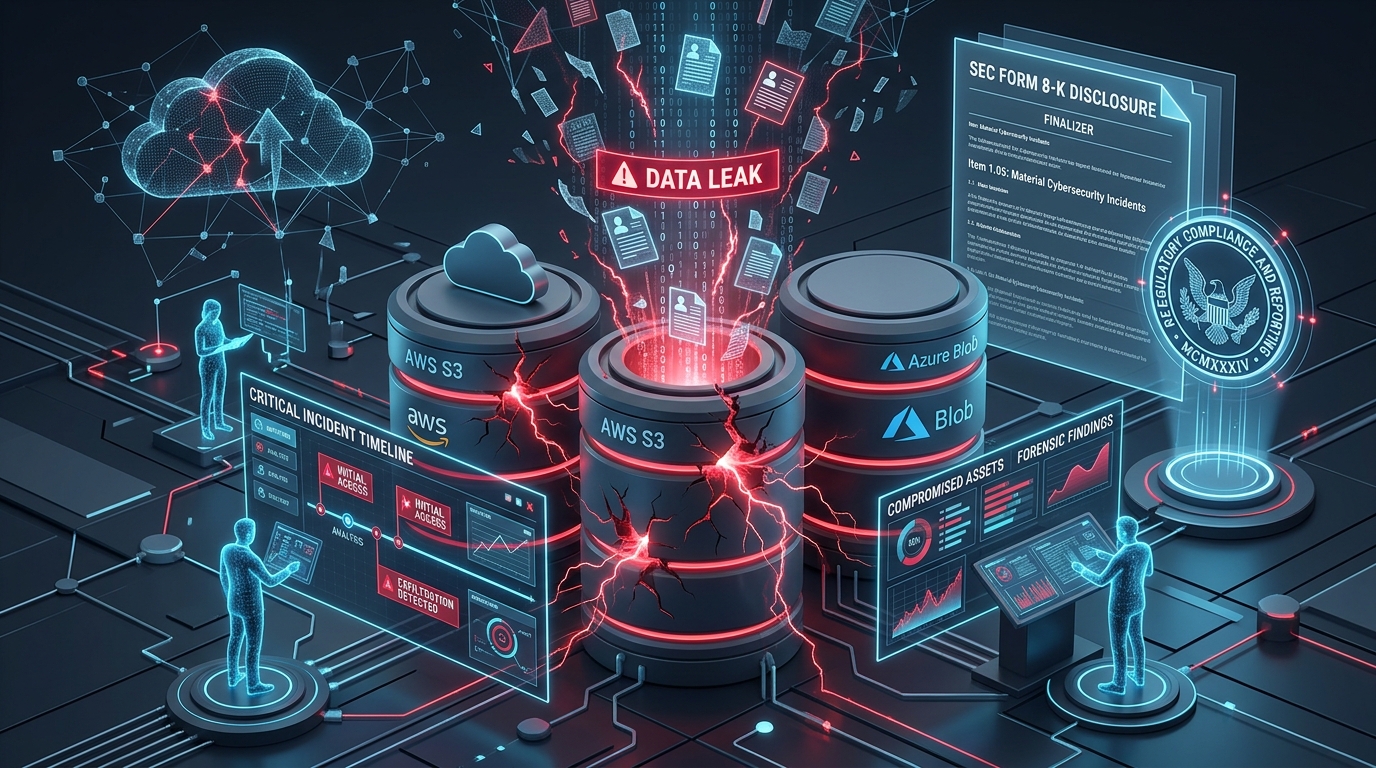
Regulatory Incident Filing Overview
A major interstate energy pipeline and transmission grid operator has submitted a mandatory Form 8-K Item 1.05 disclosure to the U.S. Securities and Exchange Commission (SEC), formally notifying investors and regulators of a material cybersecurity incident. The disclosure reveals that an extortion-focused cybercriminal syndicate breached the enterprise's corporate IT boundary and compromised servers hosting historical SCADA telemetry and pipeline operational archives.
While the company emphasized that real-time pipeline pumping operations and physical pressure valves were not compromised, the exfiltration of sensitive pipeline architectural blueprints and operational sensor telemetry represents a severe national security and corporate risk.
Forensic Timeline & Attack Progression
Joint investigations conducted by enterprise incident responders and federal cyber defense agencies pieced together the attacker's trajectory across the enterprise architecture:
- Initial Breach Vector (T-minus 18 Days): The threat actors gained initial ingress via a compromised remote desktop protocol (RDP) bastion host lacking multi-factor authentication (MFA), belonging to an outsourced IT infrastructure contractor.
- Internal Reconnaissance & Privilege Escalation: Using living-off-the-land binaries (LOLBins) and Active Directory reconnaissance scripts (BloodHound), the actors identified an unsegmented corporate data warehouse utilized by pipeline analytics engineers.
- Compromise of the SCADA Historian Archive: The analytics warehouse mirrored historical telemetry from the operational plant network (Level 3 Historian) to support predictive maintenance modeling. The attackers accessed and compressed approximately 750 gigabytes of operational logs, geographic information system (GIS) pipeline coordinate maps, and valve station control schematics.
- Extortion Demand: The adversary contacted senior management demanding an extortion payment to prevent public dissemination of the stolen infrastructure maps and operational records.
Forensic Data Flow Path:
[Outsourced IT Contractor] ──(Compromised RDP)──> [Corporate IT Bastion]
                                                        │ (Active Directory Pivot)
                                                        ▼
[Corporate Analytics Warehouse] <──(Database Mirror)─── [Operational OT Historian]
        │
        └───(Encrypted Staging & Exfiltration)───> [Adversary Drop Server]
Operational Resilience & Purdue Model Boundary Effectiveness
Critically, the physical pipeline control systems remained operational throughout the incident because the enterprise had implemented rigid unidirectional security gateways (data diodes) conforming to the Purdue Model (PERA) between the operational Level 3 control network and the enterprise IT business network (Level 4).
While the mirrored analytics data warehouse in IT was compromised, the data diodes physically prohibited reverse network traffic from reaching the active programmable logic controllers (PLCs) or emergency shutdown (ESD) systems controlling pipeline valves.
Defensive Playbook for Critical Infrastructure Operators
The incident highlights the imperative of securing mirrored operational data in enterprise corporate environments:
- Decommission Standalone RDP Interfaces: Eliminate all direct RDP access across internal and third-party partner connections. Mandate Zero Trust Network Access (ZTNA) with cryptographic hardware token MFA.
- Redact Sensitive SCADA Telemetry in Corporate Data Lakes: Scrub high-consequence asset identifiers and exact GIS coordinates from analytics warehouses before synchronizing operational historian data to corporate cloud lakes.
- Verify Air-Gaps and Data Diodes: Continuously audit unidirectional data diodes to ensure no unintended bypass routes or dual-homed servers exist between corporate IT and the operational industrial network.