Regulatory Disclosure Overview
A leading publicly traded manufacturer of connected electric vehicles (EVs) has submitted an Item 1.05 Form 8-K disclosure to the U.S. Securities and Exchange Commission (SEC), reporting that it has determined an unauthorized cloud platform intrusion to be a material cybersecurity incident. Under SEC cybersecurity disclosure regulations, public corporations must report material incidents within four business days of determination.
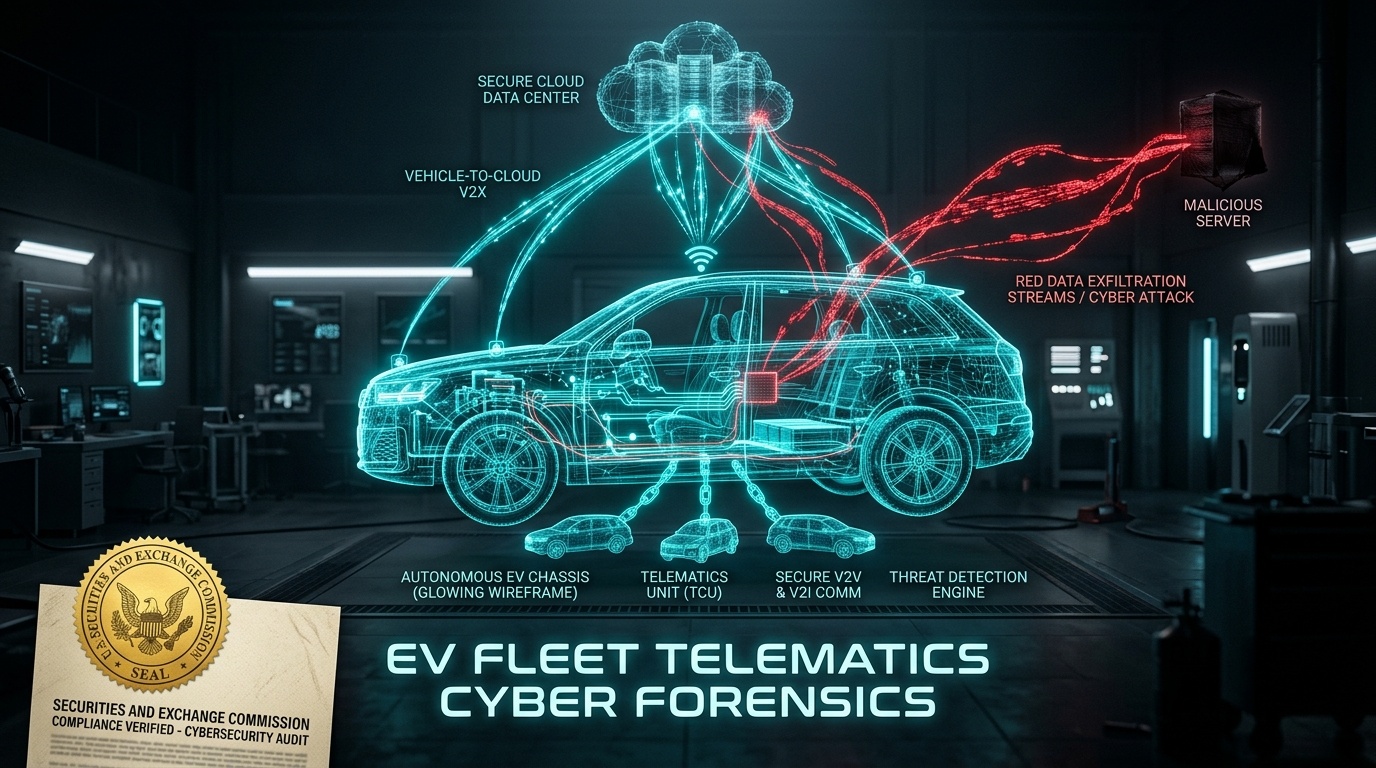
According to the regulatory filing, threat actors accessed backend databases and streaming telemetry APIs supporting the company’s global Connected Vehicle Platform (CVP), which manages vehicle-to-cloud (V2C) communications for hundreds of thousands of active consumer and commercial fleet vehicles.
Forensic Intrusion Reconstruction & Kill Chain
Forensic investigators from external incident response firms and automotive safety authorities reconstructed the adversary’s progression across a three-week dwell window:
| Intrusion Phase | Adversary TTP & Vector | Forensic Evidence Identified |
|---|---|---|
| T-21 Days (Credential Leak) | Hardcoded AWS service principal credentials exposed in public Git repo (T1552.001) | Unauthorized AWS CloudTrail STS AssumeRole calls |
| T-14 Days (Cloud Escalation) | Abuse of over-privileged MQTT broker policy (T1098) | Mass subscription to fleet-wide vehicle telemetry topics (vehicles/+/telemetry) |
| T-6 Days (Data Exfiltration) | Continuous streaming exfiltration of location logs (T1048.003) | Egress spikes from cloud Cassandra database cluster |
| T-2 Days (Command Exploration) | Attempted dispatch of remote climate control and door unlock RPCs (T1489) | Anomalous API calls flagged by anomaly detection engine |
| T-0 Days (SEC Form 8-K Filing) | Session key revocation and public regulatory disclosure | Item 1.05 filing and customer notifications |
Blast Radius: Telematics Records Compromised vs. Physical Vehicle Safety
The automaker clarified that the electronic control units (ECUs) responsible for critical vehicle dynamics—including steering, electronic stability control, and friction/regenerative braking—operate on physically isolated CAN buses separated from the in-vehicle infotainment (IVI) and telematics control unit (TCU) via an internal cryptographic security gateway (ISO 21434 compliant). As a result, remote control of physical driving dynamics was never possible.
However, the exfiltrated datasets represent substantial consumer privacy and operational exposure:
- Real-Time & Historical GPS Trajectories: Time-stamped geographical coordinates detailing precise vehicle locations and recurring commute patterns for fleet and consumer drivers.
- Battery Health & Charging Logs: Detailed diagnostic telemetry on battery cell degradation, fast-charging frequency, and thermal management cycles.
- Mobile App Authentication Tokens: Ephemeral OAuth tokens used by mobile apps to trigger remote cabin pre-heating, charging timers, and door locks.
Automotive Cybersecurity Hardening Playbook
This incident provides critical takeaways for original equipment manufacturers (OEMs) and connected fleet managers:
- Enforce Zero-Trust Telematics Brokers: Isolate MQTT and Kafka telematics brokers using mutual TLS with short-lived client certificates uniquely tied to each vehicle’s hardware secure element (HSM).
- Granular Topic-Level Access Control: Ensure cloud microservices can only publish or subscribe to specific vehicle sub-topics rather than granting wildcard
+or#permissions across entire fleet namespaces. - Automated Secret Scanning: Deploy continuous automated secret scanning across all developer repositories, staging branches, and container image registries to block hardcoded API keys before deployment.