Regulatory Disclosure Overview
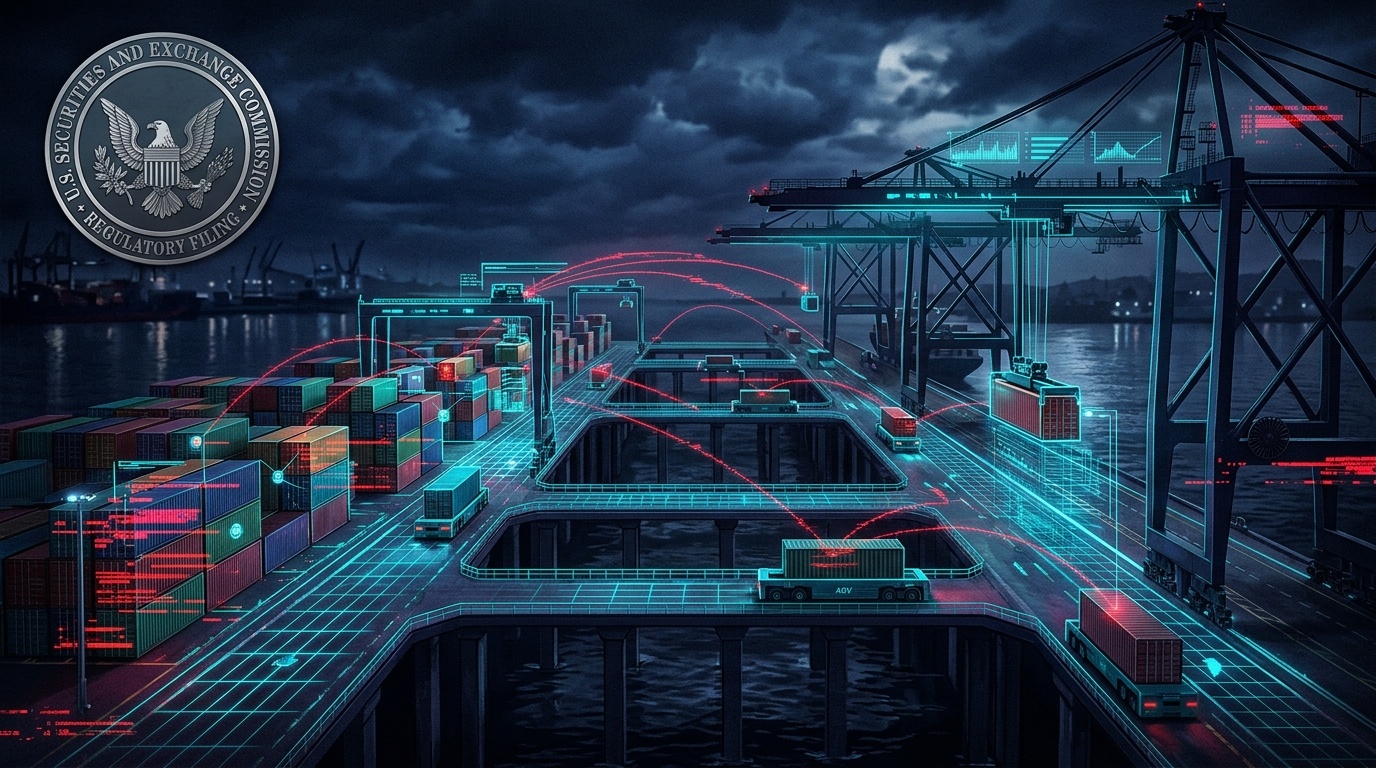
A premier publicly traded operator of international maritime container terminals has submitted a Form 8-K Item 1.05 regulatory filing to the U.S. Securities and Exchange Commission (SEC), disclosing that an unauthorized network intrusion into its operational technology and logistics infrastructure constituted a material cybersecurity incident. Under SEC guidelines, public issuers must report material cyber events within four business days of determination.
According to the regulatory disclosure, threat actors breached the company’s core Terminal Operating System (TOS), the mission-critical software engine that orchestrates container stowage planning, automated guided vehicle (AGV) dispatch, ship-to-shore (STS) gantry crane scheduling, and customs clearance gates across multiple major deep-water ports.
Forensic Timeline & Intrusion Vector
In cooperation with U.S. Coast Guard Cyber Command (CGCYBER) and private forensic investigators, the enterprise mapped the adversary’s lateral progression over a four-week campaign:
| Intrusion Phase | Technique / TTP Observed | Forensic Telemetry Identified |
|---|---|---|
| T-28 Days (Initial Ingress) | Compromised 3PL Partner API Key (T1078.004) | Anomalous EDIFACT BAPLIE message injection via EDI gateway |
| T-20 Days (Pivoting into TOS) | Exploitation of internal Java RMI service (T1210) | Remote code execution on central dispatch cluster |
| T-10 Days (Data Manipulation) | Database SQL Injection into Yard Database (T1565.001) | Tampered container weight manifests and customs clearance flags |
| T-2 Days (Extortion Trigger) | Disruption of automated gate OCR scanners (T1489) | Truck queue backlog exceeding 4,000 drayage vehicles |
| T-0 Days (SEC Form 8-K Filing) | Materiality confirmation and law enforcement referral | Item 1.05 public disclosure and maritime security directives |
Blast Radius & Global Supply Chain Exposure
Maritime ports operate on strict just-in-time logistics. When the Terminal Operating System was desynchronized, automated container handling was paralyzed:
- Vessel Stowage Disruption: Falsified container weight and hazardous materials declarations threatened vessel stability, preventing containerships from loading or departing berths.
- Drayage Gate Halts: Gate optical character recognition (OCR) systems failed to match incoming chassis with booking numbers, creating gridlock across surrounding metropolitan transit arteries.
- Smuggling & Illicit Interception: Investigators are examining whether the intrusion was an extortion campaign or a targeted illicit operation to clear flagged high-risk contraband containers through customs holds.
Defensive Guidance for Critical Infrastructure Operators
This incident provides urgent takeaways for operators of seaports, rail intermodal yards, and air cargo logistics hubs:
- Mandate Mutual TLS on Supply Chain APIs: Restrict EDI and REST API endpoints strictly to authenticated mTLS connections with dynamic token expiration and strict IP whitelisting.
- Segment TOS Core from Corporate IT: Enforce strict IEC 62443 zones and conduits between corporate logistics networks, TOS dispatch engines, and physical crane PLC networks.
- Maintain Air-Gapped Manual Reversion Playbooks: Regularly test offline paper-manifest and manual crane operation drills to maintain berth throughput during active cyber containment operations.