Regulatory Framework Overview
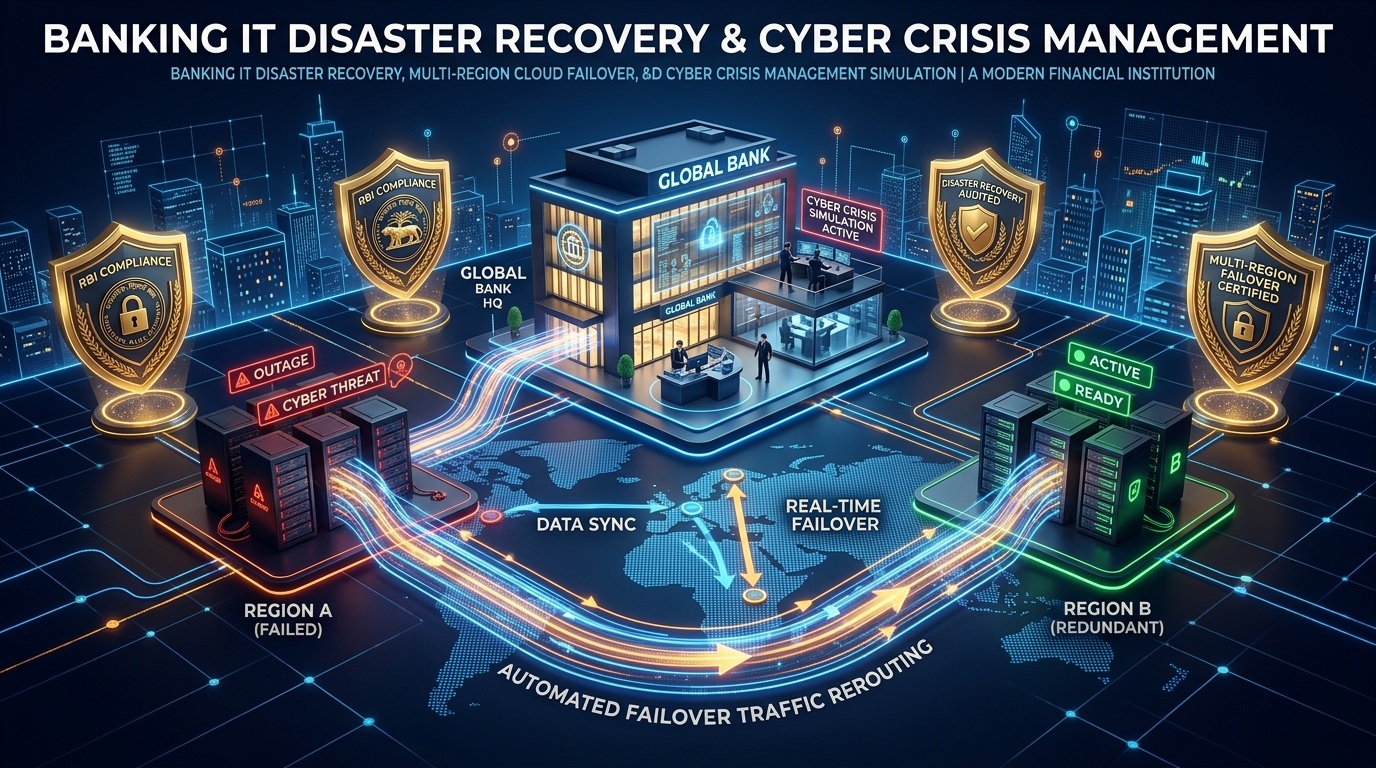
The Reserve Bank of India (RBI) has issued binding directions updating the mandatory Cyber Crisis Management Plan (CCMP) guidelines for all Scheduled Commercial Banks, Small Finance Banks, Payment Banks, and Upper-Layer Non-Banking Financial Companies (NBFC-UL). The directive establishes statutory benchmarks for cyber incident disaster recovery, multi-region cloud high availability, and operational resilience testing across the Indian banking ecosystem.
As India’s digital payments infrastructure scales to hundreds of millions of daily transactions, the central bank aims to ensure that no single-region cloud outage, widespread ransomware campaign, or third-party core banking failure can cause prolonged systemic financial disruption.
Statutory Technical Requirements for Banking Cloud Deployments
The amended guidelines establish concrete technical parameters governing disaster recovery (DR) architecture and crisis preparedness:
| Resilience Domain | RBI Regulatory Standard | Mandatory Verification SLA |
|---|---|---|
| Cloud High Availability | Multi-region active-active or active-hot-standby architecture across geographically separated seismic zones | Continuous 24/7 telemetry replication |
| Recovery Time Objective (RTO) | Maximum 30 minutes for critical payment switches (UPI, IMPS, RTGS, Net Banking) | Verified via unannounced live DR drill every 6 months |
| Recovery Point Objective (RPO) | Near-zero data loss (synchronous ledger database replication) | Continuous zero-lag transaction logging |
| Crisis Tabletop Simulation | Board-level cyber crisis simulation covering extortion, extortion communications, and regulatory disclosures | Annual mandatory board sign-off |
Automated Live Cross-Region Cloud Failover Testing
Historically, banks satisfied disaster recovery mandates by conducting paper audits or isolated synthetic dry-runs in staging environments. The 2026 RBI directive explicitly mandates live production traffic shift drills every six months:
- Unannounced Traffic Ingress Cutover: The bank must reroute 100% of live customer transaction traffic from its primary cloud region (e.g., Mumbai) to its secondary recovery region (e.g., Hyderabad) during operational hours.
- Automated DNS & Anycast Failover: Border gateway routing must automatically detect primary region failure via health probes and transition DNS/BGP routing within 300 seconds without dropped database transactions.
- Data Integrity Reconciliation: Independent external auditors must verify that cryptographic ledgers and account balances between primary and secondary databases match exactly post-failover.
Governance & Supervisory Penalties
Regulated entities must submit a comprehensive CCMP Evaluation Report signed by the Board Information Security Committee (BISC) directly to the RBI Department of Supervision via the CIMS portal.
Failure to demonstrate compliance or refusal to conduct live production failover tests empowers the Reserve Bank to levy monetary fines under Section 47A of the Banking Regulation Act, 1949, and place restrictions on introducing new digital lending or payment products.