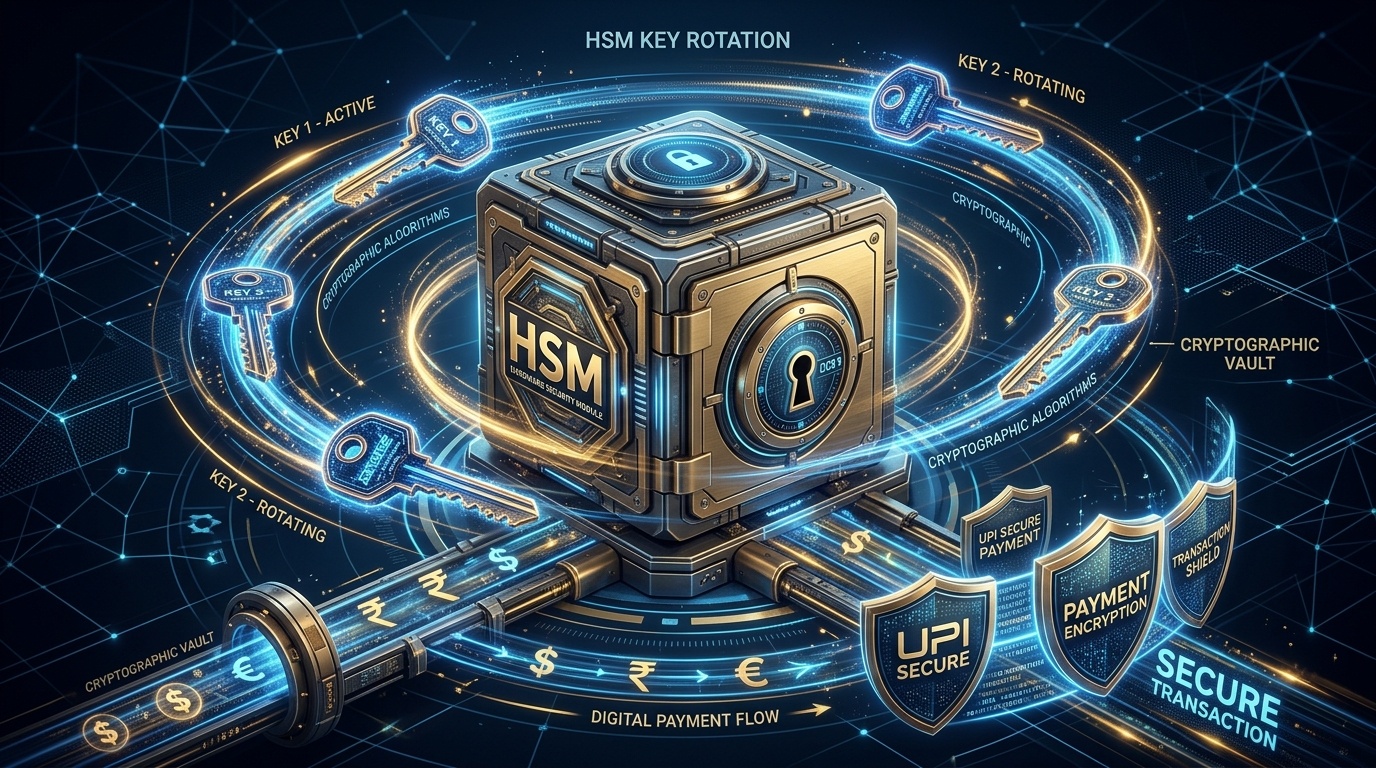
Regulatory Framework Overview
The Reserve Bank of India (RBI) has issued comprehensive amendments to its Master Direction on Digital Payment Security Controls. The new directions establish statutory mandates governing cryptographic key lifecycle management, Hardware Security Module (HSM) operational governance, and transaction tokenization security across all commercial banks, non-bank payment system operators (PSOs), and payment aggregators (PAs).
With India processing billions of digital transactions monthly across the Unified Payments Interface (UPI), Immediate Payment Service (IMPS), and credit/debit card tokenization frameworks, the central bank aims to eliminate human vulnerability in cryptographic operations and mitigate risks of long-lived cryptographic key compromise.
Key Statutory Requirements for Financial Institutions
The amended circular establishes four core technological requirements that regulated entities must enforce across payment processing gateways:
| Security Control Area | Regulatory Requirement | Enforcement SLA |
|---|---|---|
| Automated HSM Key Rotation | Zero-downtime automated rotation of Key Encrypting Keys (KEKs) and Zone Master Keys (ZMKs) | Every 90 Days (Automated API-driven) |
| Hardware Validation Standard | Payment processing HSMs must be certified to FIPS 140-3 Level 3 or PCI HSM v3 | Immediate mandatory baseline |
| Token Decryption Auditing | Immutable WORM-compliant logging of all token detokenization operations | Real-time log streaming with 7-year retention |
| Dual-Control Split Knowledge | No single administrator may possess complete key ceremony credentials (M of N threshold) | Enforced via physical smartcards |
Zero-Downtime Automated HSM Key Rotation Architecture
Historically, payment key rotation ceremonies required manual split-knowledge key generation by dual key custodians, leading organizations to defer key rotation for a year or more. The RBI directive explicitly bans manual ceremony deferrals, requiring financial institutions to deploy automated key management servers (KMS) interfaced with certified HSM appliances.
Payment switches must support dual-key active verification windows: when a new Zone Master Key (ZMK) or PIN Encryption Key (PEK) is rotated, the payment gateway must accept incoming authorization messages encrypted under both the outgoing key and the new active key for a graceful 24-hour transition window, preventing dropped point-of-sale (POS) or e-commerce authorizations.
Supervisory Enforcement & Governance Oversight
Regulated entities must submit quarterly cryptographic compliance certificates signed by their Chief Information Security Officer (CISO) and Chief Technology Officer (CTO) directly to the Department of Payment and Settlement Systems (DPSS) via the RBI CIMS portal.
Failure to meet these cryptographic security controls exposes entities to supervisory restrictions under Section 10(2) of the Payment and Settlement Systems Act, 2007, including prohibition from onboarding new merchants or restrictions on introducing new payment products.