In the era of multi-tenant cloud computing, serverless functions, and untrusted AI code execution environments, the foundational premise of containerization—that Linux cgroups, namespaces, and seccomp filters provide sufficient isolation—has been thoroughly discredited. A single kernel vulnerability (such as a use-after-free in netfilter, an integer overflow in io_uring, or a dirty copy-on-write defect) allows an unprivileged container process to compromise the monolithic host Linux kernel, exposing co-located tenant workloads. Cloud hyper-scalers have resolved this boundary challenge through two radically different architectural paradigms: hardware-assisted microVMs (AWS Firecracker) and user-space kernel syscall virtualization (Google gVisor).
The Monolithic Kernel Boundary Problem
Standard container runtimes (such as Docker, containerd, and runc) share the host operating system kernel across all containers. The attack surface of the Linux kernel is immense, encompassing more than 450 distinct system calls and tens of thousands of internal driver routines.
To prevent arbitrary code execution from breaking out onto the underlying server, cloud architectures must decouple untrusted guest processes from direct access to host kernel ring 0.
AWS Firecracker: Minimalist Hardware-Assisted MicroVMs
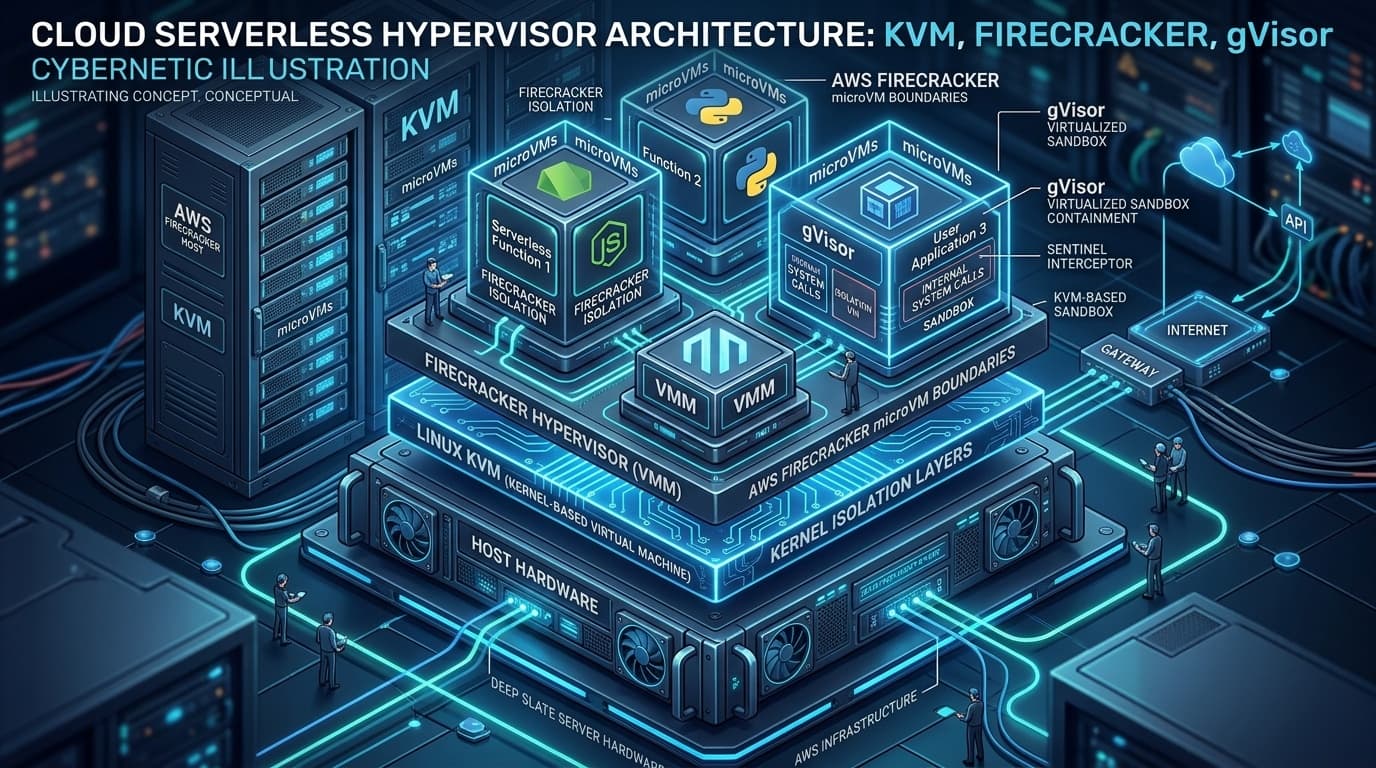
Developed in Rust by Amazon Web Services to power AWS Lambda and AWS Fargate, Firecracker leverages the Linux Kernel-based Virtual Machine (KVM) subsystem to create lightweight virtual machines known as microVMs.
Firecracker strips away all legacy QEMU emulation (omitting PCI buses, ACPI tables, IDE controllers, and USB hubs), implementing only four essential virtualized devices:
virtio-net: Network packet transport over tap devices.virtio-block: Block storage I/O mapped to raw disk files.virtio-vsock: Zero-configuration host-guest IPC socket communication.serial & minimal keyboard: Basic kernel boot logging.
Furthermore, Firecracker wraps each microVM inside a multi-tiered security container called the Jailer, applying chroot, cgroups, network namespace isolation, and strict seccomp filtering to the Virtual Machine Monitor (VMM) process itself.
Google gVisor: User-Space System Call Interception
Developed in Go by Google to power Google Cloud Run and GKE Sandbox, gVisor (runsc) takes an application-level approach. Instead of launching a separate guest kernel inside hardware-assisted CPU virtualization modes, gVisor introduces a user-space kernel called the Sentry.
When an untrusted container invokes a system call (such as socket(), clone(), or epoll_create()), the call is intercepted using platform hooks (ptrace or KVM virtualization) and directed into the Sentry. The Sentry re-implements the semantics of the Linux kernel entirely in memory-safe Go, completely shielding the host kernel from direct interaction.
Architectural Comparison Matrix
| Architectural Metric | AWS Firecracker (MicroVM) | Google gVisor (runsc Sandbox) | Standard Container (runc) |
|---|---|---|---|
| Isolation Boundary | Hardware-assisted KVM (CPU ring 0 guest/host) | User-space Go kernel (Sentry interception) | Software namespaces & cgroups (Shared kernel) |
| Memory Overhead per Instance | < 5 MB | ~15–20 MB | < 1 MB |
| Cold Start Boot Time | ~5–10 milliseconds | ~15–30 milliseconds | ~1–3 milliseconds |
| Implementation Language | Rust (Memory-safe VMM) | Go (Memory-safe user-space kernel) | Go / C (Host kernel dependent) |
| Vulnerability Blast Radius | Restricted to KVM hypercall interface & VMM jail | Restricted to Go Sentry logic & host seccomp filter | Full host kernel ring 0 compromise |
Forensic Analysis of Container Breakout Vectors
Evaluating the attack surfaces of both architectures demonstrates distinct threat models:
- Firecracker Threat Model: Attackers cannot break out via conventional Linux kernel exploits because the guest kernel is isolated in hardware. Exploitation requires finding a memory corruption defect within the Rust virtio parsing code or an unpatched CPU speculative execution side-channel (e.g., Spectre-v2 / Branch Target Injection) crossing VM boundaries.
- gVisor Threat Model: Attackers target discrepancies between the Sentry's Go implementation of POSIX semantics and the real Linux kernel. Flaws such as VFS2 file descriptor race conditions or IPC socket handle leaks represent the primary breakout vectors.
Enterprise Implementation Recommendations
- Deploy Firecracker for Untrusted Code Execution: Organizations operating multi-tenant code runners, AI agent code interpreters, or serverless functions should standardize on Firecracker microVMs for absolute hardware-enforced tenant boundaries.
- Deploy gVisor for OCI Container Sandboxing: For complex enterprise microservices deployed on Kubernetes that require rich Linux compatibility, filesystem sharing, and seamless Docker integration, gVisor provides superior developer ergonomics.
- Mandate Jailer Deployment: Always run Firecracker through its production Jailer daemon, ensuring dropped privileges and seccomp containment before the VMM binary initializes.