Executive Summary
Enterprise adoption of autonomous agentic workflows has accelerated rapidly, making visual orchestration platforms high-value targets for threat actors. Security engineers at DataStax and the open-source Langflow project have issued an urgent security bulletin disclosing a critical remote code execution (RCE) vulnerability, tracked as CVE-2026-51204, affecting Langflow versions prior to 1.3.1. The flaw carries a maximum CVSS v3.1 base score of 9.8 (Critical).
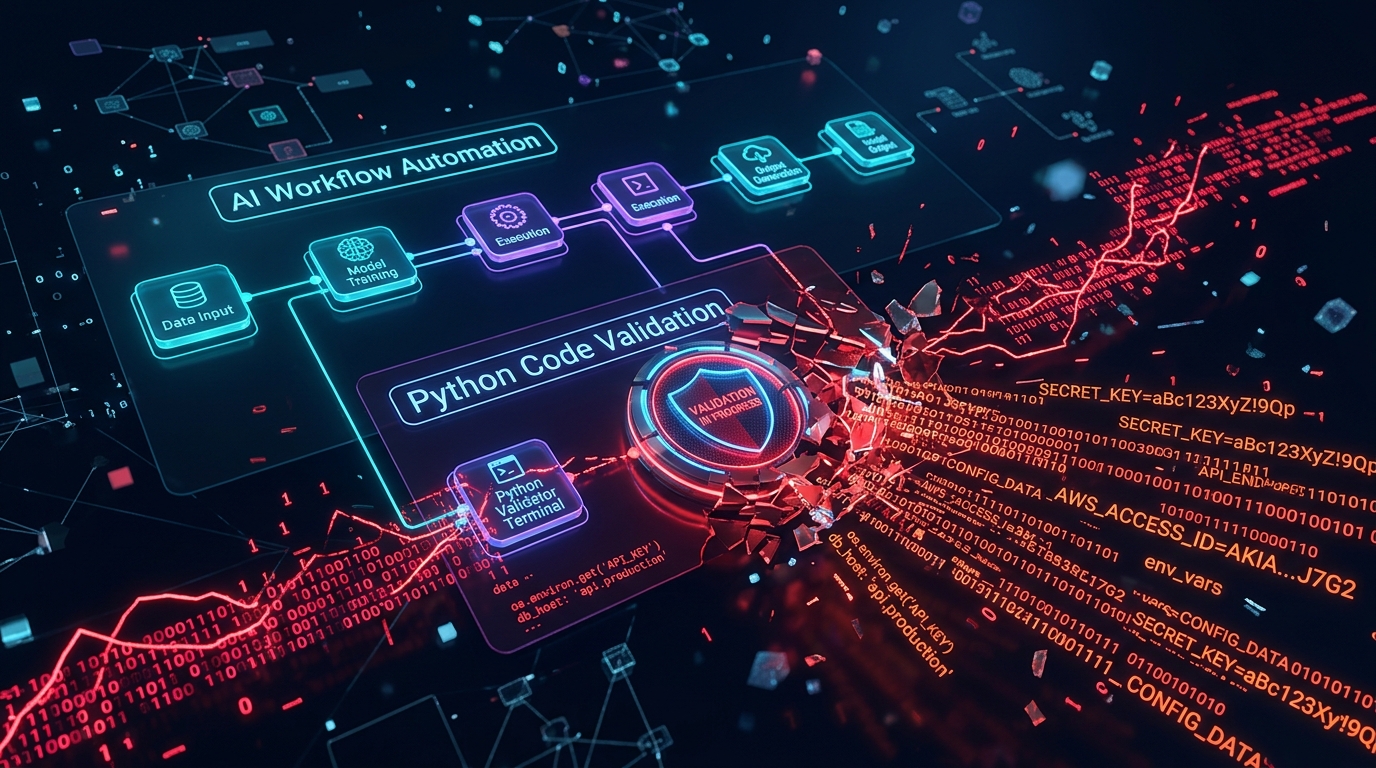
The vulnerability exists within the framework's custom Python component deserialization and dynamic Abstract Syntax Tree (AST) evaluation module. By sending an untrusted graph configuration containing obfuscated Python payload nodes to an exposed Langflow instance, an unauthenticated attacker can break out of the platform's restricted execution sandbox and achieve arbitrary command execution under the privileges of the underlying container or host service.
Vulnerability Mechanics: AST Bypass & Deserialization Breakdown
Langflow allows developers to define custom agentic logic using dynamic Python code nodes. To mitigate arbitrary execution risks, earlier releases utilized an AST-based parser intended to sanitize imports and block dangerous built-ins (such as __import__, eval, exec, and os.system). However, security researchers identified that Python's subclass hierarchy traversal allows attackers to reconstruct access to the underlying os module via object.__subclasses__() without triggering the keyword-based AST filter.
# Example representation of the subclass traversal vector bypassing basic AST filters
def exploit_sandbox():
    # Traversing object subclasses to locate subprocess.Popen
    for cls in ().__class__.__bases__[0].__subclasses__():
        if cls.__name__ == 'Popen' or 'subprocess.Popen' in str(cls):
            # Arbitrary host command execution outside restricted namespace
            cls(['cat', '/run/secrets/langflow_api_keys.env'])
            break
Furthermore, when serialized graph flows were ingested through the REST API endpoint /api/v1/process/flow, the backend engine instantiated components prior to completing cryptographic signature verification. This structural ordering flaw enabled threat actors to bypass frontend authentication proxies and submit malicious payloads directly to worker pods.
Threat Actor Landscape & Blast Radius
Langflow instances are commonly deployed across Kubernetes clusters with ambient access to internal vector databases (such as Milvus, Qdrant, and Pinecone), cloud object storage containing proprietary retrieval-augmented generation (RAG) indices, and enterprise LLM API gateway credentials. An unauthenticated breakout allows an adversary to:
- Harvest production OpenAI, Anthropic, and AWS Bedrock API tokens from container environment variables.
- Dump sensitive RAG document embeddings and internal knowledge base corpora.
- Deploy persistent reverse shells to initiate lateral movement across internal VPC networks.
Remediation & Defensive Playbook
Organizations operating Langflow deployments must immediately execute the following mitigation sequence:
- Upgrade Immediately: Deploy Langflow version
1.3.1or higher, which completely deprecates in-process AST sanitization in favor of kernel-isolated Docker and gVisor seccomp sandboxing. - Network Perimeter Hardening: Ensure that Langflow administrative interfaces are strictly isolated behind zero-trust network access (ZTNA) or enterprise VPN tunnels. Never expose port 7860 to the public internet.
- Secret Rotation: If an unauthenticated instance was accessible via the public internet, treat all embedded LLM API keys and database credentials as compromised and initiate immediate rotation.
Version Remediation Matrix
| Langflow Stream | Vulnerable Versions | Remediation Release | Mitigation Action |
|---|---|---|---|
| Langflow 1.2.x | <= 1.2.14 | 1.3.1 | Immediate upgrade to 1.3.1 |
| Langflow 1.3.x | 1.3.0 | 1.3.1 | Hotfix update via pip/Docker |