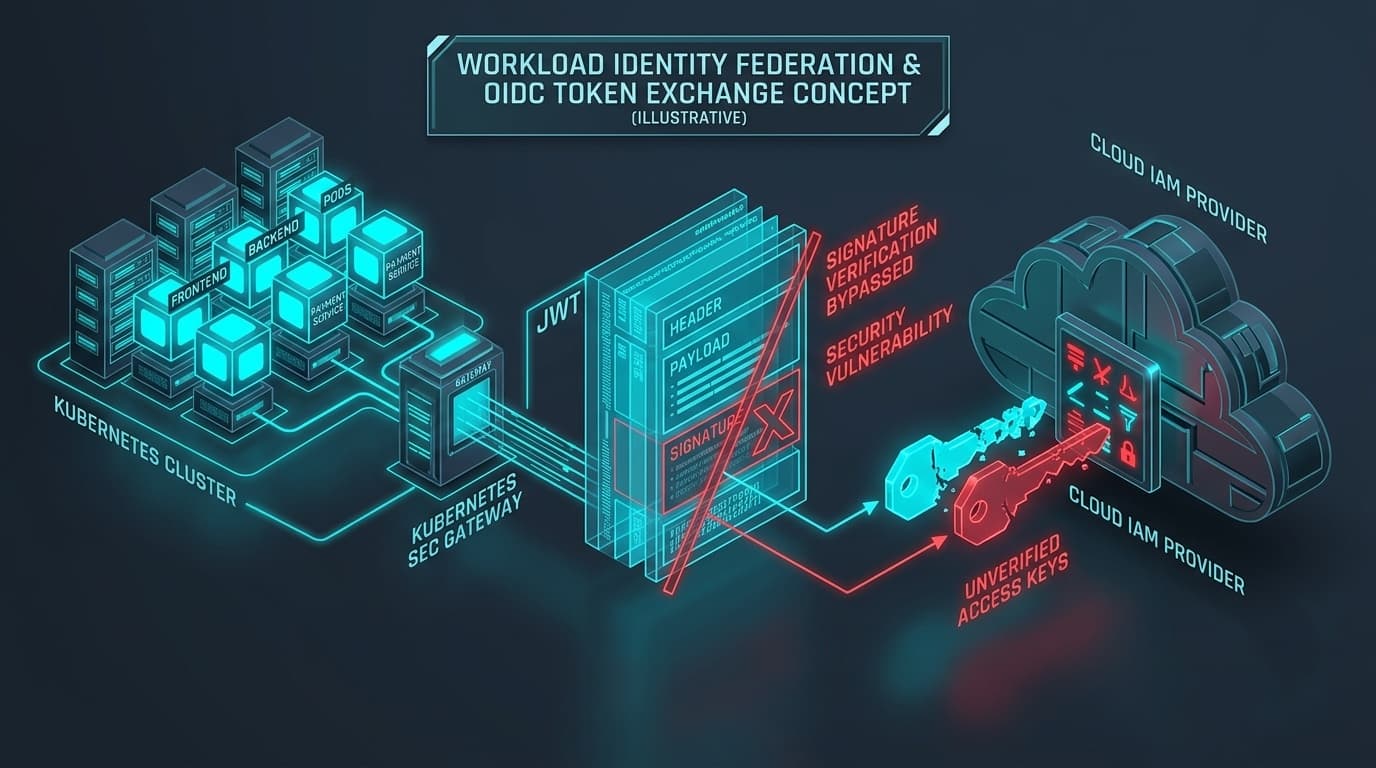
Google Cloud has remediated CVE-2026-19410 (CVSS score 8.6, High), an authentication bypass vulnerability within client-side Workload Identity Federation libraries. The flaw permitted external OpenID Connect (OIDC) tokens issued by third-party identity providers to be submitted against Google Cloud Security Token Service (STS) endpoints without enforcing strict audience scoping, potentially allowing cross-tenant service account impersonation.
Executive Threat Summary & Exploit Landscape
Workload Identity Federation is the modern industry standard for passwordless cloud authentication, eliminating the need to store long-lived Google Cloud service account keys inside CI/CD repositories such as GitHub Actions, GitLab, or Terraform Cloud. Workloads exchange ephemeral signed JWT tokens for temporary Google Cloud access tokens.
Under CVE-2026-19410, client authentication libraries failed to enforce exact string equivalence on the aud (audience) claim during token preparation. An attacker operating a public GitHub Actions workflow within an unrelated organization could harvest a signed GitHub OIDC token and pass it to a vulnerable application endpoint, gaining access to target Google Cloud project resources without authorized IAM bindings.
Vulnerability Mechanics & Technical Root Cause (CWE-287)
In Google Cloud's Python and Node.js authentication SDKs, the identity_pool provider validates incoming claims before requesting federated credentials. The vulnerability stemmed from using substring matching rather than strict exact URL equality when verifying the STS target audience:
# Vulnerable Audience Verification Logic in google-auth
def _validate_audience(token_aud, expected_aud):
    # VULNERABLE: Substring check allowed malicious tokens targeting
    # //iam.googleapis.com/projects/123/locations/global/workloadIdentityPools/shared
    # to match expected_aud prefixes
    return expected_aud in token_aud
By registering a workload identity pool with an ID that shared a prefix with an enterprise victim's pool, an adversary could generate a valid token that passed client-side validation, leading to unauthorized IAM token exchange and data exfiltration.
Vulnerable Software Versions & Patch Status Matrix
| Library / Runtime | Vulnerable Versions | Fixed Release | Remediation Priority |
|---|---|---|---|
| google-auth (Python) | Versions prior to 2.35.0 | Version 2.35.0 or later | Patch Live (PyPI) |
| google-auth-library (Node.js) | Versions prior to 9.14.2 | Version 9.14.2 or later | Patch Live (NPM) |
| google-auth-library-java | Versions < 1.28.0 | Version 1.28.0+ | Maven Central Live |
Step-by-Step Remediation Playbook & Patch Commands
DevOps and backend engineering teams must upgrade client authentication libraries across all container images and serverless functions:
- Python Environments (pip / poetry):
# Upgrade via pip pip install --upgrade "google-auth>=2.35.0" # Poetry update poetry add "google-auth@^2.35.0" # Verify installed release pip show google-auth - Node.js Microservices (npm / yarn):
# Update npm package npm install google-auth-library@^9.14.2 --save # Yarn update yarn upgrade google-auth-library@^9.14.2 - Harden Workload Identity Pool Attribute Conditions: In the Google Cloud Console, configure strict attribute conditions on Workload Identity Pools to require exact repository matches:
gcloud iam workload-identity-pools providers update-oidc my-provider --workload-identity-pool=my-pool --location=global --attribute-condition="assertion.repository_owner == 'my-enterprise-org'"
Threat Detection, Log Auditing & Forensic Queries
Review Google Cloud STS token exchange logs in Cloud Logging:
// Cloud Logging Query
protoPayload.serviceName="sts.googleapis.com"
AND protoPayload.methodName="google.identity.sts.v1.SecurityTokenService.ExchangeToken"
AND protoPayload.request.audience!~"//iam.googleapis.com/projects/YOUR_PROJECT_NUMBER/"