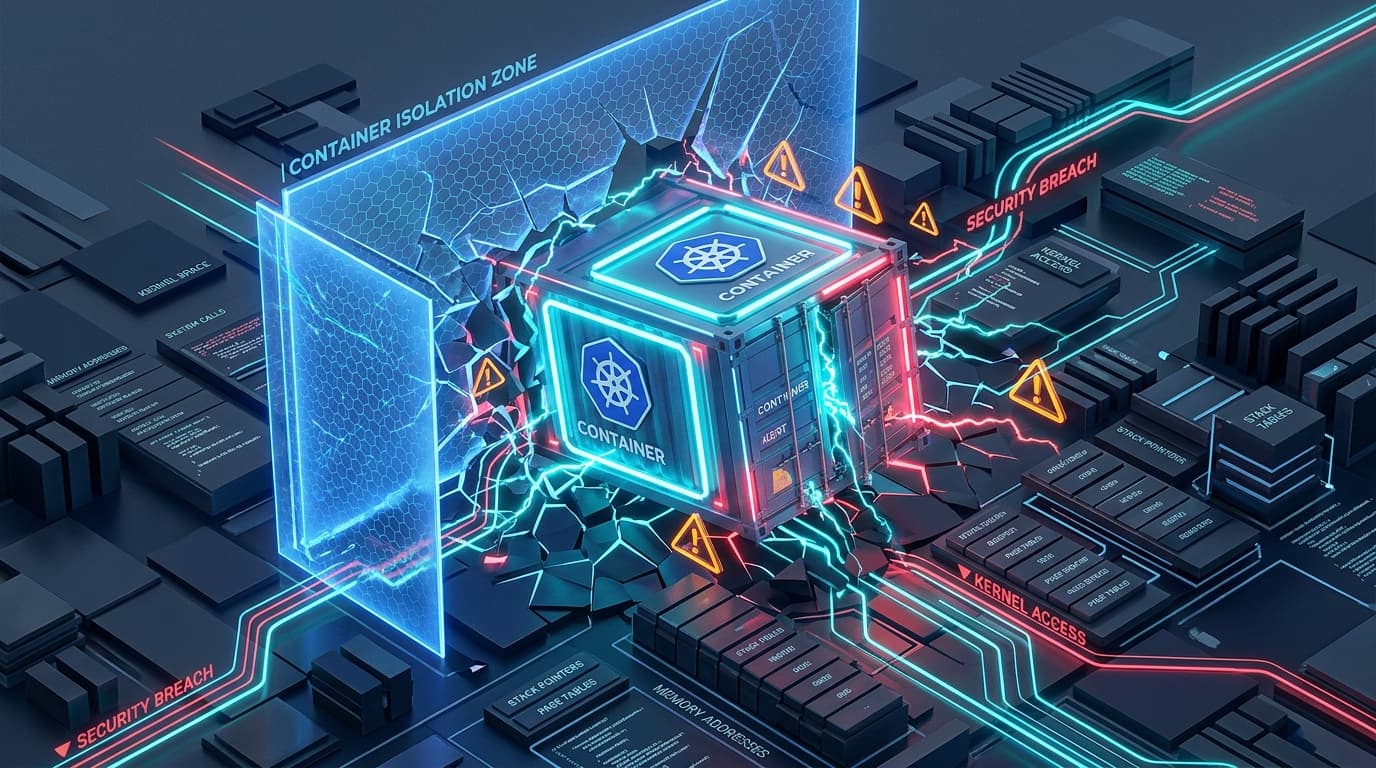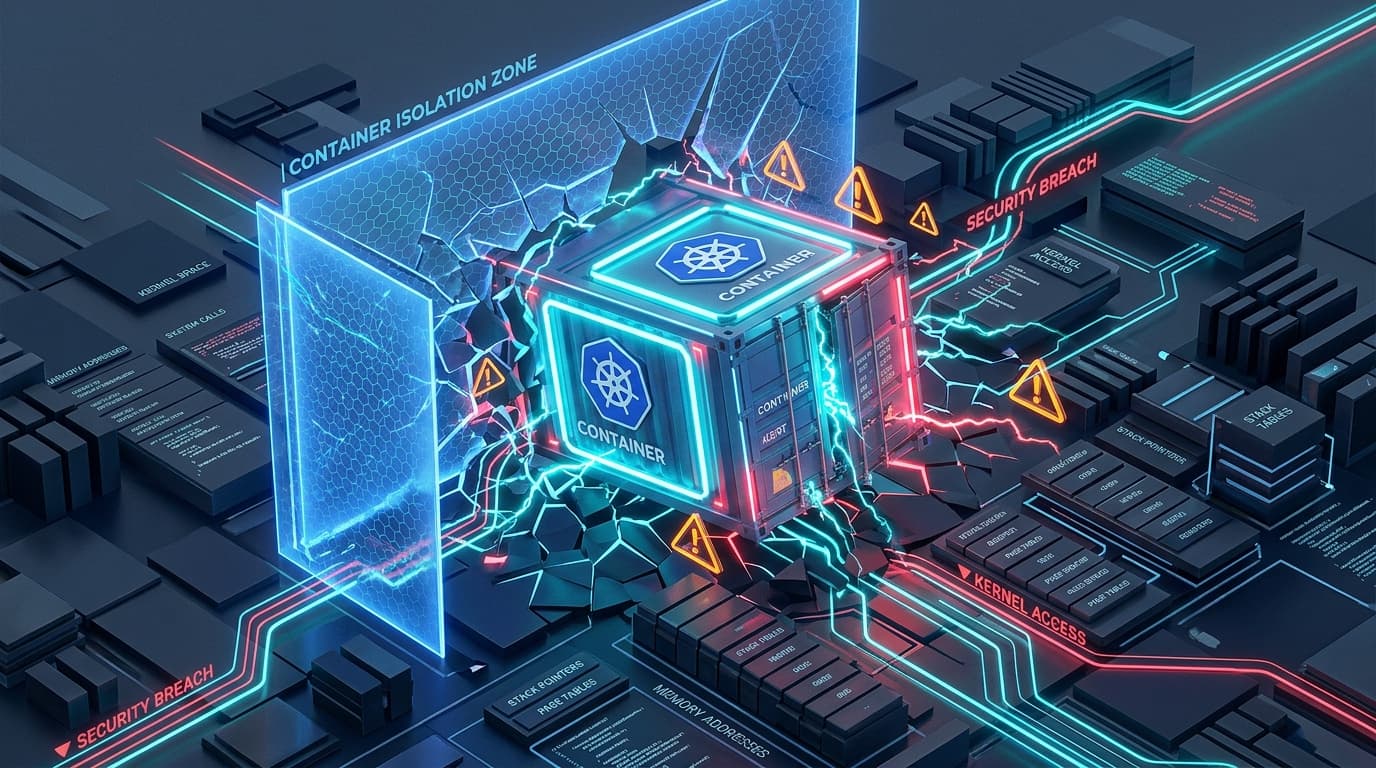
Executive Summary: Breaking Multi-Tenant Isolation in Managed Kubernetes
Google Cloud has addressed a significant container breakout and local privilege escalation vulnerability impacting Google Kubernetes Engine (GKE) node images. Tracked as CVE-2026-39821, the flaw carries a Common Vulnerability Scoring System (CVSS v3.1) base rating of 8.8 High.
In cloud multi-tenant architectures, Kubernetes clusters routinely run workloads from different teams, customers, or untrusted CI/CD pipelines on shared underlying virtual machines (nodes). The kernel provides the fundamental security barrier separating these containers through Linux namespaces (pid, mount, net, ipc), control groups (cgroups), and seccomp filters. CVE-2026-39821 allowed an attacker with standard execution permissions inside an unprivileged pod to exploit an internal kernel synchronization defect, escape namespace confinement, and attain root control over the GKE host node.
Kernel Root Cause: Race Condition in Memory Cgroup Accounting
The vulnerability originated within the Linux kernel's implementation of cgroups v2 memory charging routines (specifically within mm/memcontrol.c). In GKE clusters configured with default Container-Optimized OS (COS) or Ubuntu node images:
- When an unprivileged process inside a container spawned hundreds of asynchronous memory allocation threads while simultaneously triggering container memory limit exhaustion (OOM), a race condition occurred between page uncharging and cgroup teardown.
- The race condition resulted in a use-after-free (UAF) condition within the kernel slab allocator (
kmalloc-512cache). - By precisely spraying the slab cache with crafted socket buffer structures (
sk_buff), an attacker could overwrite kernel function pointers and hijack kernel execution flow, redirecting execution to shellcode running in Ring 0.
Exploitation Mechanics & Namespace Breakout Walkthrough
Once kernel-mode execution was achieved from within the container context, escaping to the host node required only standard kernel capability manipulation:
// Kernel privilege escalation exploit primitive (Ring 0 execution payload)
void escape_namespaces(void) {
    // 1. Locate current task_struct in kernel memory
    struct task_struct *cur = get_current_task();

    // 2. Elevate credentials to init_cred (root)
    commit_creds(prepare_kernel_cred(NULL));

    // 3. Switch container namespaces to host root namespaces (init_nsproxy)
    switch_task_namespaces(cur, &init_nsproxy);

    // 4. Reset fs_struct to host root filesystem (/)
    set_fs_root(cur->fs, &init_fs.root);
    set_fs_pwd(cur->fs, &init_fs.root);
}
Upon execution of the exploit, the container process transitioned from its isolated namespace into the host node's root namespace. From this vantage point, the attacker gained complete visibility into all other pods colocated on the node, including adjacent tenant secrets, environment variables, mounted persistent volumes, and the node's local Kubelet credentials.
Blast Radius Across Multi-Tenant Kubernetes Architectures
| Compromised Asset | Immediate Exposure | Attacker Pivot Capability |
|---|---|---|
| Kubelet API Client Certificate | Read/Write access to local node Kubelet | Steal credentials from all other pods scheduled on the node; inject malicious sidecars |
| GCP Instance Service Account | Node identity token via IMDS (metadata.google.internal) |
Escalate into Google Cloud project services (Container Registry, Cloud Storage, Spanner) |
| Host Memory & Process Table | Direct access to /proc and physical RAM |
Dump cryptographic keys, database connection strings, and TLS private keys from adjacent pods |
Remediation Playbook: Securing GKE Node Pools
- Verify GKE Automated Upgrades: Ensure GKE node pools are enrolled in automatic upgrades and verify that node images reflect the patched kernel versions:
# Query cluster node versions via gcloud CLI gcloud container clusters list --format="table(name,currentMasterVersion,currentNodeVersion)" gcloud container node-pools list --cluster=[CLUSTER_NAME] - Deploy GKE Sandbox (gVisor): For untrusted workloads, multi-tenant microservices, and AI code-execution containers, enforce GKE Sandbox. gVisor replaces direct Linux syscall execution with an application-kernel sandbox implemented in Go, preventing host kernel exploits:
apiVersion: apps/v1 kind: Deployment metadata: name: untrusted-tenant-workload spec: template: spec: runtimeClassName: gvisor # Enforces user-space syscall interception containers: - name: tenant-app image: tenant-registry/app:v2 - Enforce Kubernetes Admission Controls: Deploy Kyverno or OPA Gatekeeper policies to reject any pod requesting
hostPID,hostNetwork, or elevated Linux capabilities (CAP_SYS_ADMIN,CAP_NET_ADMIN).