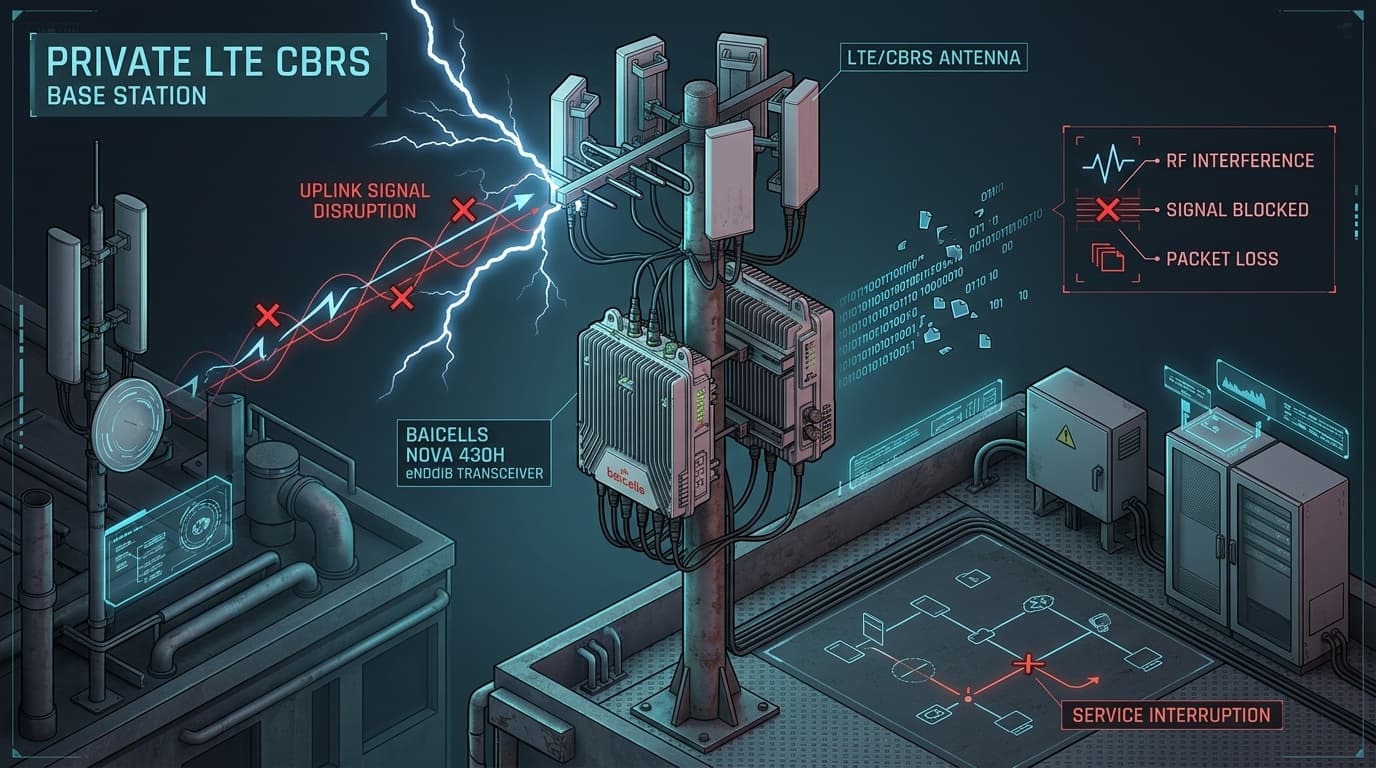
The Cybersecurity and Infrastructure Security Agency (CISA) has issued security advisory ICSA-26-272-04 warning industrial asset owners of a high-severity denial-of-service vulnerability (CVE-2026-96274, CVSS 7.5) impacting Baicells Nova 430H outdoor micro-eNodeB base stations. The devices, deployed across automated container shipping terminals, open-pit mines, and electrical utility grids to provide private Citizens Broadband Radio Service (CBRS) and LTE wireless backhaul, can be knocked offline by unauthenticated attackers transmitting malformed radio frequency (RF) uplink packets.
Private Cellular in Industrial Automation (IACS)
In modern critical infrastructure, industrial private LTE/5G networks have largely superseded commercial Wi-Fi due to superior range, deterministic latency, and support for high-speed automated machinery. The Baicells Nova 430H serves as a compact 4x250mW outdoor transceiver connecting automated guided vehicles (AGVs), autonomous haulage trucks, and remote terminal units (RTUs) to the industrial core network (EPC).
Vulnerability Mechanics: SCTP Signaling Teardown (CWE-20)
The vulnerability resides within the LTE Layer 3 Radio Resource Control (RRC) and Stream Control Transmission Protocol (SCTP) signaling parser.
When processing incoming uplink control frames from mobile client stations, the eNodeB firmware fails to validate the structure of specific RRC connection request parameters. An unauthenticated adversary operating a software-defined radio (SDR) within RF transmission range can broadcast malformed signaling frames:
# Threat actor transmission via Software-Defined Radio (SDR)
Transmitted Frame: LTE Uplink RRCConnectionRequest
Malformed Parameter: IE-EstablishmentCause (Invalid Bit Length 0xFF)
Result: Kernel panic in baseband processor -> SCTP S1-MME Link Teardown
The malformed frame causes the baseband processing software to crash, terminating the SCTP association between the eNodeB and the Mobility Management Entity (MME). All connected industrial clients lose connectivity instantaneously, triggering emergency safety shutdowns across autonomous robotic machinery.
Mitigation Actions for Private Network Operators
- Deploy Baicells Firmware Patch: Contact Baicells technical support to deploy the latest firmware update incorporating boundary validation for all RRC signaling parameters.
- Deploy Radio Frequency Intrusion Detection (RFID): Install RF spectrum monitoring sensors around perimeter boundaries to identify unauthorized SDR transmissions or rogue LTE cell spoofing.
- Fail-Safe Physical Interlocks: Ensure that all autonomous machinery and remote RTUs utilize independent hardware fail-safe mechanisms when cellular carrier signals drop, preventing runaway mechanical conditions.