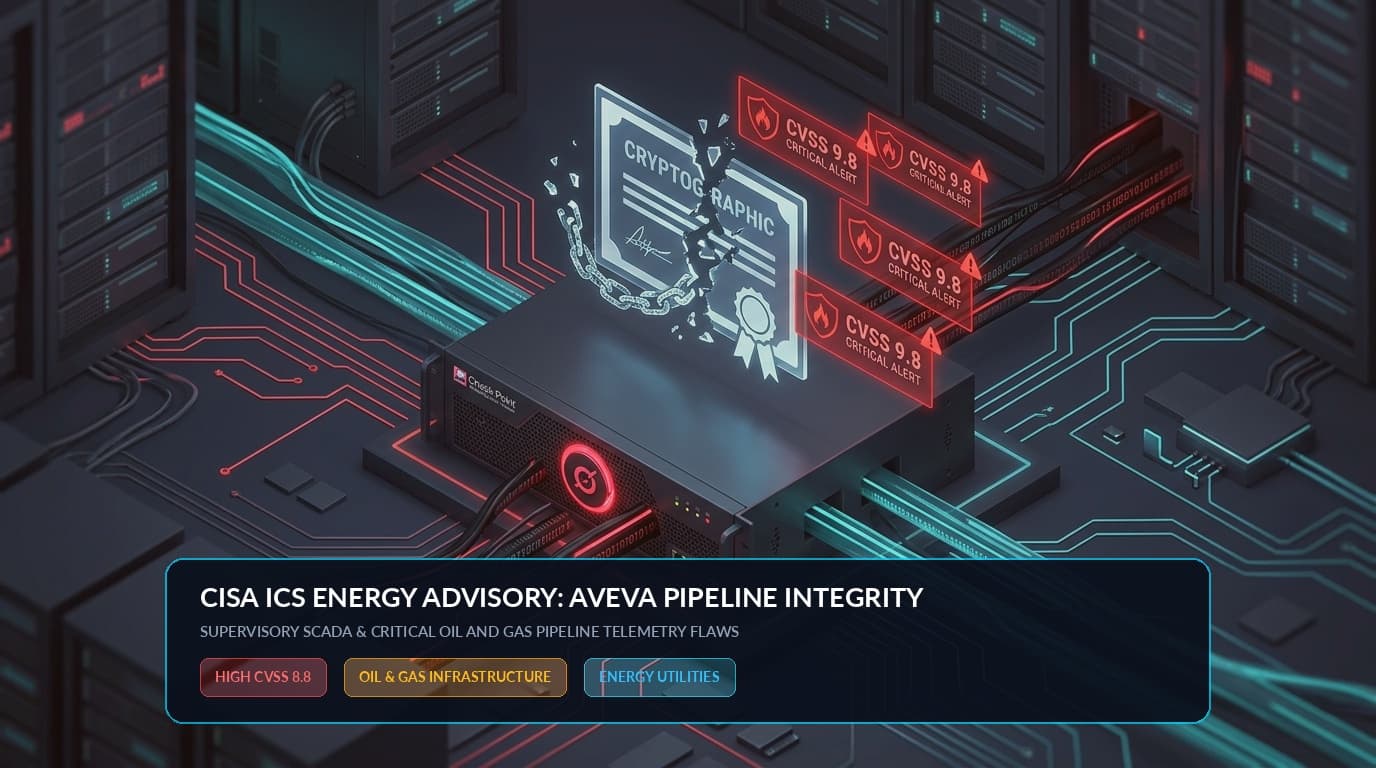
The Cybersecurity and Infrastructure Security Agency (CISA) has released an urgent Industrial Control Systems (ICS) Advisory, ICSA-26-253-02, addressing multiple high-severity vulnerabilities in AVEVA Pipeline Integrity Monitor. The software is a critical supervisory control application deployed by liquid petroleum, natural gas, and hazardous chemical pipeline operators globally to detect pipeline leaks, monitor flow hydraulics, and calculate real-time pressure thresholds.
The advisory encompasses four distinct Common Vulnerabilities and Exposures, led by CVE-2026-81821 (CVSS v3.1 base score 8.8) and CVE-2026-81822 (CVSS 8.5). If exploited, these flaws allow remote adversaries to crash automated leak-detection telemetry or inject falsified hydraulic data into pipeline control rooms.
Vulnerability Breakdown: Buffer Overflows & Telemetry Spoofing
AVEVA Pipeline Integrity Monitor communicates with remote terminal units (RTUs), programmable logic controllers (PLCs), and supervisory SCADA servers via proprietary TCP/IP telemetry listening ports. Vulnerability analysis revealed significant boundary check deficiencies within the acoustic and pressure wave packet decoders:
- Heap Overflow in Sensor Packet Ingestion (CVE-2026-81821): When the monitor ingests specialized batch monitoring or sonic wave packets, an integer mismatch in the array allocation header triggers an out-of-bounds heap write, permitting arbitrary process termination or remote code execution.
- Authentication Bypass in Remote Configuration (CVE-2026-81822): The administrative configuration listener fails to validate session origin tokens, allowing unauthorized entities on the operational technology (OT) network to alter alarm thresholds and disable pipeline rupture warnings.
- Denial of Service via Packet Loop (CVE-2026-81823): Continuous transmission of malformed telemetry packets causes memory leak accumulation, freezing pipeline operator visualization consoles.
Pipeline integrity monitors are safety-critical systems. Tampering with leak detection software during a physical failure or cyber-physical disruption could prevent operators from isolating ruptured pipeline valves in time.
Affected Versions & Remediation Table
| Component | Affected Versions | Vulnerability Details | Patched Build / Mitigation |
|---|---|---|---|
| AVEVA Pipeline Integrity Monitor | Versions prior to 2026.2 | CVE-2026-81821 (Heap Overflow) | Update to Build 2026.2.1 |
| AVEVA Enterprise SCADA Gateway | Versions 2023 through 2026.1 | CVE-2026-81822 (Auth Bypass) | Apply Security Hotfix HF-81822 |
| Hydraulic Transient Analyzer | All unpatched legacy builds | CVE-2026-81823 (Resource Exhaustion) | Apply Service Pack 3 |
Operational Technology (OT) Defense Directives
Energy sector asset owners and pipeline operators must apply the following defense-in-depth measures recommended by CISA and AVEVA:
- Apply Vendor Patches: Download and install AVEVA Pipeline Integrity Monitor version 2026.2.1 from the AVEVA Customer Support Hub.
- Enforce Purdue Model Network Segmentation: Ensure Pipeline Integrity Monitor workstations are strictly isolated within Level 3 (Operations Systems) or Level 2 (Control Systems) of the Purdue Enterprise Reference Architecture, with unidirectional security gateways (data diodes) bridging to Level 4 enterprise networks.
- Disable Remote Public Access: Verify that no SCADA ports, telemetry listeners, or RTU gateways are accessible via direct internet routing or unsegmented corporate VPNs.
- Monitor Telemetry Baselines: Deploy industrial intrusion detection sensors (e.g., Nozomi, Claroty, Dragos) to monitor Modbus TCP, DNP3, and OPC UA traffic for anomalous polling bursts or malformed length parameters.