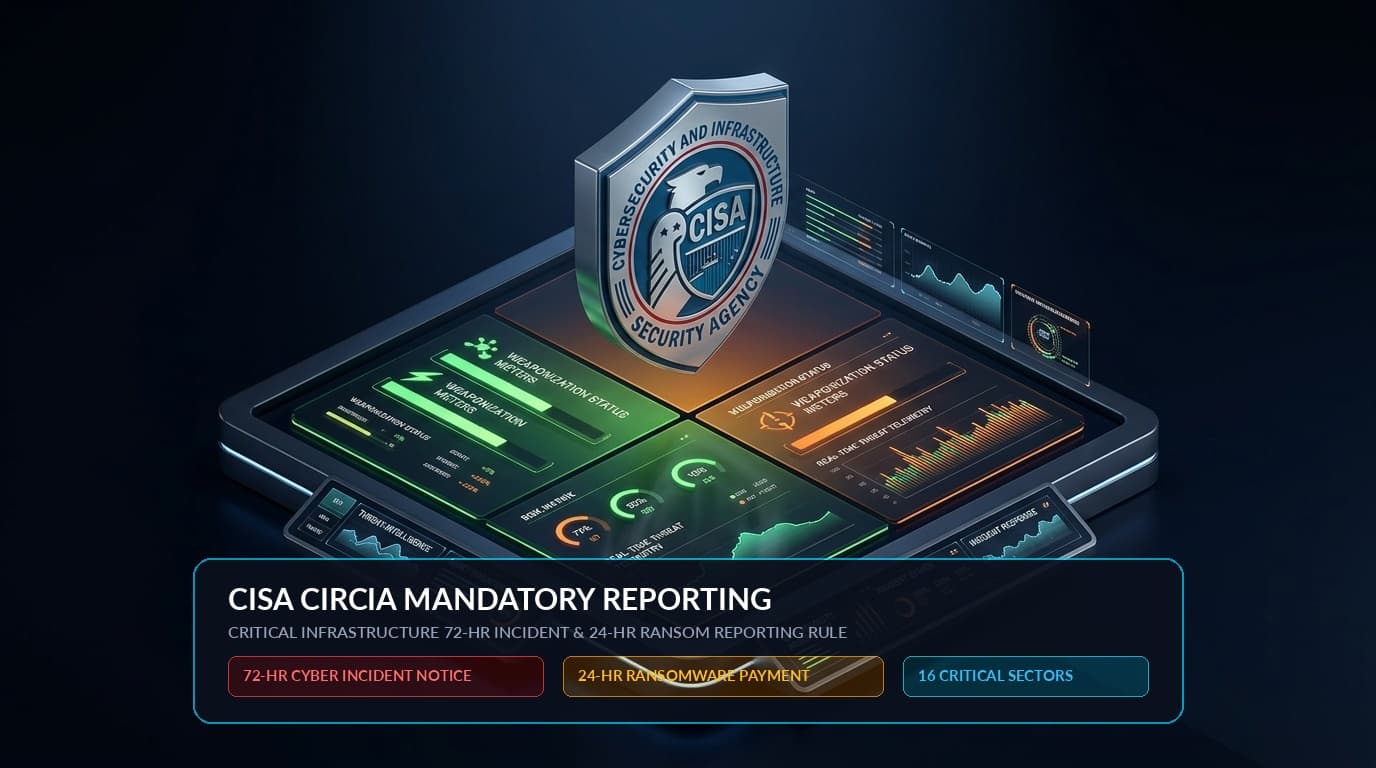
In a transformative regulatory milestone for United States cybersecurity policy, the Cybersecurity and Infrastructure Security Agency (CISA) has issued its landmark Final Rule implementing the Cyber Incident Reporting for Critical Infrastructure Act of 2022 (CIRCIA). The comprehensive regulation establishes legally binding reporting deadlines for thousands of public and private sector organizations operating across the nation’s 16 critical infrastructure sectors.
Under the finalized regulatory framework, covered entities must formally report any substantial cyber incident to CISA within 72 hours of establishing a reasonable belief that an incident occurred. Furthermore, any entity that makes a ransom payment following a ransomware demand must submit a report within 24 hours of the payment being disbursed, regardless of whether the underlying incident meets the substantial impact criteria.
Scope & Qualifying Criteria: Who Must Report?
The CIRCIA Final Rule applies broadly across 16 critical infrastructure sectors—encompassing financial services, healthcare and public health, energy, communications, chemical facilities, water systems, defense industrial base, and information technology.
An incident qualifies as a "substantial cyber incident" triggering the 72-hour reporting clock if it results in any of the following outcomes:
- Substantial Loss of Availability: Any operational interruption or degradation affecting industrial control systems (ICS), operational technology (OT), or critical information systems.
- Compromise of Safety or Resiliency: Disruption that impacts life safety systems, physical plant operations, or vital supply chain continuities.
- Unauthorized Access via Supply Chain: Incidents caused by a compromised managed service provider (MSP), cloud host, or software supply chain dependency.
- Major Disruption of Business Operations: Impairment causing substantial financial, operational, or data confidentiality fallout.
CIRCIA closes the critical visibility gap that has long plagued federal defense operations. For the first time, CISA will possess real-time nationwide telemetry to detect systemic ransomware campaigns as they unfold.
Key Reporting Windows & Compliance Matrix
| Regulatory Obligation | Statutory Deadline | Trigger Event | Enforcement Mechanism |
|---|---|---|---|
| Substantial Cyber Incident Report | Within 72 Hours | Reasonable belief that a qualifying incident has occurred | Administrative subpoena; referral to Department of Justice |
| Ransomware Payment Report | Within 24 Hours | Disbursement of ransom payment (currency or crypto) | Civil enforcement; federal contracting eligibility review |
| Supplemental Reports | Promptly as available | Discovery of new material information or ransom engagement changes | Compliance audit tracking |
Legal Protections & Privacy Safe Harbors
To encourage transparent reporting without fear of regulatory double-jeopardy, CIRCIA embeds strong statutory protections for reporting entities:
- Freedom of Information Act (FOIA) Exemption: Reports submitted to CISA under CIRCIA are explicitly exempt from public disclosure requests under FOIA.
- Litigation Safe Harbor: Submitted reports cannot be admitted as evidence or used against the entity in civil litigation brought by third parties in federal or state courts.
- Regulatory Non-Disclosure: Telemetry shared with CISA cannot be utilized directly by other civil regulatory bodies (such as the SEC, FTC, or state attorneys general) to initiate enforcement actions against the reporting organization.
Enterprise Incident Response Alignment Checklist
Corporate Chief Information Security Officers (CISOs) and General Counsel must immediately adapt incident response retainers and internal crisis playbooks to comply with the CIRCIA rule:
- Align the Triage Clock: Define clear operational criteria for what constitutes a "reasonable belief" within SOC escalation workflows, ensuring the 72-hour timer begins without administrative latency.
- Document Ransomware Incident Procedures: Update ransomware negotiation protocols to ensure legal and forensic retainers preserve cryptocurrency transaction hashes, extortion communications, and wallet addresses required for the 24-hour report.
- Harmonize Cross-Regulatory Filings: Establish unified reporting procedures reconciling CIRCIA's 72-hour requirement with SEC Form 8-K (4 business days from materiality determination) and EU NIS2 / DORA notifications for multinational operations.
- Test the CISA Intake Portal: Validate access credentials and test emergency escalation templates with designated points of contact in the CISA Incident Reporting System.