Regulatory Disclosure & Incident Anatomy
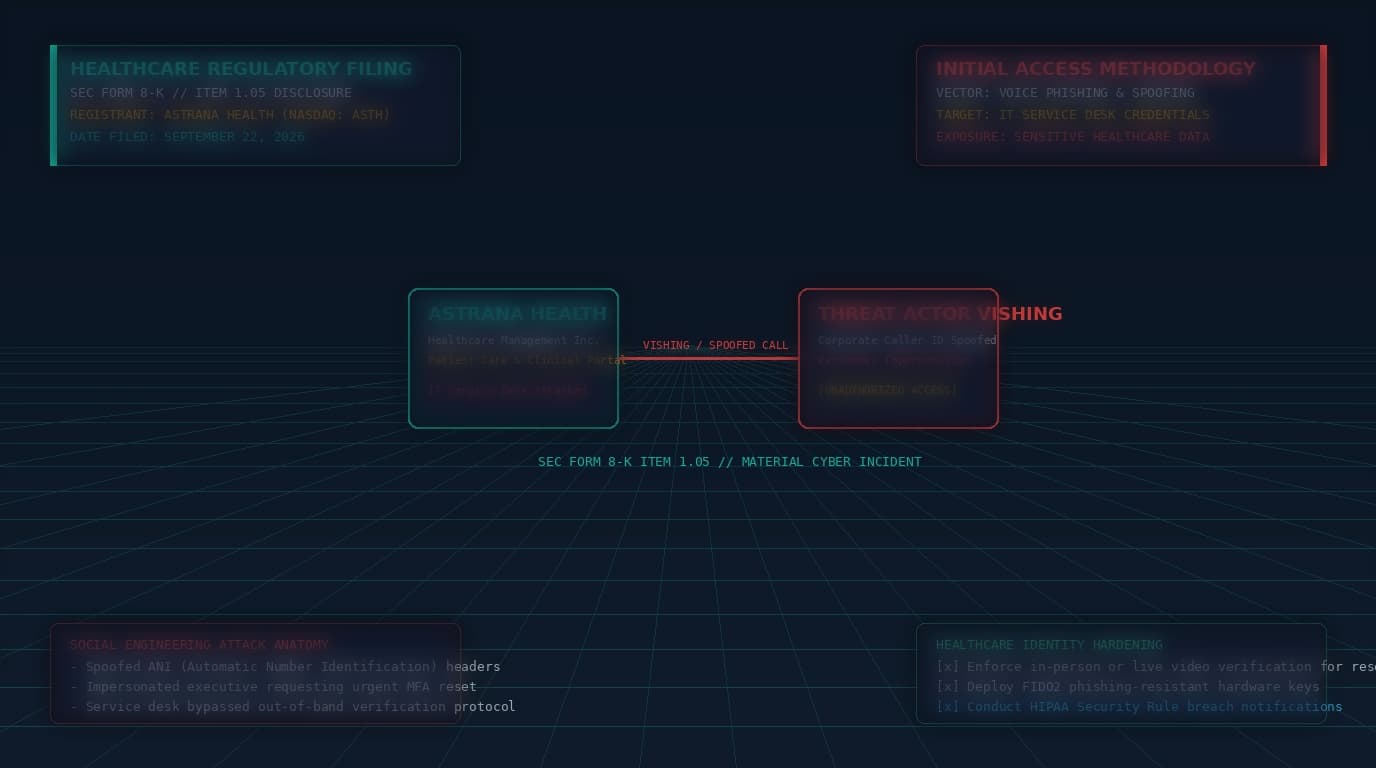
Astrana Health, Inc. (NASDAQ: ASTH), a prominent healthcare management and technology services organization coordinating care for hundreds of thousands of patients, has submitted a formal Form 8-K Item 1.05 disclosure to the U.S. Securities and Exchange Commission (SEC). The filing reports a material cybersecurity intrusion impacting its principal operating subsidiary, Astrana Health Management, Inc.
According to the regulatory disclosure, sophisticated cyber adversaries executed a targeted social engineering campaign involving voice phishing (vishing) and telephone number spoofing. Threat actors spoofed the company's official corporate telephone number and impersonated bona fide Astrana Health personnel when contacting internal IT help desk technicians. By manipulating service desk representatives into believing they were assisting a legitimate employee facing an urgent technical blocker, the attackers successfully compromised internal user credentials and gained unauthorized access to enterprise systems.
Astrana Health made the formal determination of materiality on September 22, 2026, citing the "potential confidential and sensitive nature of the data that is involved". While the company stated it maintains comprehensive cybersecurity insurance, the breach triggers mandatory notifications under the Health Insurance Portability and Accountability Act (HIPAA) Breach Notification Rule.
The Vishing Playbook: How Help Desks Became Enterprise Ground Zero
Astrana Health's disclosure reflects a rapidly accelerating cyber threat vector tracked closely by CISA and the FBI. Rather than relying on technical exploits against network firewalls, extortion cartels (such as Scattered Spider / UNC3944) increasingly bypass multi-factor authentication (MFA) by attacking human service desk operators:
[Attacker Reconnaissance]
  |-- Scrape LinkedIn & ZoomInfo for Astrana Health IT technicians and executives
  |-- Acquire target phone numbers, employee IDs, and manager names via data broker leaks
        |
        v
[Spoofed VoIP Inbound Call]
  |-- SIP trunk configured to spoof Astrana corporate caller ID (ANI header)
  |-- Threat actor places call to internal IT Help Desk:
  |   "Hi, this is Dr. [Name]. My phone broke and I am locked out of Epic/EHR.
  |    I need an emergency MFA token reset immediately for patient rounds."
        |
        v
[Help Desk Verification Failure]
  |-- Technician trusts incoming caller ID and employee ID matching internal directory
  |-- Bypasses out-of-band video verification or manager callback protocol
  |-- Re-registers MFA token to attacker-controlled FIDO/TOTP device
        |
        v
[System Compromise & Lateral Movement]
  |-- Attacker logs into Astrana Microsoft 365, VPN, and Patient Care Management portals
  |-- Data exfiltration of patient records and clinical management databases
Healthcare Regulatory & Financial Blast Radius
In the healthcare sector, data breaches carry extraordinary statutory liability under both federal securities law and medical privacy frameworks:
| Regulatory Authority & Framework | Mandatory Compliance Obligations | Enforcement & Penalties |
|---|---|---|
| U.S. SEC Form 8-K Item 1.05 | Public disclosure within four business days of materiality determination; ongoing amendments | SEC Division of Enforcement investigations, securities class actions |
| HHS Office for Civil Rights (OCR) | Mandatory breach notification to Secretary of HHS and affected individuals within 60 days | HIPAA civil monetary penalties up to $2,000,000 per violation category |
| State Attorneys General | Individual notices to state AG offices across California, New York, Texas, and other patient states | State consumer protection lawsuits, mandatory external security monitoring |
| Centers for Medicare & Medicaid (CMS) | Verification of healthcare network continuity and patient care delivery integrity | Medicare/Medicaid billing compliance audits |
Help Desk Identity Hardening Playbook
To defend against voice spoofing and social engineering, healthcare organizations and enterprise security leaders must implement rigorous identity verification controls:
1. Eliminate Voice-Only Credential and MFA Resets
Service desk policies must explicitly prohibit technicians from resetting passwords, providing temporary access passes (TAPs), or registering new MFA devices based solely on an incoming phone call:
- Mandatory Live Video Verification: Technicians must initiate a live video conference with the requesting employee and match their face against an HR badge photograph before proceeding with any credential change.
- Supervisor Out-of-Band Callback: When video verification is unavailable, the technician must contact the employee's registered direct supervisor via an independently verified internal extension to validate the reset request.
2. Deploy Phishing-Resistant FIDO2 / WebAuthn Hardware Keys
Replace vulnerable SMS, voice call, and push-notification MFA with hardware security keys (e.g., YubiKeys). FIDO2 credentials bind authentication directly to the origin URL of the authentication portal, preventing adversaries from intercepting or re-registering tokens over the telephone.
3. Implement Caller ID Spoofing Defenses (STIR/SHAKEN)
Ensure enterprise PBX and VoIP telephone infrastructure enforces STIR/SHAKEN call attestation. Inbound calls that do not possess Full Attestation (A-level) from the originating carrier must be flagged as "External / Unverified" on technician softphone screens, preventing spoofed internal caller IDs from deceiving support staff.