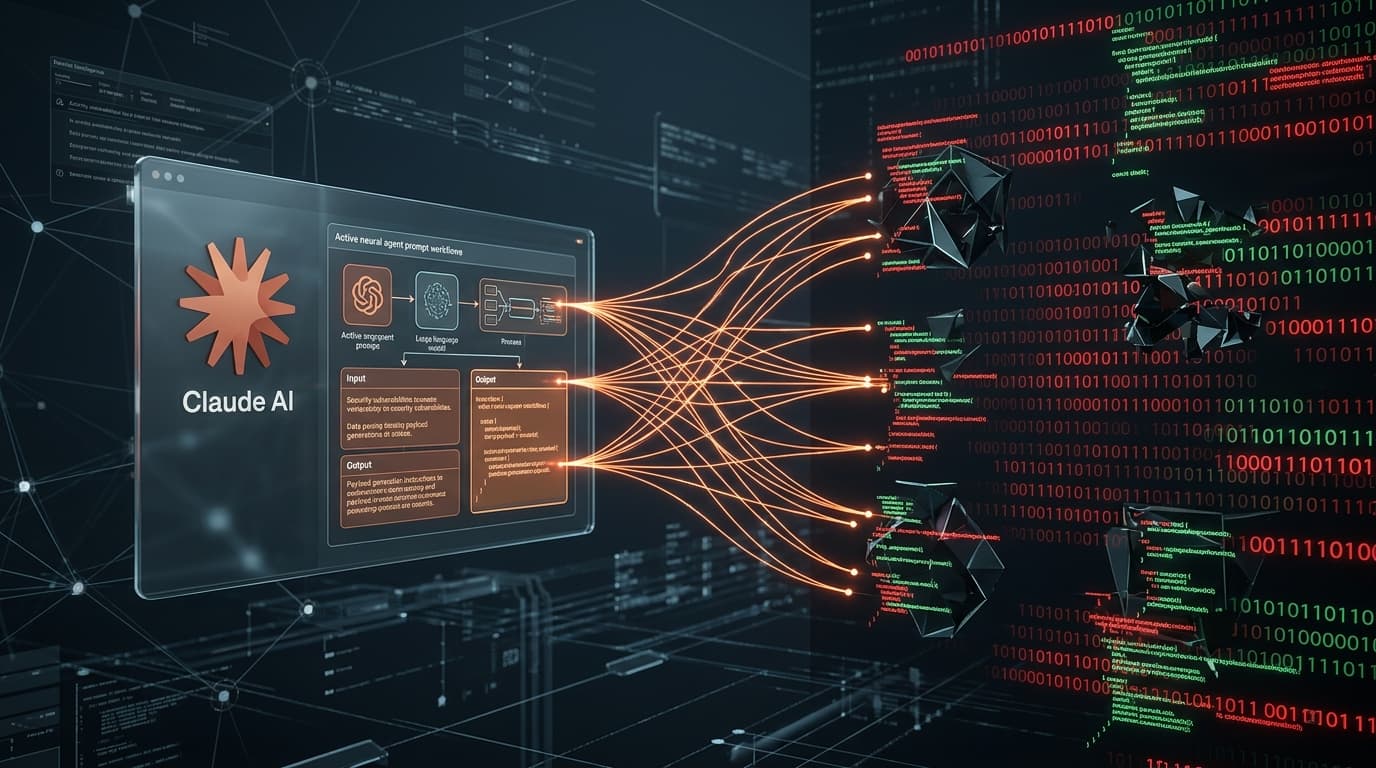
Anthropic’s September 2026 threat-intelligence report is not primarily a story about a model writing a single exploit. Its more important claim is operational: actors are using Claude inside workflows that run reconnaissance, intrusion support, data handling and tool maintenance faster and in more parallel than a conventional human-led operation can manage.
The report covers misuse Anthropic says it disrupted between December 2025 and August 2026 across seven areas, including cyber operations, influence, surveillance, fraud, weapons development, biological misuse and illicit distillation. Anthropic says it used the findings to strengthen safeguards and shared intelligence with authorities and industry partners where appropriate.
From assistant to orchestrator
Anthropic uses the term Generative Threat Group, or GTG, for its internal designators for actors observed abusing AI. That matters when reading the attribution. For GTG-20006, Anthropic says its attribution is consistent with public reporting linking the activity to Midnight Blizzard; it does not present the GTG label itself as a public intelligence-community attribution.
Anthropic describes GTG-20006 as a Russian-speaking espionage actor using an AI-assisted workflow around a custom toolkit. The reported toolkit included Windows implants, a mobile-exploitation kit, a browser-password credential stealer, a phishing platform and an administrative console for compromised accounts. The report says these tools were managed and retooled during operations through AI-assisted workflows.
The defensive implication is not that every detection is obsolete. It is that a detection event may no longer buy defenders the same amount of time. Anthropic says the actor used AI to monitor the stealth and persistence of implants in on-premises environments. When security products flagged an implant, the workflow could help identify, modify and redeploy the detected artifact. The pressure shifts from a one-off malware signature to the speed of the attacker’s repair loop.
Humans still choose the targets
It would be wrong to read the report as evidence that cyber operations are fully autonomous. Anthropic explicitly separates autonomy from harm. It says humans retained the decisions that matter most to the actors, including target selection, monetization and review of results. In the GTG-20006 case, Anthropic describes actors directing operational activity while Claude assisted with tasks such as running commands, harvesting credentials and exfiltration.
That distinction is useful for defenders. A faster workflow does not remove the surrounding infrastructure: identity abuse, anomalous device registration, unfamiliar administrative activity, unusual data-export patterns and unexpected changes to persistence mechanisms remain observable. The response should therefore focus on the operational trail an actor leaves behind, not only the particular binary that happened to trigger an alert.
The report’s broader warning
GTG-20006 is only one of the cases Anthropic describes. The report also documents actors using AI in multi-agent frameworks for reconnaissance, exploitation and theft; an actor it says operated an ongoing vulnerability-research and exploit-development effort; and abuse of stolen API keys and session tokens to obtain access to AI capability. Anthropic’s central assessment is that AI is compressing the labour and tooling gap across the cyber kill chain: reconnaissance, tool development, data processing and execution can run in parallel with less operator effort.
That does not make every AI-assisted campaign sophisticated or successful. Anthropic notes that the cases it publishes are notable examples rather than typical misuse. It also says the attacks themselves still commonly rely on familiar weaknesses: stolen credentials, exposed services, unpatched edge devices and phishing. The novelty is the speed, breadth and persistence of the workflow around those techniques.
What defenders should change
- Measure time to detect and contain. Assume that an attacker may revise tooling shortly after an alert. Track whether containment can beat that cycle rather than treating an endpoint block as the end of the case.
- Prioritise identity and cloud telemetry. Review device registrations, mailbox exports, token use and administrative changes alongside endpoint evidence. These signals remain valuable when the payload changes.
- Protect AI-service access. Treat API keys, authenticated browser sessions and developer workstations as high-value access paths. Anthropic’s report describes criminal interest in compromised AI access and token resale.
- Instrument automation. If your own teams use agents, record tool calls, enforce least privilege and require approval at irreversible actions. The same orchestration that improves a defender’s speed can magnify a bad permission decision.
The practical takeaway is not to wait for a new class of malware before acting. The controls that constrain identity abuse, restrict privileged tools, log administrative changes and detect abnormal data movement are the controls that make an AI-assisted operation harder to scale.