In a detailed assessment addressing the long-term resilience of cryptographic key management, Ethereum co-founder Vitalik Buterin warned that future threats to cryptocurrency hardware wallets are likely to bypass conventional defensive inspections through the integration of lookalike chips harboring concealed malicious functions. As physical device security becomes a critical pillar of decentralized asset protection, hardware-level subversion represents an escalating concern for enterprise custody solutions and individual asset holders alike.
Modern cryptocurrency hardware wallets rely on dedicated microcontrollers, secure elements, and cryptographic co-processors designed to keep private keys completely isolated from network-connected host machines. However, as Buterin highlighted, malicious actors seeking to intercept private seed phrases or manipulate transaction outputs could increasingly target the upstream silicon supply chain rather than attempting complex side-channel attacks against deployed devices. Fabricating visually identical microchips that embed unauthorized operational logic poses a distinct verification challenge that standard visual inspections and firmware integrity routines are ill-equipped to counter.
The Mechanics of Lookalike Silicon and Hardware Subversion
Traditional physical attacks against hardware wallets have generally relied on non-invasive side-channel monitoring, fault injection via voltage or clock glitching, or physical memory readout via decapping. While vendors counter these vectors using active tamper-detection meshes, cryptographically signed firmware, and hardened secure elements, component substitution introduces a fundamentally different attack surface.
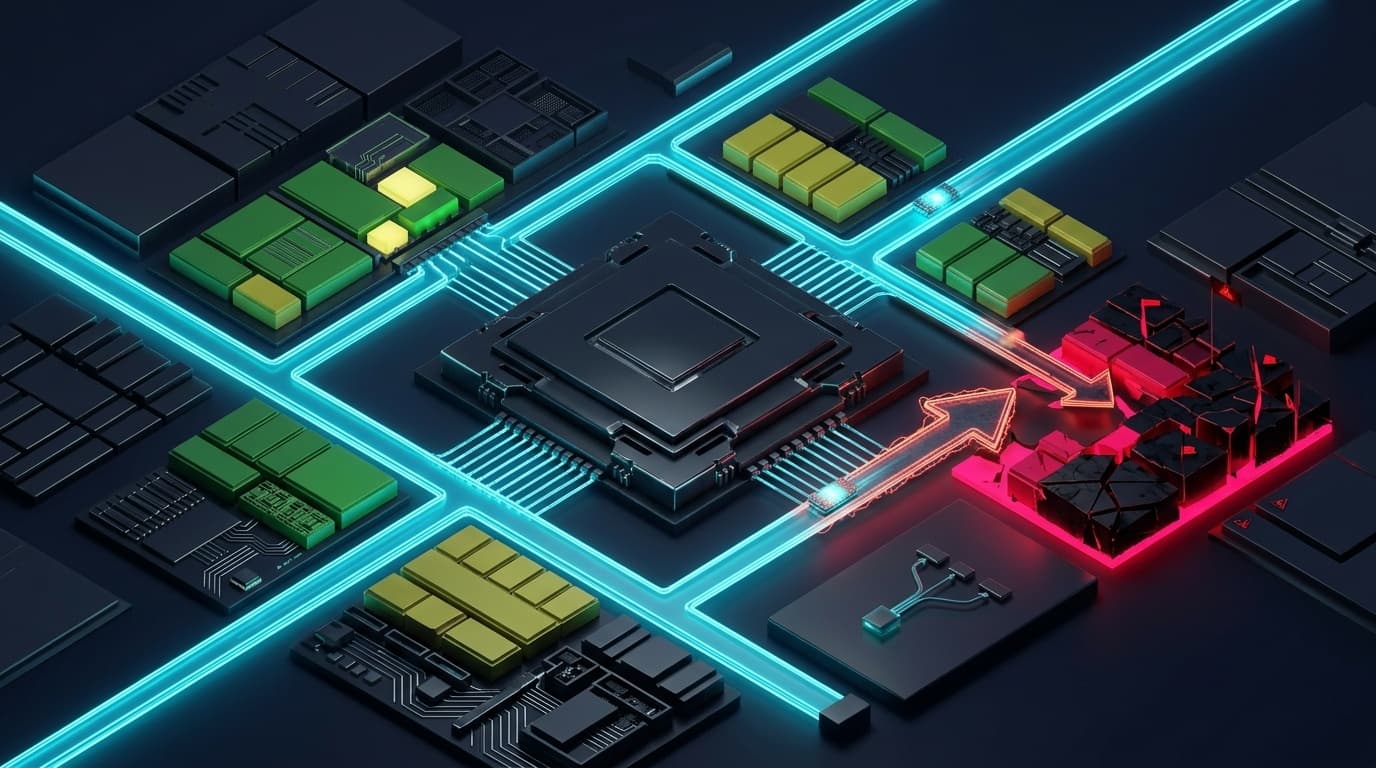
By producing counterfeit or modified semiconductors that mirror the pin configuration, casing dimensions, electrical characteristics, and normal operational responses of genuine secure chips, an adversary could introduce hardware-level trojans. Such implants can remain dormant during standard operational testing, only activating under specific conditions—such as generating deterministic rather than purely random private keys, leaking entropy through side channels, or subtly altering target recipient addresses during transaction signing.
Because the malicious functionality is etched directly into the silicon or masked within genuine-looking integrated circuit packaging, neither external optical examination nor routine board-level continuity testing would reveal the modification. This creates a severe detection deficit for original equipment manufacturers (OEMs), distributors, and end users who rely on outward physical integrity to infer internal hardware security.
The Strategic Push for Verifiable Chips
To address this threat vector, Buterin emphasized the necessity of advancing toward verifiable chips. Rather than relying on closed-source, proprietary secure element manufacturing where third-party inspection is legally or practically impossible, a verifiable hardware ecosystem focuses on provable silicon authenticity and design transparency.
The concept of verifiable chips encompasses multiple engineering principles intended to validate that the physical hardware strictly conforms to its intended logical schematic:
- Transparent Silicon Layouts: Using open-standard hardware instruction set architectures (such as RISC-V) combined with open-source silicon layouts that allow independent structural auditing prior to fabrication.
- Non-Destructive Physical Verification: Developing advanced optical and electron microscopy methodologies, alongside X-ray computed tomography, enabling security researchers to verify chip geometry against reference masks without destroying the operational device.
- Zero-Knowledge Silicon Attestation: Exploring cryptographic proofs embedded at the hardware level, allowing components to mathematically prove their design properties and operational parameters without exposing proprietary microcode or secret keys.
While open-source firmware has become a widely adopted baseline across many modern hardware wallet vendors, the underlying silicon layer remains predominantly proprietary. Securing the device firmware provides limited protection if the underlying hardware co-processor can execute arbitrary machine instructions or modify cryptographic operations at the gate level.
Affected Deployments and Supply Chain Exposure
The operational risks highlighted by Buterin impact a broad spectrum of cryptographic storage architectures. Hardware wallets are ubiquitous across both institutional custody firms managing digital assets and retail self-custody ecosystems. The vulnerabilities associated with opaque component manufacturing extend throughout the hardware deployment lifecycle:
| Deployment Vector | Primary Risk Exposure | Current Verification Deficit |
|---|---|---|
| Retail Hardware Wallets | Supply chain interdiction during transit; unauthorized component swaps at contract manufacturing facilities. | Users rely solely on tamper-evident packaging seals and basic device attestation certificates during initial setup. |
| Institutional Cold Storage | Sophisticated nation-state or insider hardware implants targeted at high-value signing modules. | Audits typically focus on logical ceremony controls and physical vaults rather than destructive silicon inspection. |
| Automated Key Signing Services | Hardware Security Modules (HSMs) deployed in cloud or on-premises validation nodes. | Trust is anchored entirely in vendor proprietary certifications without independent hardware layout verification. |
When hardware components cannot be independently verified, users are forced to extend absolute trust to every link in the manufacturing and distribution chain—including silicon foundries, packaging facilities, logistics handlers, and retail resellers.
Practical Recommendations for Organizations and Custodians
While fully verifiable commercial silicon remains an evolving paradigm, organizations and asset managers handling high-value cryptographic operations must implement defense-in-depth measures to mitigate hardware-layer risks:
- Implement Multi-Vendor Threshold Signing: Do not rely on a single hardware manufacturer or component architecture for critical asset protection. Deploy multi-signature or multi-party computation (MPC) schemes that require sign-offs across disparate devices built on different microcontrollers and secure elements.
- Procure Directly Through Authorized Channels: Avoid third-party resellers or secondary market hardware devices. Ensure procurement comes directly from original manufacturers with verifiable shipment tracking and cryptographic provenance records.
- Leverage Cryptographic Device Attestation: Always execute vendor-provided initialization checks to confirm the integrity of device firmware and onboard certificates, ensuring the device has not been loaded with modified software builds.
- Validate Entropy Independence: Where supported, utilize features that allow the injection of supplementary external randomness (such as user-generated dice rolls) during seed phrase generation to prevent reliance on potentially compromised internal hardware random number generators (RNGs).
- Segregate High-Value Approvals: Enforce strict policy controls, requiring air-gapped verification of transaction details across independent monitoring interfaces prior to authorizing cryptographic signatures on hardware devices.
Known Parameters and Open Questions
The discussion initiated by Buterin underscores theoretical and emerging practical challenges in cryptographic hardware manufacturing, but several critical dimensions remain open:
It remains unconfirmed whether specific commercial hardware wallet models currently in active distribution have been subject to documented in-the-wild component substitution attacks involving lookalike chips. Additionally, the broader semiconductor industry faces significant technical hurdles in achieving economically viable, high-volume manufacturing of verifiable silicon that can match the cryptographic hardening of established proprietary secure elements.
Until standardized silicon verification frameworks and cost-effective auditing tools become commercially available, security teams must treat hardware custody devices as specialized endpoints that require multi-layered physical and cryptographic separation to minimize single-point-of-failure vulnerabilities.