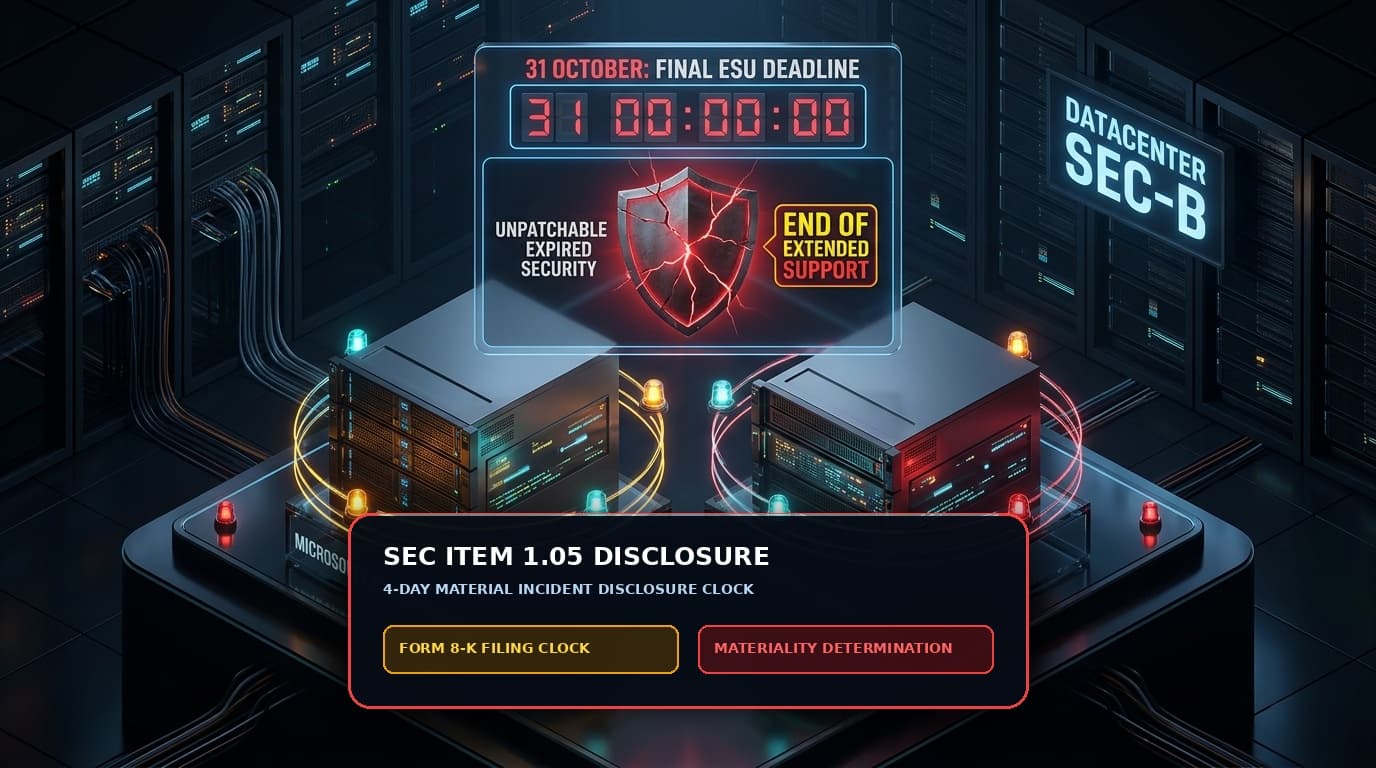
The U.S. Securities and Exchange Commission (SEC) enforcement of Form 8-K Item 1.05 has fundamentally transformed corporate cybersecurity disclosure. Public registrants must file a Form 8-K disclosure within four business days of determining that a cybersecurity incident is material, establishing unprecedented scrutiny over technical root causes, blast radius containment, and executive incident response governance.
Regulatory Framework: The Four-Day Materiality Clock
Unlike historical regulatory frameworks that allowed organizations to delay disclosures until forensic investigations were fully concluded, the SEC standard triggers upon the materiality determination rather than the initial date of incident discovery:
- Determination Without Unreasonable Delay: Registrants cannot intentionally prolong technical investigations to defer the materiality clock. SEC guidance emphasizes that assessment must proceed expeditiously.
- Disclosure Scope: Companies must describe the nature, scope, and timing of the incident, as well as the material impact or reasonably likely material impact on the registrant's financial condition and results of operations.
- Item 8.01 vs. Item 1.05 Distinction: Voluntary disclosures made before a formal materiality determination must be filed under Item 8.01 to prevent investor confusion, reserving Item 1.05 strictly for confirmed material breaches.
Forensic Deep-Dive: Root Causes Across Recent 8-K Disclosures
An empirical review of recent SEC Form 8-K Item 1.05 filings identifies three predominant architectural vectors responsible for triggering material disclosures:
- Edge Network Gateway Compromise: Exploitation of zero-day vulnerabilities in unpatched perimeter appliances (VPNs, firewalls, and load balancers) allowing threat actors to bypass multi-factor authentication and harvest Active Directory Kerberos tickets.
- Cloud Workload & IAM Session Hijacking: Theft of long-lived AWS IAM access keys or OAuth bearer tokens stored in exposed CI/CD pipelines, allowing bulk exfiltration of customer database backups from cloud storage buckets.
- Third-Party SaaS Supply Chain Pivoting: Compromise of managed service providers (MSPs) or outsourced IT support platforms, providing adversaries with trusted lateral pathways into corporate networks.
Materiality Evaluation Matrix for Corporate Security Leaders
| Evaluation Dimension | Materiality Indicators (Form 8-K Required) | Non-Material Indicators (Internal Resolution) |
|---|---|---|
| Financial Impact | Direct remediation costs, extortion demands, or revenue loss exceeding materiality thresholds (>1-2% of net income). | Contained expenses fully absorbed within existing operational cybersecurity budgets. |
| Operational Disruption | Prolonged shutdown of manufacturing, logistics, or trading platforms exceeding 48 hours. | Transient workstation disruptions successfully isolated via network segmentation. |
| Data Exfiltration Scope | Theft of proprietary core IP, source code, or regulated PII/ePHI impacting >100,000 individuals. | Insignificant volume of non-confidential, public marketing collateral accessed. |
| Regulatory & Legal Exposure | High probability of formal FTC, SEC, or GDPR enforcement proceedings and class-action litigation. | Standard regulatory notification without severe statutory penalty exposure. |
Defensive Action Checklist & Compliance Architecture
To ensure regulatory compliance and operational resilience, CISOs and corporate leadership must implement the following structural controls:
- Formalize the Cyber Materiality Committee (CMC): Establish a multidisciplinary committee comprising the CISO, Chief Legal Officer (CLO), Chief Financial Officer (CFO), and Head of IR that meets within 24 hours of any P1 incident.
- Immutable Cloud Forensic Logging: Enforce multi-region, write-once-read-many (WORM) storage for cloud audit trails (AWS CloudTrail, Azure Monitor, Google Cloud Logging) to ensure tamper-proof evidence preservation during regulatory inquiries.
- Strict Privilege Delegation: Eliminate long-lived access keys across cloud infrastructures, mandating short-lived OIDC workload identity federation and hardware-backed FIDO2 multi-factor authentication for all administrative personnel.
Step-by-Step Incident Telemetry & Materiality Audit Commands
Corporate legal and security teams must preserve forensic audit logs and verify disclosure readiness:
# AWS S3: Verify immutable Object Lock on regulatory audit log bucket
aws s3api get-object-lock-configuration --bucket sec-materiality-audit-logs

# Query Active Directory for administrative password changes during incident window
Get-ADUser -Filter * -Properties PasswordLastSet |
  Where-Object { $_.PasswordLastSet -gt (Get-Date).AddDays(-4) } |
  Select-Object SamAccountName, PasswordLastSet