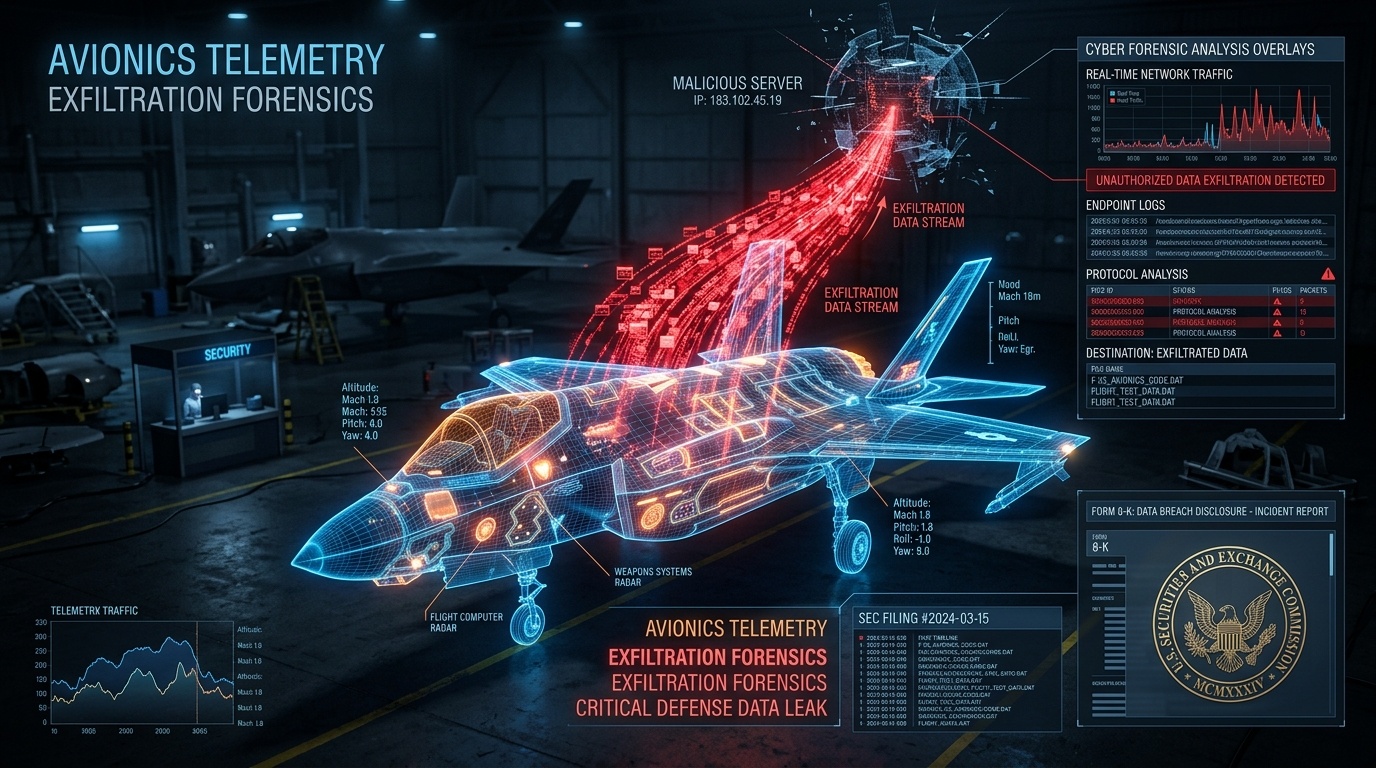
Regulatory Disclosure Overview
A premier publicly traded defense aerospace contractor and prime supplier of military satellite communications hardware has submitted an Item 1.05 Form 8-K filing to the U.S. Securities and Exchange Commission (SEC), disclosing that it has determined an unauthorized digital network infiltration to be a material cybersecurity incident.
According to the regulatory disclosure, advanced persistent threat (APT) actors breached engineering networks supporting the development, calibration, and cryptographic keying of next-generation Satellite Telemetry, Tracking, and Command (TT&C) ground stations utilized by defense and allied coalition armed forces.
Forensic Intrusion Reconstruction & Kill Chain
Specialists from the Defense Counterintelligence and Security Agency (DCSA) and third-party incident response firms reconstructed the intrusion campaign across a 45-day dwell period:
| Intrusion Phase | Adversary TTP & Technique | Forensic Artifact Recovered |
|---|---|---|
| Perimeter Breach | Exploitation of zero-day path traversal flaw in perimeter enterprise edge VPN appliance (T1190) | Anomalous web server child process spawning reverse shell |
| Credential Harvesting | Dumping LSASS memory on engineering domain controllers (T1003.001) | Stolen Kerberos Golden Tickets utilizing krbtgt account hash |
| Lateral Movement | Pivot into air-gapped ground station software build pipeline via compromised jump box (T1563) | RDP connections bypassing dual-factor gateway via token reuse |
| Exfiltration | Compression and exfiltration of modem DSP firmware and cryptographic interface specifications (T1041) | Encrypted multi-part RAR archives egressed to compromised domestic VPS |
| SEC Item 1.05 Filing | Containment confirmed, enterprise-wide credential rebuild, public regulatory filing | SEC EDGAR regulatory submission |
Blast Radius: Tactical Ground Software vs. Orbital Fleet Integrity
The contractor clarified that active military satellite constellations currently in orbit remain fully operational and under secure government control, as flight vehicle command links operate on dedicated NSA Type-1 cryptographic hardware encryption units (e.g., KGV-72 and KI-103) with one-time operational keying material physically loaded outside contractor enterprise systems.
However, the exfiltrated engineering datasets included highly sensitive technical blueprints:
- Digital Signal Processing (DSP) Modem Algorithms: Source code for anti-jamming waveform generation and frequency-hopping algorithms utilized in tactical SATCOM modems.
- TT&C Software Communication Stacks: Ground station controller interface code governing antenna dish azimuth/elevation tracking and telemetry decommutation.
- Pre-Production Cryptographic Interface Blueprints: Software development kit (SDK) documentation defining API boundaries for key loading and zeroization routines.
Defense Industrial Base (DIB) Cybersecurity Playbook
Defense industrial contractors must enforce the following NIST SP 800-171 / CMMC Level 2 cybersecurity standards to protect critical aerospace engineering assets:
- Phishing-Resistant FIDO2 Authentication: Enforce strict WebAuthn hardware tokens for all external access, administrative interfaces, and code repository commits.
- Air-Gap Software Build Pipelines: Disconnect critical aerospace software compilation and testing pipelines entirely from enterprise IP networks, utilizing hardware data diodes and signed immutable artifacts.
- Micro-Segmented Enclave Architecture: Ensure classified and export-controlled (ITAR) program data repositories reside within isolated security enclaves governed by strict zero-trust network access (ZTNA) policies.