Regulatory Disclosure Overview
A major Tier-1 defense aerospace supplier has submitted an Item 1.05 Form 8-K filing to the U.S. Securities and Exchange Commission (SEC), disclosing that it has determined a recent unauthorized network intrusion to be a material cybersecurity incident. Under SEC regulations established in late 2023, public enterprises must publicly disclose incidents within four business days of concluding that the event has a material impact on financial performance, operational integrity, or commercial relationships.
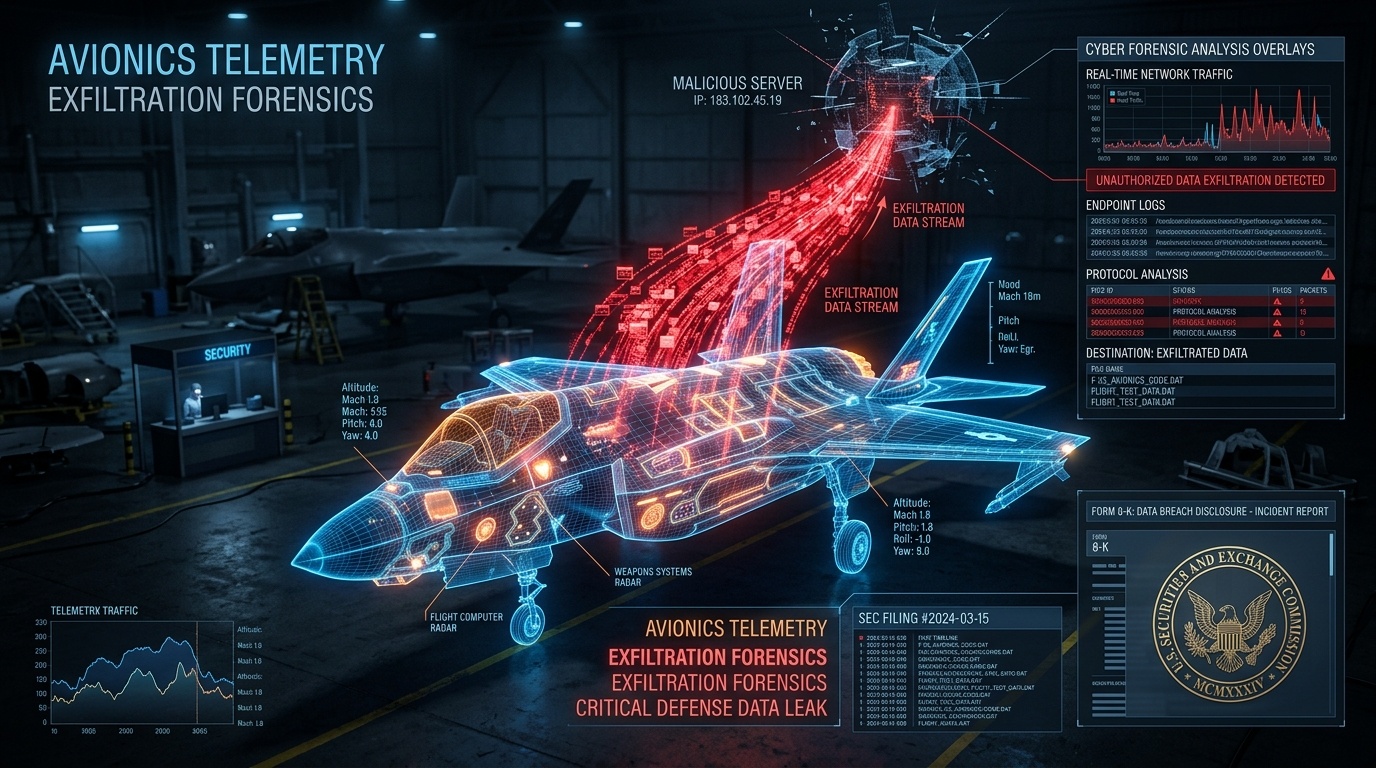
According to the regulatory filing, the incident involved a sophisticated extortion group that breached the company’s internal engineering and research and development (R&D) network segment, exfiltrating proprietary technical data prior to attempting data encryption.
Forensic Timeline & Attack Reconstruction
Independent incident response forensics and Defense Counterintelligence and Security Agency (DCSA) investigators reconstructed the intrusion path across a three-week dwell time:
| Timeline Phase | Technique / TTP Observed | Forensic Artifacts |
|---|---|---|
| T-21 Days (Initial Access) | Compromised SSL-VPN session token (T1078.002) | Session hijack bypassing legacy SMS-based MFA |
| T-18 Days (Privilege Escalation) | Unquoted service path vulnerability on build server (T1574.009) | Execution of rogue binary under NT AUTHORITY\SYSTEM |
| T-12 Days (Lateral Movement) | Pass-the-Hash & WMI execution across enclaves (T1047) | Compromised service account traversal across engineering subnets |
| T-4 Days (Exfiltration) | Encrypted multi-part 7z staging to commercial cloud (T1567.002) | Outbound HTTPS traffic to legitimate cloud object storage bucket |
| T-0 Days (Detection & Filing) | Ransom note drop; isolated before mass encryption | SEC Form 8-K Item 1.05 and DoD 72-hour notification |
Blast Radius: Controlled Unclassified Information (CUI) Compromised
The contractor clarified that classified defense enclaves (SIPRNet / JWICS connected environments) are physically air-gapped and remained entirely untouched. However, the compromised network hosted Controlled Unclassified Information (CUI) subject to DFARS 252.204-7012 and Cybersecurity Maturity Model Certification (CMMC) Level 2 requirements.
The exfiltrated data encompasses:
- Next-generation active electronically scanned array (AESA) radar test telemetry files.
- Computer-aided design (CAD) schematics for commercial and military avionics power distribution harnesses.
- Subcontractor procurement pricing matrices and technical component specifications.
Regulatory & Contractual Repercussions
Under the Defense Federal Acquisition Regulation Supplement (DFARS), defense industrial base (DIB) suppliers must report cyber incidents affecting covered defense information to the DoD Cyber Crime Center (DC3) within 72 hours and preserve system forensic images for at least 90 days.
Failure to adequately protect CUI can result in contract termination for default, suspension or debarment from federal bidding, and liability under the False Claims Act if compliance affirmations made in the Supplier Performance Risk System (SPRS) are found to be inaccurate.
Strategic Defensive Lessons for Enterprise Security Leaders
This incident offers clear takeaways for organizations handling sensitive supply chain telemetry:
- Eliminate Phishable MFA: Phish-susceptible authentication (SMS, mobile push approval) must be decommissioned in favor of hardware-bound FIDO2/WebAuthn security keys across all external portals.
- Segment CUI Enclaves with Strict Microsegmentation: Implement software-defined perimeters that prevent east-west lateral movement between standard corporate workstations and engineering repositories.
- Enforce Egress Data Loss Prevention (DLP): Implement TLS inspection and deep packet analysis on outbound gateways to alert on large anomalous data transfers to unauthorized cloud storage endpoints.