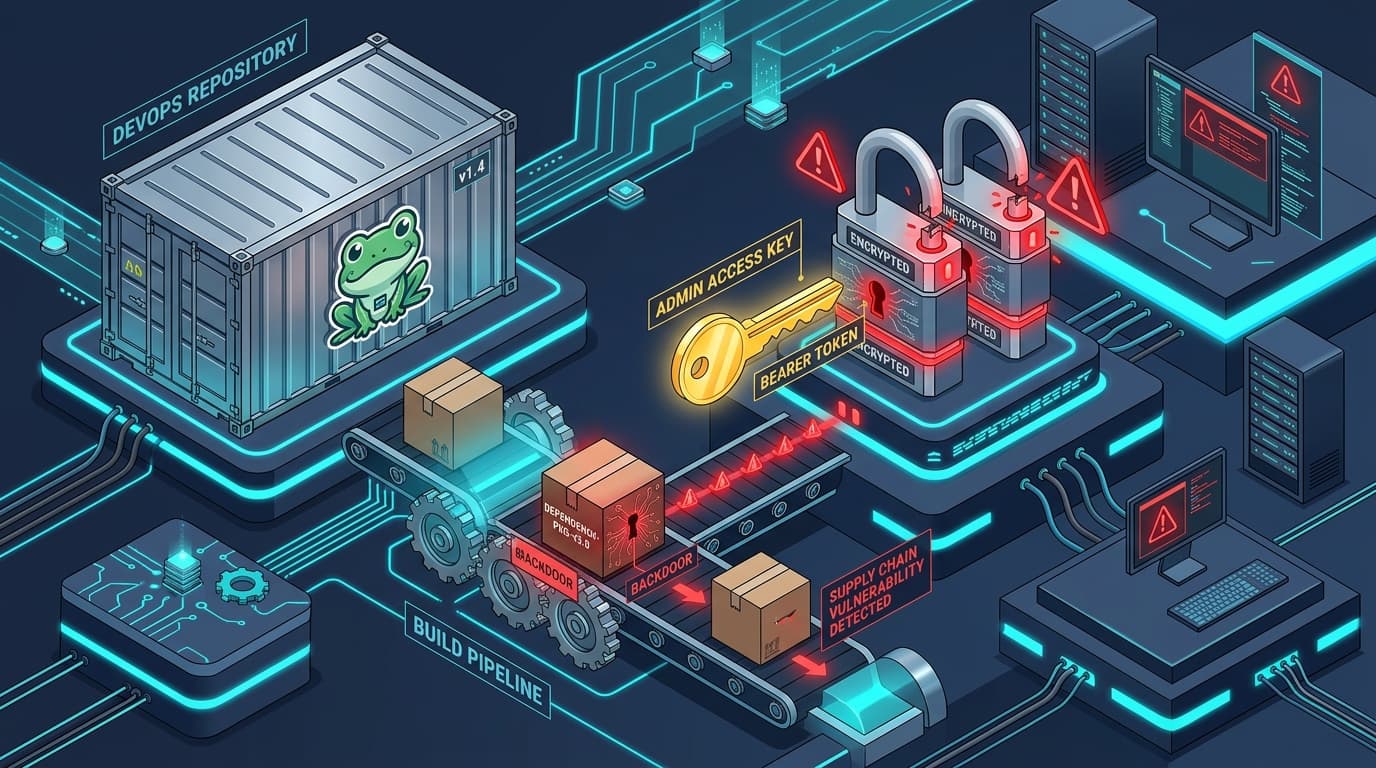
Cloud security researchers at Wiz have uncovered active in-the-wild exploitation of two vulnerabilities in JFrog Artifactory, the central artifact repository utilized by thousands of enterprises to manage software packages, container images, and CI/CD build assets. When chained together, the two flaws allow an unauthenticated attacker to elevate from zero access to complete administrative control over the artifact management cluster.
The observed intrusions targeted unpatched, internet-accessible self-hosted instances between August 15 and September 8, 2026. Attackers leveraged administrative permissions to overwrite legitimate build artifacts, plant persistent web shells, and modify continuous deployment pipelines.
How the Exploit Chain Works
Neither vulnerability provides full system compromise on its own. The power of the attack lies in the seamless chaining of two subtle authentication and authorization logic defects:
- CVE-2026-42018 (Token Generation Bypass): Under normal configurations, unauthenticated users cannot request internal authentication tokens. Due to an API routing flaw, Artifactory's authentication service would return an internal anonymous-user bearer token to an unauthenticated caller — even on instances where anonymous access had been explicitly disabled in settings.
- CVE-2026-42016 (Token Exchange Privilege Escalation): Artifactory supports a token-exchange endpoint intended to swap short-lived tokens for scoped session credentials. While the validation logic verified that the inbound token was cryptographically signed by Artifactory itself, it failed to verify whether the requester had authority to grant the requested scope. Attackers simply requested an exchange of their anonymous token for a full
admintoken, which the server willingly minted.
An attacker needs only two HTTP POST requests to turn an anonymous internet connection into a root API token on an enterprise software distribution server.
Supply Chain Blast Radius
JFrog Artifactory holds the "crown jewels" of modern software engineering operations. Gaining administrative dominion over an Artifactory instance allows attackers to:
- Poison Internal Dependencies: Replace internal npm, PyPI, Maven, or Docker packages with trojanised counterparts that automatically propagate to developer workstations and production Kubernetes clusters.
- Extract Proprietary Source Binaries: Download proprietary compiled software, firmware images, and intellectual property.
- Harvest Build Secrets: Steal CI/CD credentials, signing certificates, and cloud access keys cached within repository configurations.
Required Defender Actions
JFrog released security updates addressing both flaws; however, widespread legacy deployments remain unpatched. Security engineering teams should verify their posture against the following checklist:
- Verify Version Baseline: Confirm all self-hosted Artifactory servers are running patched versions where token-exchange validation is enforced.
- Audit Access Token Logs: Inspect access logs for calls to
/artifactory/api/security/tokenresulting in token creation with administrative scopes originating from unrecognized external IP addresses. - Check Package Integrity: Review checksums of recently published internal packages against commit signatures produced by your trusted CI/CD builders.
- Network Perimeter Controls: Disallow direct public ingress to Artifactory web and API interfaces; route all administrative and build-runner traffic through secure internal gateways.