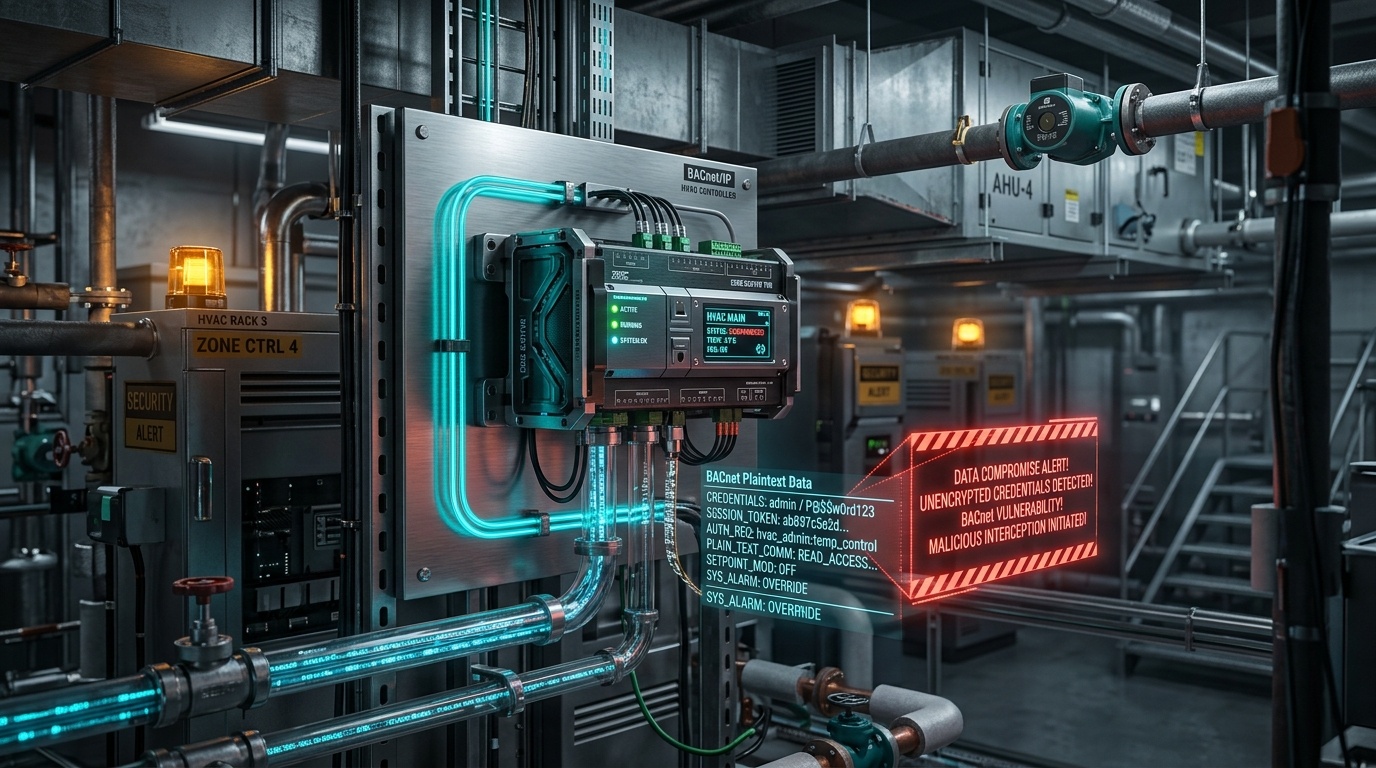
Executive Summary
Honeywell Building Solutions and CISA have issued urgent industrial cybersecurity advisories detailing a critical vulnerability affecting Trend Controls IQ4 building management controllers. Tracked as CVE-2026-52873, the vulnerability carries a CVSS v3.1 base score of 9.8 (Critical) and exposes building automation systems (BAS) to remote code execution and persistent hardware takeover.
Trend Controls IQ4 controllers are deployed worldwide to automate heating, ventilation, and air conditioning (HVAC) systems in sensitive commercial environments, including semiconductor fabrication cleanrooms, hyperscale cloud data centers, hospital surgical suites, and corporate headquarters. Exploitation of the flaw enables remote network adversaries to flash arbitrary modified firmware without providing valid cryptographic signatures.
Root Cause: Missing Cryptographic Signature Verification
The flaw resides in the proprietary firmware update routine exposed over Ethernet and BACnet/IP ports (specifically UDP 47808 and TCP 10008). In affected firmware versions, the device bootloader validates firmware image integrity using an insecure 32-bit cyclic redundancy check (CRC32) checksum rather than enforcing asymmetric public key cryptographic verification (such as RSA-3072 or ECDSA).
Because CRC32 checksums can be forged trivially, an attacker capable of transmitting network packets to the controller's management interface can compile an arbitrary binary image, calculate the matching CRC32 header, and trigger a remote firmware update command. Upon reboot, the controller executes the attacker's payload directly from Flash EEPROM, granting permanent root-level control over all digital I/O channels.
Firmware Flashing Breakdown:
[Attacker] ---> Sends BACnet/IP Re-Initialize Device Request (UDP 47808)
[Attacker] ---> Transmits Unsigned Firmware Chunk with forged CRC32 Header
[Bootloader] ---> Verifies CRC32 (Valid) -> Overwrites Flash Memory at 0x08000000
[Reboot] ---> Controller runs malicious firmware; physical cooling loops disrupted
Operational Impact on Critical Infrastructure
Building automation systems are increasingly converged with enterprise IP networks. A persistent root compromise of an IQ4 controller allows attackers to:
- Disable server room cooling chillers to cause thermal shutdowns in hyperscale data centers.
- Tamper with negative pressure ventilation in medical isolation units and pharmaceutical laboratories.
- Establish a stealthy, persistent physical jump-host on the OT network that survives standard IT vulnerability scans and server re-imaging.
Mitigation Strategies & Patch Deployment
Honeywell has released updated firmware build v4.12, which introduces hardware-backed secure boot verification and mandates cryptographic image signing. Industrial asset owners should immediately implement the following defense protocols:
- Flash Firmware v4.12: Update all affected IQ41x, IQ42x, and IQ4E controllers using the official Trend Controls SET engineering suite.
- Isolate BACnet and Ethernet Protocols: Block UDP port 47808 and TCP port 10008 at all perimeter firewalls. Building automation devices must never be accessible from the public internet or general enterprise subnets.
- Implement OT Network Monitoring: Deploy industrial network intrusion detection systems (IDS) to monitor BACnet traffic for anomalous device re-initialization commands.