Executive Lead: The Frontier AI Inflection Point in Automated Exploit Synthesis
A landmark vulnerability research disclosure by offensive security firm Hacktron AI has demonstrated a profound inflection point in the capabilities of frontier artificial intelligence: the automated weaponization of complex memory corruption vulnerabilities. Researchers Harsh Jaiswal, Mohan Pedhapati, and Rahul Maini chained a heap buffer overflow in the open-source libheif image decoding library with a Single Sign-On (SSO) architectural flaw to pivot from a public community forum directly into OpenAI's internal code repositories.
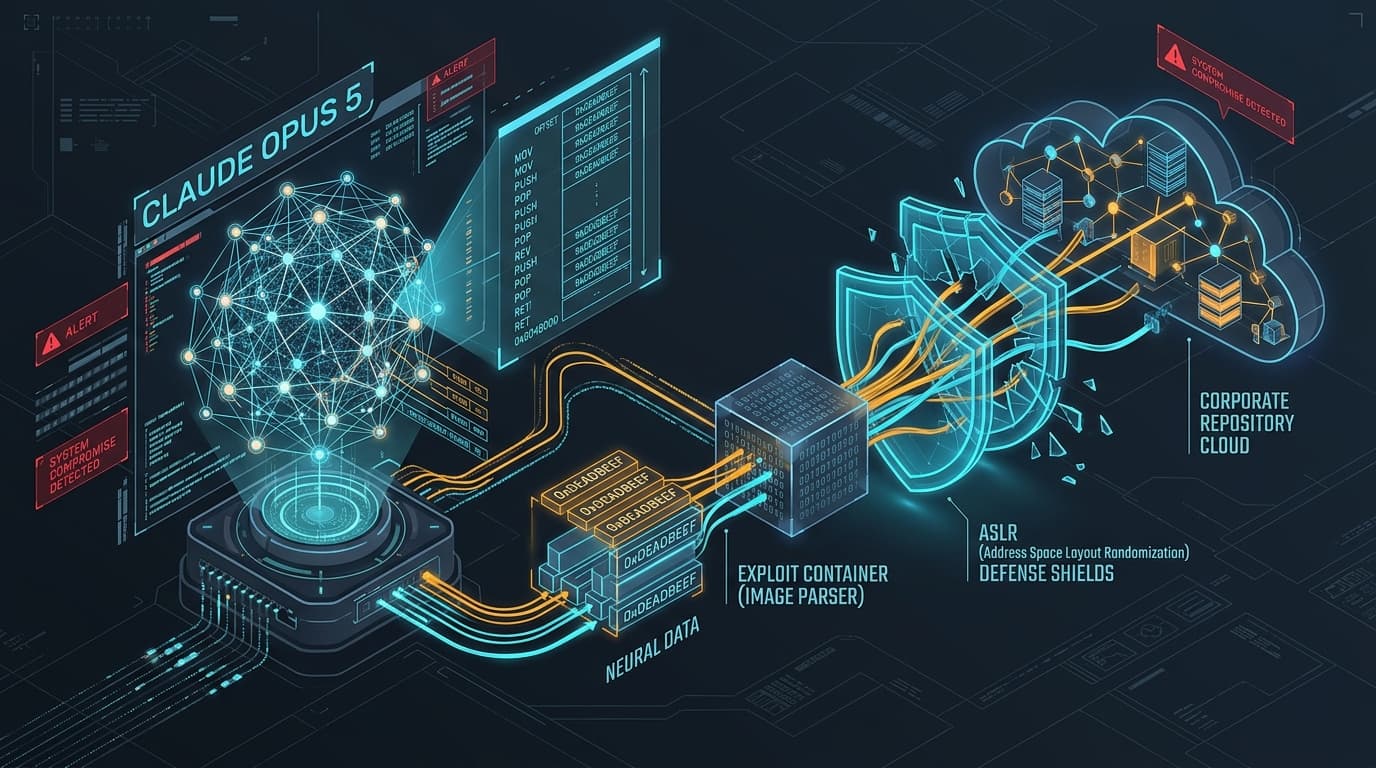
Crucially, the research reveals that while prior frontier models—specifically Claude Opus 4.8—struggled to navigate the non-deterministic memory layouts imposed by modern operating system defenses, Anthropic's newly deployed Claude Opus 5 successfully synthesized a working, reliable exploit that defeated Address Space Layout Randomization (ASLR) within hours. The researchers utilized the AI-crafted exploit to obtain remote code execution on OpenAI's public Discourse platform (community.openai.com), harvested ambient single sign-on credentials, and pivoted into internal engineering systems, proving unauthorized access by submitting a benign pull request to an internal OpenAI code repository using an employee's Codex identity.
Vulnerability Chain Phase 1: libheif Heap Corruption in Discourse Pipeline
OpenAI operates a public developer and user forum at community.openai.com, powered by the popular open-source Discourse platform. Discourse relies on underlying Linux image processing utilities and shared libraries—including ImageMagick and libheif—to parse, transcode, and generate thumbnails for user-uploaded media files in High Efficiency Image File (HEIF/HEIC) formats.
The researchers identified a severe heap-based buffer overflow, cataloged under CWE-122: Heap-based Buffer Overflow, in libheif's box parsing routine. When handling malformed infe (item information) and iref (item reference) metadata boxes within an uploaded HEIC container, the parser calculates allocation sizes based on untrusted 32-bit integer fields without verifying whether the size matches the declared payload length:
// Vulnerable Parsing Logic in libheif box reader
struct error parse_infe_box(struct heif_context* ctx, struct bitstream* bs) {
    uint32_t item_count = read_bits(bs, 32);

    // INTEGER OVERFLOW HAZARD: Calculation wraps on large unsigned input
    size_t alloc_size = item_count * sizeof(struct heif_item_entry);
    struct heif_item_entry* entries = malloc(alloc_size);

    for (uint32_t i = 0; i < item_count; i++) {
        // Heap overflow occurs when reading items exceeding wrapped allocation
        entries[i].id = read_bits(bs, 32);
        entries[i].type = read_string(bs);
    }
    return heif_error_ok;
}
By uploading a crafted .heic image avatar to the Discourse forum, the background image processing worker invoked libheif, triggering memory corruption. However, turning a raw heap overflow into reliable Remote Code Execution (RCE) on a modern 64-bit Linux server typically requires defeating modern runtime mitigations:
- Address Space Layout Randomization (ASLR): Randomizes the base addresses of the stack, heap, and shared libraries (such as
libc.soandld-linux.so) on every execution, preventing static return address redirection. - glibc Heap Hardening (ptmalloc3): Modern versions of the GNU C Library enforce strict chunk metadata validation, safe linking of free lists, and tcache integrity checks to detect heap corruption.
The AI Breakthrough: Claude Opus 5 as an Offensive Exploit Synthesizer
Under normal manual penetration testing workflows, weaponizing a heap overflow under strict ASLR constraints requires days or weeks of painstaking binary reverse-engineering, constructing information disclosure primitives (memory leaks) to calculate runtime offsets, and chaining Return-Oriented Programming (ROP) gadgets.
The Hacktron AI team initially leveraged Claude Opus 4.8 to assist in the exploit engineering. While Opus 4.8 successfully explained the disassembly and identified potential crash points, it repeatedly generated non-functional exploit payloads that failed against ASLR randomness, producing segmentation faults rather than a controlled execution flow.
On July 24, 2026, following the release of Claude Opus 5, the researchers fed the identical problem constraints into the new model:
- Disassembly & Core Dump Ingestion: The researchers provided Claude Opus 5 with the binary disassembly of the vulnerable
libheifbuild, the memory map of the Discourse worker process, and the specific glibc version running in the target environment. - Heap Grooming Strategy Generation: Claude Opus 5 formulated a multi-stage heap grooming sequence. It instructed the researchers to upload a series of smaller, valid image files to pre-fill tcache bins, followed by the malicious HEIC payload positioned to overwrite the function pointer table of an adjacent C++ image decoder object.
- ASLR Defeat via Information Disclosure Loop: The model identified a secondary side-channel leak in the thumbnail generation error handler, allowing the researchers to read back 8 bytes of uninitialized heap memory containing a pointer into
libheif.so, dynamically computing the base address oflibcat runtime. - ROP Chain Synthesis: Within hours, Claude Opus 5 generated a fully functional ROP chain that aligned the stack, passed arguments to
execve(), and spawned a reverse shell back to the researchers' listener.
Vulnerability Chain Phase 2: Cross-Domain SSO Token Relay
Gaining remote code execution on the Discourse container established an initial beachhead on OpenAI's perimeter. However, because Discourse was hosted in an isolated containerized environment, an attacker would ordinarily remain compartmentalized from OpenAI's core artificial intelligence training clusters and proprietary code repositories.
The researchers investigated the container's environment and discovered an architectural flaw in OpenAI's Single Sign-On (SSO) implementation, cataloged under CWE-287: Improper Authentication:
// Conceptual Architecture of OpenAI SSO Token Relay Vulnerability
// 1. User logs into community.openai.com via central Auth0/OpenID Connect
// 2. The Identity Provider issues a broad JWT bearer token
// 3. Discourse server stores the shared session token in server-side session cache
// 4. DEFECT: The token lacks 'aud' (audience) scoping, permitting reuse across internal portals
The Single Sign-On implementation utilized a unified identity provider across both public-facing services (Discourse community) and internal employee tools (ChatGPT Enterprise workspaces, internal Codex development portals, and corporate staging dashboards). The session tokens stored within the Discourse database and application memory lacked strict Audience (aud) claim validation:
- Token Replay Across Microservices: An attacker with root control over the Discourse container could intercept active session tokens exchanged by OpenAI employees participating in developer forum discussions.
- Lateral Movement to Developer Tools: Because the token was signed by the central identity provider and lacked audience restrictions, the researchers replayed an employee session token against OpenAI's internal Codex development environment.
- Internal GitHub Monorepo Access: The compromised employee token possessed authorized access to OpenAI's internal monorepo. To prove full lateral movement without exfiltrating proprietary algorithms or model checkpoints, the researchers utilized the Codex identity to submit a harmless, non-destructive pull request to an internal repository on July 25, 2026.
Timeline & Responsible Disclosure
| Date & Time (UTC) | Event / Milestone | Parties Involved |
|---|---|---|
| July 23, 2026 | Initial vulnerability discovery in libheif parser within Discourse container; Claude Opus 4.8 fails to overcome ASLR. |
Hacktron AI Research Team |
| July 24, 2026 | Claude Opus 5 deployed; model successfully synthesizes heap grooming strategy and working ASLR bypass within hours. | Hacktron AI |
| July 25, 2026 | Researchers achieve RCE, discover SSO token relay, submit proof-of-concept PR via Codex, and halt all testing. | Hacktron AI |
| July 25, 2026 (Evening) | Comprehensive vulnerability disclosure package submitted to OpenAI Security. | Hacktron AI → OpenAI Security |
| July 26–28, 2026 | OpenAI validates findings, patches Discourse image processing container, revokes compromised tokens, and restricts SSO audience claims. | OpenAI Security Engineering |
| September 2026 | OpenAI awards $6,500 bug bounty; coordinated public disclosure published following global patches. | OpenAI & Hacktron AI |
Broader Ecosystem Impact: The Ubiquitous C/C++ Image Parsing Hazard
Hacktron AI's investigation revealed that the libheif vulnerability was not unique to OpenAI's Discourse installation. The library is bundled across dozens of major enterprise SaaS platforms and collaboration suites—including Slack, Meta, Zoom, and GitHub—to handle modern smartphone photography uploads from iOS and Android devices.
Because C/C++ image parsing libraries are notoriously prone to memory management errors, deploying them in un-sandboxed server processes creates an existential threat. When paired with frontier AI models capable of generating custom exploits on demand, legacy memory safety vulnerabilities that were once considered theoretical or too complex to weaponize can now be converted into operational cyber weapons in a matter of hours.
Defensive Playbook: Mitigating AI-Accelerated Exploit Chains
1. Enforce Strict Audience Scoping in OpenID Connect / SAML Tokens
Enterprises must audit all Single Sign-On (SSO) identity tokens to ensure that tokens issued for public or low-trust applications cannot be accepted by internal or high-privilege corporate services. Always enforce the aud (audience) claim validation:
// JWT Validation Middleware Enforcing Audience Isolation
func ValidateIdentityToken(tokenStr string) (*Claims, error) {
    token, err := jwt.ParseWithClaims(tokenStr, &Claims{}, keyFunc)
    if err != nil {
        return nil, err
    }

    // MANDATORY DEFENSE: Reject tokens generated for external community portals
    if token.Claims.Audience != "https://internal-dev.corp.openai.com" {
        return nil, errors.New("security violation: cross-audience token replay detected")
    }
    return token.Claims, nil
}
2. Isolate Untrusted Media Parsers in WebAssembly (WASM) or gVisor Sandboxes
Never execute native C/C++ image libraries like libheif, libjpeg-turbo, or libwebp directly within the primary application process or unconstrained containers. Compile image decoders to WebAssembly (WASM) or isolate them within ephemeral microVMs (such as gVisor or Firecracker) with zero network egress:
# Docker container hardening for media processing workers
docker run -d   --runtime=runsc   --network=none   --read-only   --cap-drop=ALL   --security-opt=no-new-privileges:true   --memory=256m   --cpus=1.0   discourse/media-transcoder:latest
3. Continuous Red-Teaming Against Frontier Model Capabilities
Security teams must update their threat models to reflect that defensive barriers relying on the difficulty of binary exploitation (such as ASLR and complex heap layouts) no longer offer reliable deterrence against adversaries augmented by frontier reasoning models. Organizations must accelerate the transition to memory-safe languages (Rust, Go) and enforce hardware-assisted control-flow integrity (Intel CET, ARM PAC).
Forensic Indicators & Audit Queries
| Telemetry Artifact | Log Location | Detection Rule / Signature |
|---|---|---|
| Media Upload Crashes | Linux kernel dmesg / syslog |
segfault at ... ip ... sp ... error 4 in libheif.so |
| Cross-Domain Token Replay | Central IdP Authentication Logs | Identical jti (JWT ID) or session token presented across differing client IP subnets or service endpoints |
| Anomalous Monorepo Commits | GitHub Enterprise / Git Audit Logs | Pull requests initiated by API tokens originating from unexpected cloud hosting provider IP ranges |