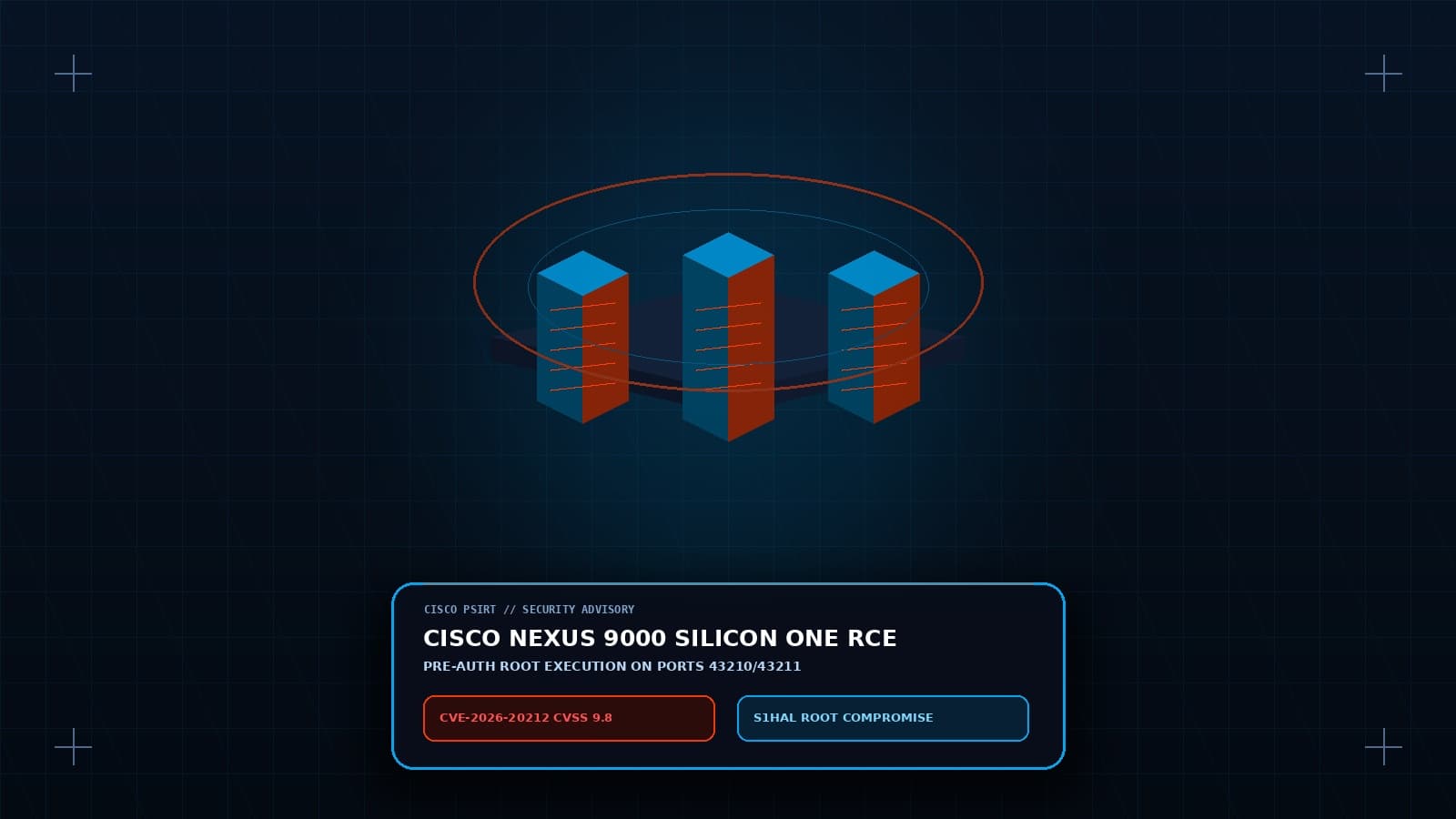
Cisco has published a critical security advisory addressing CVE-2026-20212 (CVSS 9.8), an unauthenticated remote code execution vulnerability impacting enterprise datacenter switches in the Cisco Nexus 9000 Series equipped with Cisco Silicon One hardware architecture.
The flaw allows an unauthenticated network adversary who can transmit traffic to an affected device on specific TCP ports to execute arbitrary code with root operating system privileges, or to force a crash of the Silicon One Hardware Abstraction Layer (S1HAL) process, triggering a reload of the entire switch fabric.
Root Cause: Unrestricted Socket Binding on Default VRFs
The vulnerability stems from an incorrect socket binding implementation within internal hardware diagnostic daemons. During switch initialization, the S1HAL service establishes internal inter-process communication (IPC) listeners on TCP ports 43210 and 43211. Due to an architectural omission, these sockets bind to all active interfaces across the default Layer 3 Virtual Routing and Forwarding (VRF) instance rather than being isolated strictly to internal IPC namespaces.
Any incoming TCP connection directed to either port is accepted by the daemon without authentication. By submitting crafted binary payloads, an attacker can trigger memory corruption within the S1HAL process, resulting in unconstrained root shell execution on the underlying Linux host environment of the switch.
Affected Nexus 9000 Switch Models
| Platform Series | Affected Models | Vulnerability State | Recommended Software |
|---|---|---|---|
| Nexus 9000 (Silicon One) | N9K-C9332D-GX2B, N9K-C9348D-GX2A, N9K-C9364D-GX2A | Vulnerable on default VRF ports 43210/43211 | Cisco NX-OS Maintenance Release |
| Nexus 9000 Modular | N9K-X9716D-GX Line Cards | Vulnerable on fabric management interfaces | Apply In-Service Software Upgrade (ISSU) |
Immediate Defensive Workaround
Organizations unable to reboot core switching infrastructure immediately can mitigate exposure by deploying an ingress Control Plane Policing (CoPP) policy or interface Access Control List (ACL) that denies inbound TCP traffic to ports 43210 and 43211 across all routed interfaces and management VRFs.