Executive Summary: Unauthenticated Privilege Escalation in Hybrid Cloud
The Microsoft Security Response Center (MSRC) has issued a critical security disclosure detailing CVE-2026-69399, a maximum-severity vulnerability in Microsoft Azure Arc carrying a base Common Vulnerability Scoring System (CVSS v3.1) score of 10.0 (Critical). The vector string confirms the catastrophic exposure: CVSS:3.1/AV:N/AC:L/PR:N/UI:N/S:C/C:H/I:H/A:H, indicating zero authentication required, low attack complexity, zero user interaction, scope change across security boundaries, and total loss of confidentiality, integrity, and availability.
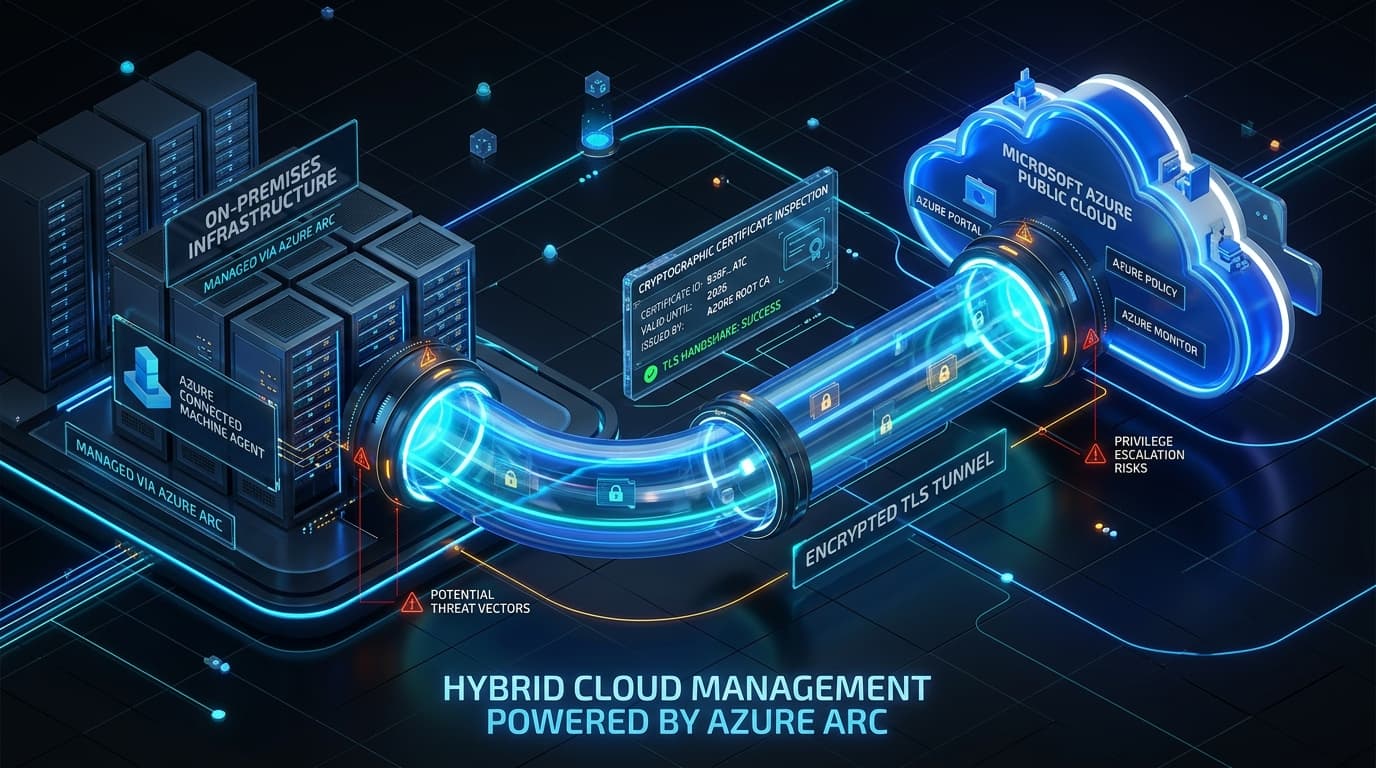
Azure Arc serves as the central operational fabric uniting multicloud, on-premises datacenters, and edge computing environments under Azure Resource Manager (ARM). Through Azure Arc, enterprise security and infrastructure teams manage tens of thousands of hybrid Linux and Windows servers, edge Kubernetes clusters, and containerized Azure application services from a unified management plane. Because Azure Arc bridges public cloud tenancy with internal private networks, the emergence of an unauthenticated confused deputy condition enables remote adversaries to breach cloud tenant boundaries and seize root/administrative authority over private on-premises infrastructure.
Vulnerability Mechanics & Confused Deputy Architecture (CWE-441)
CVE-2026-69399 is rooted in CWE-441: Unintended Proxy or Intermediary (Confused Deputy). To facilitate hybrid governance, Azure Arc deploys the Connected Machine Agent (specifically the Guest Configuration service and the Hybrid Instance Metadata Service) to on-premises host nodes. These agents maintain persistent outbound TLS connections to Azure Arc endpoints in the cloud, polling for configuration manifests, policy evaluations, and remote command dispatches.
When a request is initiated through the Azure Resource Manager gateway to execute administrative operations on a hybrid connected resource, the Azure Arc Resource Provider acts as a broker. The flaw occurs within the request routing filter of the Arc relay dispatcher:
- Missing Provenance Verification: The relay proxy accepted inbound REST invocations without enforcing cryptographic identity attestation of the originating security principal.
- Header Spoofing & Identity Smuggling: Threat actors crafting HTTP/2 frames with custom
X-MS-AzureArc-Proxy-Contextand forged client authorization claims could deceive the upstream routing broker into treating the unauthenticated payload as a trusted control plane dispatch. - Privilege Escalation on the Host: The Azure Connected Machine Agent receives the command payload via its legitimate secure channel, validates the proxy broker's digital signature (which matches), and executes the embedded payload with
NT AUTHORITY\SYSTEM(Windows) orroot(Linux) credentials.
Affected Environments & Blast Radius Assessment
| Component | Vulnerable Configurations | Fixed Version / Remediation Status | Exploit Impact |
|---|---|---|---|
| Azure Arc Control Plane | Global ARM Hybrid Resource Providers | Mitigated automatically by Microsoft cloud-side update | Tenant boundary escape & unauthorized command relay |
| Connected Machine Agent (Linux) | azcmagent versions < 1.48.02845.1012 | azcmagent v1.48.02845.1014 or later | Host root compromise via forged extension dispatches |
| Connected Machine Agent (Windows) | AzureConnectedMachineAgent < 1.48.02845.1012 | AzureConnectedMachineAgent v1.48.02845.1014 or later | Host SYSTEM takeover & credential harvesting (LSASS) |
| Arc-enabled Kubernetes | Azure Arc Cluster Connect Helm charts < 1.15.0 | Cluster Connect Helm v1.15.2+ | Cluster-admin service account hijacking & pod escape |
Attack Flow: From Perimeter Request to On-Premises Host Takeover
[Attacker: Unauthenticated Remote]
        │
        │ 1. Crafted REST Request with forged X-MS-AzureArc-Proxy-Context
        ▼
[Azure Arc Cloud Relay Endpoint (ARM)]
        │
        │ 2. Confused Deputy: Relay fails to verify caller identity token
        │    Proxies request over persistent outbound reverse tunnel
        ▼
[On-Premises Connected Machine Agent (Port 443 Outbound)]
        │
        │ 3. Agent validates trusted Microsoft cloud tunnel signature
        │    Dispatches execution payload to local Extension Manager
        ▼
[Local Host Execution: NT AUTHORITY\SYSTEM or root]
        │
        │ 4. Executes reverse shell / memory injection / lateral movement
        ▼
[Internal Enterprise Corporate Network Compromised]
Detection Engineering & SIEM Hunting Queries
Security Operations Center (SOC) teams should immediately query Azure Activity Logs and host telemetry for anomalous extension executions or unauthorized Arc proxy events.
1. Kusto Query Language (KQL) — Azure Resource Graph
// Detect anomalous Azure Arc Custom Script Extension deployments
AzureActivity
| where TimeGenerated >= ago(7d)
| where ResourceProviderValue =~ "Microsoft.HybridCompute"
| where OperationNameValue has_any ("machines/extensions/write", "machines/runCommand/action")
| where ActivityStatusValue =~ "Success" or ActivityStatusValue =~ "Accepted"
| project TimeGenerated, Caller, CallerIpAddress, ResourceGroup, Resource, OperationNameValue, Properties
| order by TimeGenerated desc
2. Linux Host Audit Rule (Auditd) — Agent Process Execution
# Monitor unexpected child processes spawned by the Azure Connected Machine Agent
-w /opt/azcmagent/bin/azcmagent -p x -k azure_arc_execution
-w /var/opt/azcmagent/ -p wa -k azure_arc_file_write
-a always,exit -F arch=b64 -S execve -F ppid=azcmagent -k azure_arc_child_proc
Mandatory Remediation Playbook
- Verify Connected Machine Agent Version: Run the agent CLI utility across all Windows and Linux nodes to confirm compliance:
# Linux azcmagent show --json | jq .agentVersion # Windows PowerShell & "C:\Program Files\AzureConnectedMachineAgent\azcmagent.exe" show - Upgrade Host Agents Immediately: On systems where automatic updates are disabled, trigger immediate repository upgrades:
# Ubuntu / Debian sudo apt-get update && sudo apt-get --only-upgrade install azcmagent # RHEL / Rocky Linux / Oracle Linux sudo dnf upgrade azcmagent -y # Windows PowerShell (Elevated) winget upgrade Microsoft.AzureConnectedMachineAgent - Enforce Azure Arc Network Isolation: Implement Azure Private Link for Azure Arc to restrict agent-to-cloud communications entirely to dedicated express routes or private endpoints, severing exposure to public ingress proxy points.