Enterprise adoption of autonomous artificial intelligence systems is exposing structural friction in modern security architecture. As autonomous agents increasingly execute workflows spanning disparate infrastructure providers, software-as-a-service platforms, and internal data stores, organizations face an expanding shared responsibility gap. Because these agentic systems operate dynamically across distinct application perimeters, no individual platform vendor maintains comprehensive visibility or authoritative governance over an agent's end-to-end operational lifecycle.
The shared responsibility model—long established as the governing framework for cloud computing environments—divides operational control and security duties between infrastructure providers and enterprise tenants. In traditional software deployments, demarcation lines remain static: cloud service providers secure underlying physical hosts and virtualization layers, while customers govern application binaries, data access policies, and identity configurations. The rapid introduction of autonomous agents challenges this structural equilibrium, distributing executable authority across independent software boundaries.
The Multi-Platform Operational Dilemma
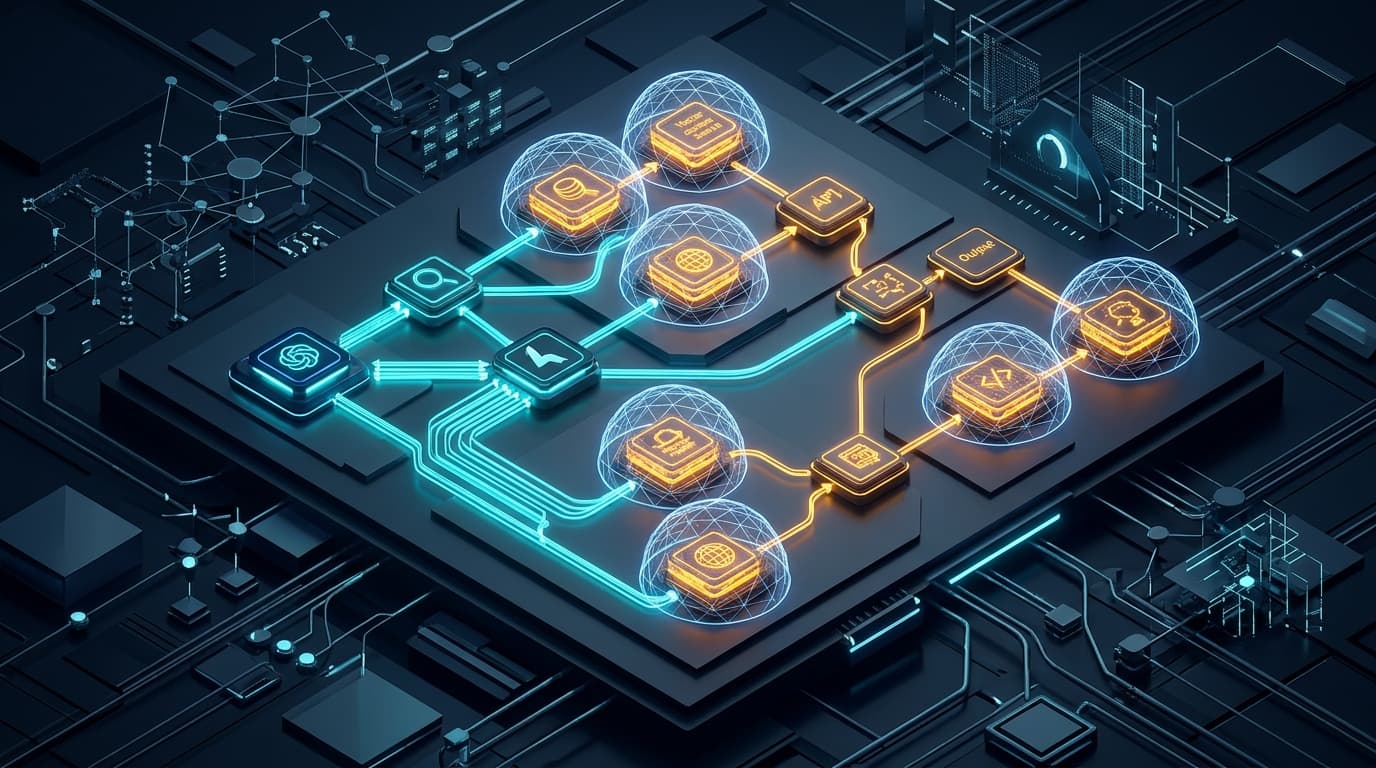
Modern enterprise agents are rarely confined to a single compute boundary or operational runtime. An agent orchestrating business automation may ingest unstructured requests from an enterprise communication suite, evaluate objectives within an external hosted large language model API, query internal operational databases, and issue transaction commits through downstream enterprise resource planning endpoints.
In such distributed workflows, each participating host sees only isolated stages of the broader execution path:
- The Originating Platform: Captures the initial prompt or trigger event but remains blind to downstream external tool-calling mechanics.
- The Model Inference Host: Validates input tokens and generates contextual completions, without persistent awareness of enterprise database architectures or external execution parameters.
- The Execution Target: Receives authenticated API commands or database transactions, unable to independently assess whether the upstream prompt was legitimate, manipulated, or operating outside organizational guardrails.
This fragmentation breaks down native security telemetry. When an anomalous transaction occurs, security operations teams are often left without a unified, immutable audit trail reconciling the high-level prompt against final execution artifacts.
Identity, Permission Inheritance, and Privilege Creep
The primary technical risk driving the agentic shared responsibility gap centers on non-human identity management. Traditional enterprise identity architectures are optimized for two primary archetypes: interactive human users governed by multi-factor authentication, and static service accounts configured with deterministic API keys or certificate credentials. Autonomous agents fit neither paradigm cleanly.
To perform dynamic reasoning tasks without requiring continuous human approval loops, agents are routinely granted broad operational scopes. If an agent operates using long-lived authentication bearer tokens or inherited machine credentials across multiple services, the principle of least privilege is rapidly degraded. Organizations face substantial privilege accumulation risks when agents accumulate rights across diverse cloud providers, software services, and proprietary data lakes.
Comparison of Enterprise Non-Human Identity Models
| Governance Dimension | Static Service Accounts | Federated Workload Identities | Autonomous Agent Principals |
|---|---|---|---|
| Behavioral Pattern | Deterministic, predictable script execution | Predefined pipeline and container tasks | Non-deterministic reasoning and multi-step tool use |
| Scope of Access | Strictly bounded to single resource or service | Bound to dynamic compute infrastructure scopes | Cross-platform access spanning disparate vendor clouds |
| Session Duration | Long-lived credential lifespans (keys/secrets) | Short-lived, cryptographic token exchanges | Dynamic sessions requiring contextual revocation |
| Visibility Demarcation | Fully monitored by target service logs | Monitored within identity provider audit streams | Fragmented across disjointed platform providers |
Without centralized, vendor-agnostic control over agent identities, enterprise administrators cannot establish whether a requested action adheres to the security baseline of the data owner, the agent platform, or the executing infrastructure.
Affected Deployments and Organizational Exposure
The shared responsibility dilemma primarily impacts production environments deploying autonomous task-oriented agents across complex integration topologies. Organizations most vulnerable to governance seams include:
- Multi-Cloud Enterprise Environments: Deployments where model inference runs in one cloud provider, enterprise orchestration logic resides in a second, and core data stores exist within on-premises data centers or third-party storage platforms.
- SaaS Integration Pipelines: Automated agent workflows authorized to read, process, and write records across customer relationship management, human resources, and financial software ecosystems.
- Autonomous Code Generation and Tool-Calling Pipelines: Systems where developer-assist agents possess write permissions to source code repositories, continuous integration runners, and deployment infrastructure.
In each scenario, reliance on disparate vendor-native logging tools produces visibility gaps, preventing unified correlation during incident response and forensic analysis.
Practical Response and Governance Strategies
Addressing the agentic shared responsibility gap requires organizations to shift from fragmented platform-native controls to a unified governance architecture that treats AI agents as distinct privileged principals. Engineering and security teams must implement proactive mitigation measures:
1. Centralize Agent Identity and Token Governance
Security teams should eliminate static, long-lived API keys assigned to agent runtimes. Instead, deploy centralized identity brokers capable of issuing ephemeral, short-lived tokens scoped strictly to the specific tool invocation required for an immediate task. Cryptographic proof-of-possession tokens should be enforced to prevent token reuse across disparate execution contexts.
2. Establish Contextual Least Privilege Scoping
Permissions assigned to autonomous agents must be context-dependent rather than role-wide. If an agent requires read access to extract summary information, write and delete permissions must remain explicitly inaccessible within the downstream target system. Micro-segmentation of application interfaces ensures that even if an agent's reasoning flow deviates from intended parameters, blast radius containment is enforced deterministically by the receiving infrastructure.
3. Implement Cross-Platform Activity Logging
Enterprises cannot rely on individual vendors to aggregate operational logs. Organizations must ingest event feeds from model hosts, orchestrators, and downstream applications into a central security information and event management (SIEM) pipeline. Correlation engines must bind original user prompts, intermediate model reasoning outputs, generated tool parameters, and final target responses under a unified session tracking identifier.
4. Explicitly Define Contractual Demarcation Lines
During enterprise software procurement, security architecture leaders must review vendor contracts and operational definitions regarding autonomous agent activities. Organizations must define which entity retains liability and accountability for unauthorized modifications, data disclosures, or unexpected transactions triggered through agentic interfaces.
Open Questions and Unknowns
As autonomous agent architectures continue to mature, critical technical and governance questions remain unresolved across the industry. There is currently no widely accepted open standard for federating identity, intent verification, and cryptographic provenance for autonomous agents crossing distinct organizational domains.
Additionally, the boundary between algorithmic non-determinism and intentional authorization bypass remains poorly defined. When an agent executes an anomalous operation within its technically permitted scopes, determining whether the event constitutes a security compromise, an adversarial input manipulation, or an unintended reasoning path remains challenging for existing audit systems. Until vendor boundaries align on shared telemetry, accountability, and permission standardization, enterprise security teams must compensate with defensive engineering and strict architectural isolation.