Advisory Summary
Yokogawa Electric Corporation has issued an emergency cybersecurity notification (YSAR-26-0004) alerting critical infrastructure operators to CVE-2026-80840 (CVSS score 9.6), a critical remote code execution flaw in CENTUM VP Human Interface Station (HIS) software.
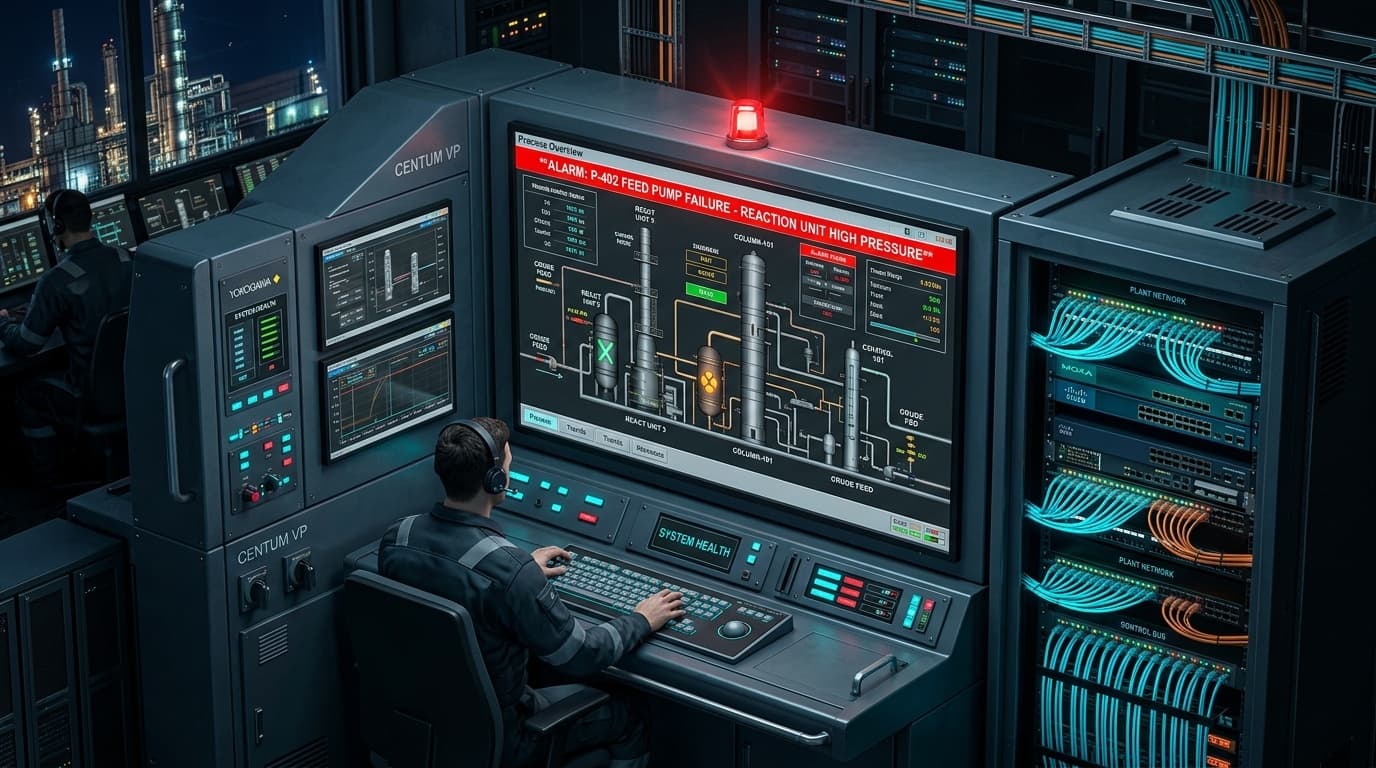
CENTUM VP is one of the world's most widely deployed Distributed Control Systems (DCS), managing process automation across major oil refineries, liquefied natural gas (LNG) terminals, chemical plants, and power generation facilities globally. The vulnerability permits an attacker to execute arbitrary machine code on operator consoles with full local administrative privileges.
Root Cause: Unsafe Graphic Macro Deserialization
The vulnerability exists within the Graphic Display Service (BKHOprGph.exe), which manages the real-time visualization of process flow diagrams, valve positions, and alarm annunciators across operator consoles.
| Vulnerability Dimension | Technical Detail |
|---|---|
| Vulnerability ID | CVE-2026-80840 |
| Common Weakness Enumeration | CWE-502 (Deserialization of Untrusted Data) |
| CVSS v3.1 Base Score | 9.6 (Critical) - CVSS:3.1/AV:N/AC:L/PR:N/UI:N/S:C/C:H/I:H/A:H |
| Impacted Systems | CENTUM VP R5.01.00 through R5.04.20, R6.01.00 through R6.10.00 |
| Remediated Software | CENTUM VP R6.11.00 / Patch Rollup YSAR-26-0004-P1 |
When an operator navigates to a graphic display window, the HIS service dynamically fetches compiled macro byte arrays over the control network via TCP port 50014. The binary parser failed to perform bounds checks or type validation before loading embedded executable objects, allowing an unauthenticated attacker on the supervisory network to inject shellcode that executes within the high-privilege SYSTEM context.
Operational Impact on Process Plants
Successful compromise of an HIS operator workstation provides adversaries with complete control over physical plant visualization and manual override capabilities:
- Blinding Operators: Attackers can freeze telemetry displays to show normal valve pressures and liquid levels while simultaneously sending destructive commands to Field Control Stations (FCS).
- FCS Logic Tampering: From a compromised HIS console, attackers can download modified ladder logic or function block diagrams directly to physical controllers over the Vnet/IP bus.
- Safety Valve Manipulation: Threat actors can force emergency shutdown valves (ESD) closed or override interlocks, risking physical overpressure events.
Industrial Remediation & Defense Playbook (IEC 62443 Standards)
Process automation engineers and DCS administrators must execute the following remediation steps:
- Apply Official Yokogawa Patches: Install Patch Rollup YSAR-26-0004-P1 or upgrade to CENTUM VP R6.11.00 immediately on all engineering workstations and HIS operator consoles.
- Vnet/IP and Control Network Segmentation (IEC 62443-3-2): Enforce strict firewall boundaries between Level 3 operations and Level 2 control systems. Block TCP port 50014 from all corporate and external networks.
- Workstation Application Whitelisting: Enable Windows Defender Application Control (WDAC) or industrial endpoint whitelisting on all HIS machines to prevent unauthorized binaries or DLLs from executing.
- Monitor for Rogue Macro Artifacts: Audit the
C:\Yokogawa\CentumVP\Graphics\directory for unexpected or recently modified graphic display definition files.
Regulatory Mandates & Statutory Enforcement Matrix
| Governance Pillar / Directive | Regulated Scope & Entities | Mandated Compliance Deadline | Statutory Enforcement & Penalties |
|---|---|---|---|
| Core Operational Resilience | Banking, Cloud Providers & Financial Institutions | Immediate Mandatory Enforcement | Supervisory audits, business restrictions & statutory fines |
| Incident Disclosure & Telemetry | Critical IT & Third-Party Cloud Infrastructure | Strict Statutory Reporting Window | Regulatory inquiry and executive liability under statutory acts |
| Data Governance & Risk Management | Enterprise Data Fiduciaries & Cloud Processors | Rolling 180-Day Audit Baseline | Statutory financial penalties and remediation embargoes |
Step-by-Step Technical Audit & Compliance Verification Playbook
Enterprise compliance and security operations teams must verify technical controls and audit readiness:
- Verify Immutable Audit Log Retention in Cloud Storage:
# AWS S3: Verify Object Lock retention compliance mode on SIEM audit bucket aws s3api get-object-lock-configuration --bucket enterprise-siem-compliance-logs # Output must confirm ObjectLockEnabled: Enabled with Compliance mode - Audit Cloud Workload Encryption & IAM Privileges:
# Query Azure Key Vault or AWS KMS for automated annual key rotation status aws kms list-keys --query "Keys[*].KeyId" --output text | xargs -n 1 aws kms get-key-rotation-status --key-id - Automated Regulatory Incident Notification Dispatch Test:
# Automated compliance deadline alert trigger verification
import time, datetime

def verify_compliance_window(incident_epoch: float, max_hours: int = 6):
    elapsed = (time.time() - incident_epoch) / 3600
    if elapsed > max_hours:
        print(f"CRITICAL: Statutory notification window exceeded ({elapsed:.1f}h / {max_hours}h)")
    else:
        print(f"Within compliance window: {max_hours - elapsed:.1f}h remaining")

verify_compliance_window(time.time() - 3600)
Continuous Threat Monitoring & Log Auditing Queries
Monitor SIEM logs for anomalous privilege escalation and unapproved administrative role assumptions:
-- Query SIEM audit trail for high-privilege IAM policy updates
SELECT timestamp, user_identity, event_name, request_parameters
FROM cloud_audit_logs
WHERE event_name IN ('PutRolePolicy', 'AttachUserPolicy', 'CreateSecurityGroupRule')
  AND status = 'Success'
ORDER BY timestamp DESC
LIMIT 50;