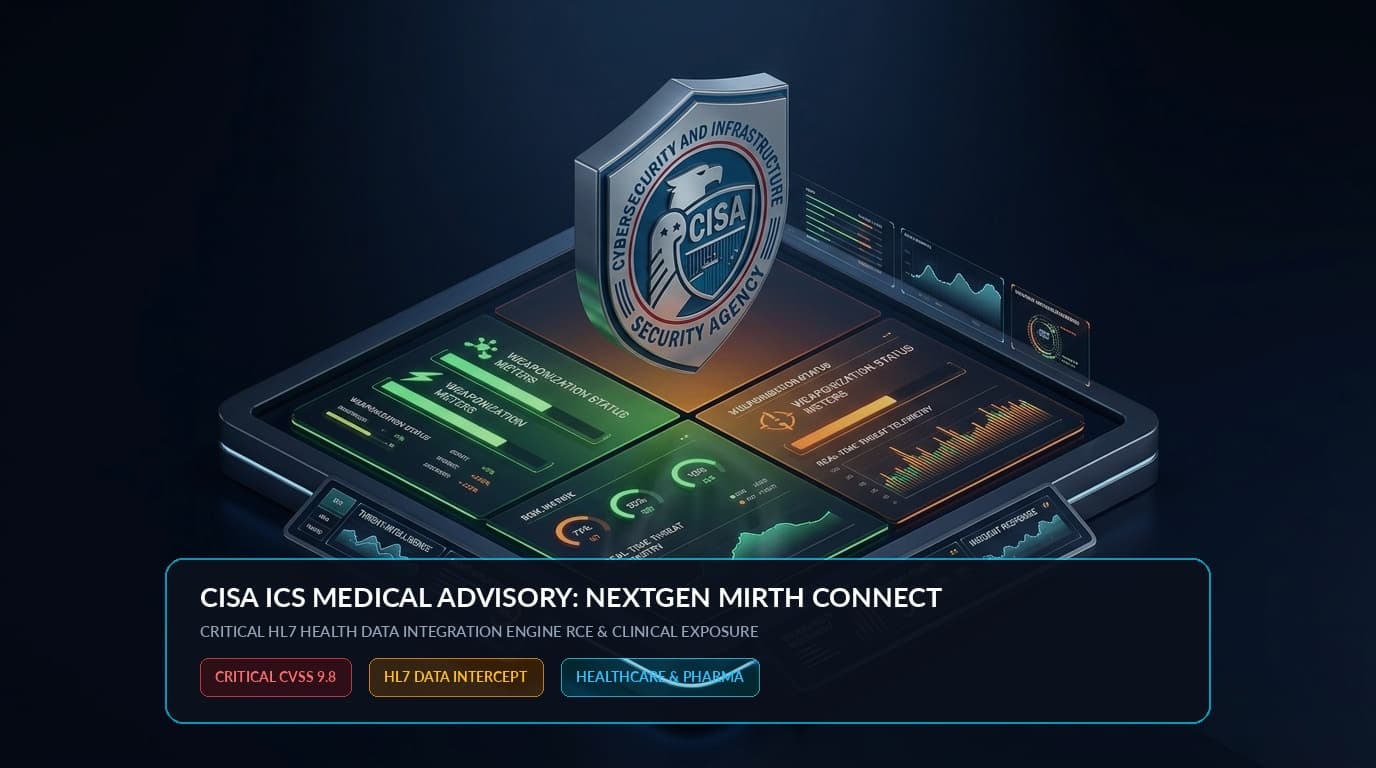
The Cybersecurity and Infrastructure Security Agency (CISA) has issued a high-priority Medical Industrial Control Systems Advisory (ICSMA-26-253-01), alerting healthcare organizations, hospital networks, and clinical laboratories to critical remote code execution (RCE) flaws in NextGen Healthcare Mirth Connect.
Mirth Connect is an open-source and commercial healthcare integration engine deployed extensively across hospitals worldwide to parse, translate, and route sensitive medical messaging protocols—such as Health Level Seven (HL7), Fast Healthcare Interoperability Resources (FHIR), and DICOM imaging streams—between disparate electronic health record (EHR) systems, laboratory databases, and telemetry monitors.
Vulnerability Deep Dive: Unsafe Java Deserialization & Channel Parsing
The primary vulnerability, designated CVE-2026-82583, carries a maximum Common Vulnerability Scoring System (CVSS v3.1) score of 9.8 (CVSS:3.1/AV:N/AC:L/PR:N/UI:N/S:U/C:H/I:H/A:H). Categorized under CWE-502: Deserialization of Untrusted Data, the defect resides in Mirth Connect's administrative web listener and inbound HTTP/TCP message transport channels.
The vulnerability manifests when incoming network requests containing malformed Java XML or serialized payloads are processed by legacy XML-to-object deserialization pipelines:
- Unauthenticated Network Reachability: The attacker submits an unauthenticated HTTP POST or raw socket packet to Mirth Connect's active channel listener (frequently exposed on TCP ports 8443, 8080, or custom HL7 listener ports).
- Transformer Execution: The engine invokes its JavaScript / Rhino script transformer engine or Java object deserializer without strict class-filtering controls.
- System Privilege Acquisition: The payload executes arbitrary operating system commands under the context of the service account (often LocalSystem on Windows or root/app user on Linux), granting full administrative compromise of the clinical data gateway.
In clinical hospital environments, Mirth Connect sits at the epicenter of patient care. If an adversary compromises an integration engine, they gain the ability to silently alter medication dosage values, clinical lab results, or exfiltrate massive troves of Protected Health Information (PHI).
Affected Deployments & Vulnerability Matrix
| Vulnerability Identifier | Impacted Versions | CVSS v3.1 Rating | Remediated Release |
|---|---|---|---|
| CVE-2026-82583 | Mirth Connect 4.4.x and earlier | Critical (9.8) | 4.5.1 / 4.6.0 |
| CVE-2026-78224 | Mirth Connect 4.3.x through 4.5.0 | High (8.2) | 4.5.1 / 4.6.0 |
| CVE-2026-82578 | Mirth Connect Server Extensions | High (7.5) | Extension Hotfix Pack |
Clinical Network Hardening & Incident Response Checklist
Hospital cybersecurity directors, clinical engineering teams, and health system CISOs must execute the following remediation directives immediately:
# Check current Mirth Connect service version and listening interfaces
netstat -tulpn | grep -E "8443|8080|9001"

# Audit Mirth Connect application logs for suspicious deserialization exceptions
grep -iE "com.thoughtworks.xstream|ClassNotFoundException|InvocationTargetException" /opt/mirthconnect/appdata/logs/mirth.log

# Verify file integrity of deployed JavaScript transformer extensions
find /opt/mirthconnect/extensions -type f -name "*.jar" -exec sha256sum {} ;
Mandatory Defensive Safeguards
- Immediate Upgrade: Upgrade NextGen Mirth Connect to version 4.5.1 or 4.6.0 immediately, which enforces strict ClassLoader filters and replaces vulnerable XML parsing modules.
- Isolate Clinical Integration Engines: Ensure Mirth Connect instances are located strictly within isolated hospital backend VLANs. Under zero circumstances should Mirth Connect administrative ports (TCP 8443, 8080) be accessible from the public internet or guest Wi-Fi networks.
- Mutual TLS (mTLS) for HL7 Feeds: Enforce certificate-based mutual TLS encryption for all inbound and outbound HL7 messaging channels to reject untrusted network connections.
- Clinical Anomaly Detection: Configure network intrusion detection rules (Snort/Suricata) to alert on unexpected outbound HTTP or DNS requests originating from Mirth Connect host servers.