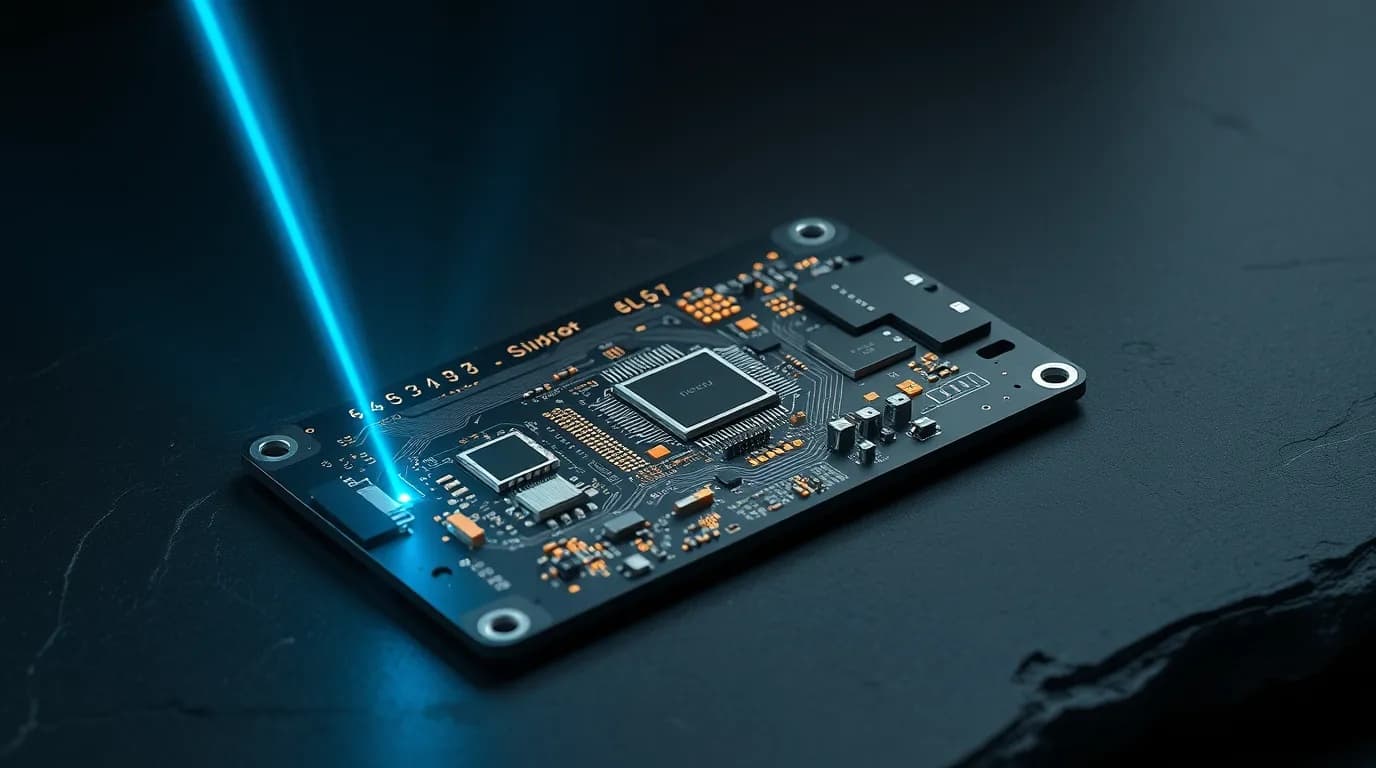
Cryptographic hardware security has long relied on the assumption that specialized microcontrollers and secure elements provide an uncompromised root of trust. As attack surfaces across decentralized networks and self-custody systems mature, threat models must expand beyond memory-corruption vulnerabilities, side-channel leakage, and firmware extraction. Security architecture discussions have increasingly highlighted a more insidious supply chain risk: the insertion of lookalike microchips engineered with hidden, malicious operational logic designed to subvert custody architectures from deep within the hardware layer.
The Evolution of Hardware-Level Supply Chain Tampering
Traditional hardware wallet defenses focus primarily on physical tamper resistance, cryptographic signature verification of loaded firmware, and secure key derivation inside monolithic integrated circuits. Attackers seeking to subvert these boundaries historically depended on fault injection, glitching, or physical extraction of non-volatile memory via decapping and microscopic probing. While these physical extraction techniques demand specialized laboratory equipment, they generally target genuine hardware produced by standard semiconductor supply chains.
However, as digital asset valuations escalate, the economic incentive for nation-state actors and advanced organized syndicates shifts toward upstream supply chain interdiction. In this threat paradigm, an adversary does not merely attempt to bypass genuine silicon safeguards. Instead, malicious actors introduce functional counterfeit silicon—lookalike microchips that replicate standard pinouts, electrical characteristics, and behavioral responses of widely utilized microcontrollers or secure elements, while harboring latent backdoors or deterministic randomness degradations.
The Anatomy of Lookalike Silicon Threats
Lookalike chips present severe diagnostic challenges for downstream manufacturers and end users. Modern integrated circuit design relies on complex third-party intellectual property (IP) blocks and multi-tiered foundry distribution networks. When malicious functionality is baked directly into the silicon layout—whether via modified mask sets during fabrication or through deceptive packaging of compromised dies—conventional verification mechanisms frequently fail:
- Visual and Packaging Deception: Counterfeit packages often mirror laser-etched markings, package dimensions, and pin configurations identically, evading standard optical automated inspection on assembly lines.
- Electrical Conformity: Under standard test vectors and operational bench checks, the component exhibits expected voltage tolerances, clock timings, and instruction processing speeds.
- Selective Triggering: Covert logic gates can remain dormant during initial quality assurance cycles, activating only after specific execution counters, external environmental triggers, or specific bus command sequences are encountered.
When deployed within hardware wallets, such covert circuitry could be instructed to quietly leak private keys over subtle physical side channels, weaken pseudorandom number generators (PRNG) to render generated seed phrases predictable, or surreptitiously alter transaction destination addresses on integrated display buses.
The Blind Spot of Cryptographic Attestation
Most commercial hardware custody devices deploy cryptographic attestation protocols where the device signs a challenge using a pre-installed factory key to prove authenticity to client software. If the underlying silicon is itself compromised or replaced with a malicious lookalike, attestation mechanisms become fundamentally unreliable.
A fabricated chip can be pre-loaded with valid stolen or cloned vendor certificates, allowing it to complete standard challenge-response exchanges without raising alerts. Furthermore, because firmware executes on top of the silicon architecture, firmware-level integrity checks cannot reliably audit the microarchitectural behavior of the CPU registers or hardware cryptographic accelerators executing those checks. If the microcode or logic gates are designed to lie to the hypervisor or runtime kernel, host systems receive clean telemetry from an inherently subverted execution environment.
The Argument for Verifiable Silicon Architectures
Mitigating the threat of lookalike silicon and hidden operational logic necessitates a paradigm shift toward open, inspectable, and verifiable hardware designs. Relying exclusively on proprietary secure elements from closed foundries creates an unverifiable single point of failure. Verifiable silicon concepts propose several engineering criteria to restore hardware assurance across sensitive custody pipelines:
- Open Source Silicon Implementations: Utilizing open-standard instruction set architectures (such as RISC-V) with transparent gate-level netlists that permit independent auditing of logic structures before and after fabrication.
- Reproducible Physical Layouts: Establishing standardized manufacturing pipelines where independent laboratories can decap sample units from production runs and compare chemical delayering imagery against published photomask layouts to detect unauthorized circuitry additions.
- Multi-Vendor Component Redundancy: Designing dual-chip or multi-chip hardware platforms where cryptographic operations require consensus between isolated silicon architectures produced by separate, distinct semiconductor foundries.
By enforcing architectural transparency, the cost and technical complexity of covertly modifying silicon designs without detection increase significantly, raising the barrier against targeted supply chain interdiction.
Comparative Analysis of Hardware Security Approaches
| Security Dimension | Proprietary Black-Box Silicon | Verifiable / Open Silicon Framework |
|---|---|---|
| Silicon Logic Visibility | Proprietary; protected by non-disclosure agreements and closed IP blocks. | Transparent netlists and auditable register-transfer level (RTL) specifications. |
| Supply Chain Integrity | High reliance on single-foundry chain of custody and vendor provenance. | Distributed provenance verification and sample destructive validation. |
| Counterfeit Detection | Limited to functional testing, packaging inspection, and factory key attestation. | Structural microarchitectural auditing and cross-foundry consensus mechanisms. |
| Attack Resistance | High resistance to casual tampering; opaque against state-level foundry modification. | Auditable defense-in-depth against covert logic insertion and backdoor circuits. |
Defensive Engineering Strategies and Operational Response
Because fully verifiable silicon ecosystems remain in developmental phases, organizations and enterprises securing high-value digital operations cannot rely on a single physical custody unit, regardless of its vendor certifications. Addressing the threat of lookalike silicon requires resilient systems architecture that assumes any individual physical endpoint may be compromised.
1. Multi-Signature and Quorum Custody
Enterprises must eliminate single points of failure by mandating threshold multi-signature architectures. High-value transactions should require independent signing keys generated and stored across disparate hardware form factors, developed by separate manufacturers utilizing silicon sourced from different global fabrication facilities. Even if an adversary successfully inserts a compromised lookalike chip into one device line, the integrity of the overarching custody quorum remains unbroken.
2. Air-Gapped and Independent Transaction Verification
Operational workflows should isolate transaction generation from transaction signing. Signing devices should communicate exclusively over strict, auditable channels (such as optical QR codes or minimal serial streams) with strict protocol parsers. Furthermore, critical details—specifically destination addresses, transferred values, and gas or fee parameters—must be verified against secondary, independent nodes rather than trusting local telemetry presented by a single connected peripheral.
3. Supply Chain Hardening and Procurement Controls
Organizations must establish rigorous chain-of-custody protocols for hardware procurement. Hardware security modules, authentication tokens, and custody hardware must be procured exclusively through verified manufacturer direct channels, avoiding third-party distributors or unauthorized secondary markets where physical interdiction is most feasible. Devices should be routinely cycled, and high-assurance institutions should explore destructive laboratory sampling of batch purchases to verify physical silicon uniformity.
Uncertainties and Emerging Challenges
While the architectural limitations of conventional hardware security models are increasingly recognized, significant engineering challenges remain before verifiable silicon can become standard across commercial consumer products:
- Verification Scalability: Non-destructive physical verification of sub-micron process nodes remains cost-prohibitive for ordinary consumers and small-to-medium enterprises, restricting rigorous destructive auditing to well-funded research facilities.
- Foundry Trust and Toolchain Integrity: Even with fully open netlists and transparent RTL code, synthesizing hardware requires complex electronic design automation (EDA) software, which itself represents an attack vector for compiler-like subversions.
- Standardization Timelines: Developing open, audited cryptographic secure elements with performance and physical side-channel resilience comparable to mature proprietary hardware requires substantial multi-year industry coordination and funding.
As threats targeting hardware components continue to evolve from speculative theory into operational realities, cryptographic ecosystems must accelerate the adoption of verifiable silicon standards to ensure that hardware roots of trust remain resilient against advanced physical and supply chain manipulation.