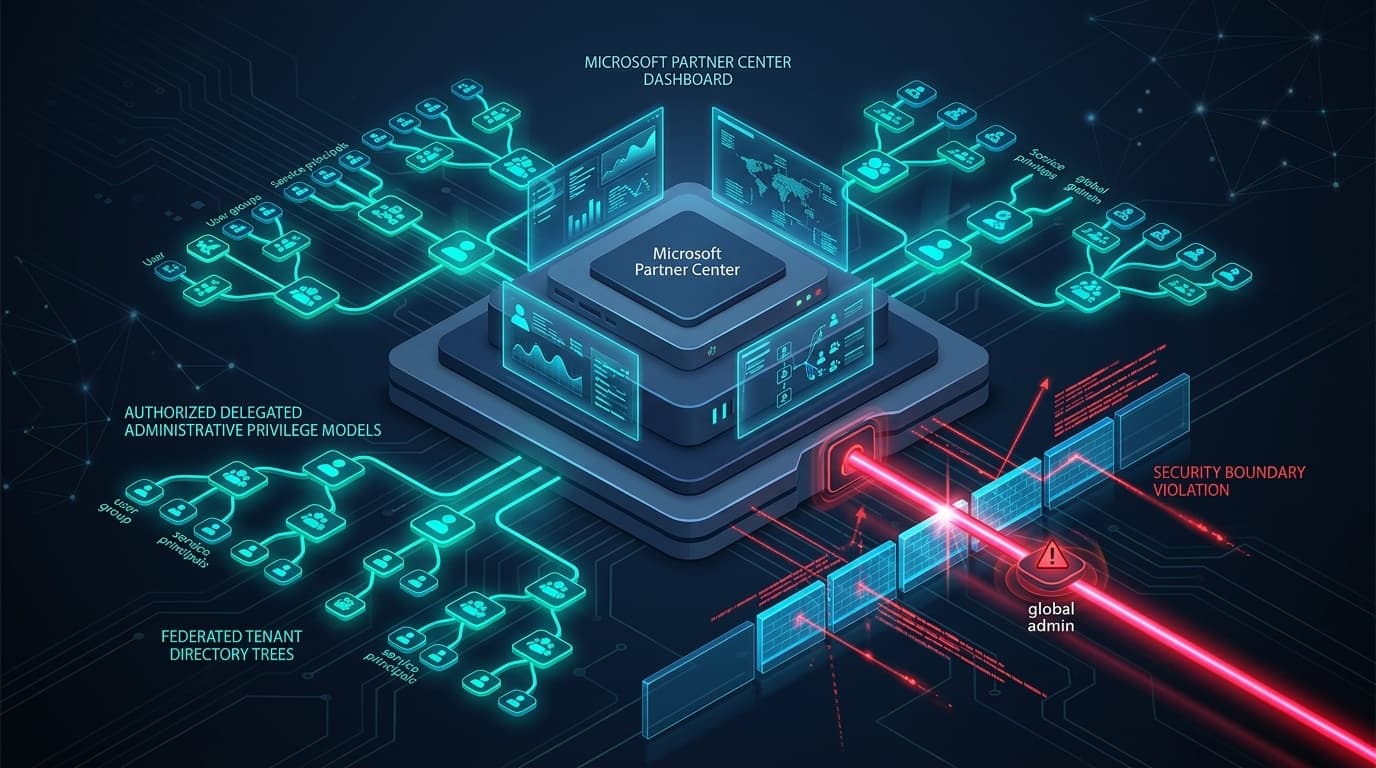
Executive Overview: Compromise via Legitimate Operational Pathways
Modern enterprise perimeter defense relies on cryptographic identity, administrative verification channels, and routine update mechanisms. When threat actors subvert these mechanisms, security perimeters fail to register unauthorized behavior because the resulting telemetry mimics standard operational workflows. According to technical disclosure disclosures published under record DISCOV-THREATS-3b4btg0, recent security assessments of Enterprise Infrastructure Core System & Services emphasize a critical security reality: modern intrusions frequently bypass defensive gates without brute-force techniques, instead capitalizing on preexisting administrative trust boundaries.
The disclosure underscores how threat groups systematically identify minor operational oversights—ranging from misplaced cryptographic signing keys to permissive update channels—to establish an initial foothold. Rather than deploying high-noise zero-day memory corruption exploits or volatile network-level denial-of-service primitives, adversaries leverage pre-authenticated access channels to bypass anomaly detection systems and maintain persistent visibility across enterprise clusters.
Technical Context and Attack Mechanics
The root problem within affected enterprise infrastructure environments stems from an over-reliance on implicit internal trust. System management components responsible for distributing configuration state, coordinating administrative roles, and handling background synchronizations often operate with elevated operating system privileges. When an entity possesses a legitimate cryptographic credential or enters through a verified messaging conduit, internal inspection routines routinely skip secondary authorization checks.
1. The Subversion of Pre-Existing Trust Mechanisms
According to official disclosure documentation, the identified security exposure centers on the operational vectors that organizations consider routine. These pathways fall into three distinct functional categories:
- Cryptographic Credential Misappropriation: The exposure or exfiltration of enterprise identity keys allows external actors to sign administrative requests or authenticate to internal management interfaces without triggering baseline behavioral alerts.
- Trusted Messaging Interception: Administrative messaging protocols and command channels, designed to coordinate tasks across disparate server clusters, are vulnerable to lateral reuse when communication endpoints fail to enforce mutual, per-request validation.
- Routine Update Channel Exploitation: Automated update components and synchronization scripts executing with service-account permissions present an immediate privilege escalation avenue if file validation and signature verification steps are not strictly isolated.
2. Mechanics of Incremental Lateral Access
As documented in the advisory record, an intrusion rarely presents itself as an immediate, full-scale breach of core datastores. Instead, an attacker identifies a minor gap—such as a misplaced administrative credential or an open message broker port—and uses it to establish an initial low-privilege foothold. Once inside the perimeter boundary, the attacker leverages the established communications architecture to query internal configuration records, map neighboring systems, and access core deployment services.
Because the initial vector relies on valid credentials or recognized administrative conduits, traditional security information and event management (SIEM) systems register these transactions as regular administrative traffic. By the time an unauthorized lateral traversal occurs, the threat actor has effectively blended into background operational noise.
Affected Deployments and Operational Architecture
The exposure documented under tracking identifier DISCOV-THREATS-3b4btg0 impacts organizations managing centralized control planes under the Enterprise Infrastructure Core System & Services umbrella. The architectural configurations most susceptible to this access methodology share specific organizational patterns:
- Centralized Fleet Management Environments: Environments where hundreds or thousands of secondary systems rely on a single central controller for policy distribution, credential rotation, and package deployment.
- Decoupled Microservice Conduits: Deployments featuring decoupled microservices communicating across internal service meshes without strict mutual transport layer security (mTLS) validation on every inter-service call.
- Automated Ingestion Pipelines: Continuous deployment and administrative synchronization pipelines configured to poll shared update directories or remote repositories using long-lived static tokens.
| Operational Vector | Primary Vulnerability Point | Observed Defensive Weakness |
|---|---|---|
| Administrative Key Management | Stolen or exposed operational keys | Lack of cryptographic key scoping and missing hardware-backed validation. |
| Internal Messaging Infrastructure | Implicitly trusted command streams | Failure to validate transaction authenticity at intermediate processing nodes. |
| Package & Policy Updates | Automated synchronization routines | Permissive service accounts executing unsigned or weakly inspected routine updates. |
Practical Defensive Response & Hardening Strategy
Addressing vulnerabilities rooted in trusted workflows requires system administrators to transition from perimeter-only defenses to continuous internal verification. To mitigate exposure across Enterprise Infrastructure Core System & Services installations, organizations should enact the following verified hardening measures:
Key Rotation and Access Scoping
Enterprise infrastructure administrators must audit all existing cryptographic access keys, service account credentials, and deployment tokens. Long-lived credentials used across multi-node environments should be revoked immediately in favor of short-lived, dynamically generated authentication tokens. Ensure that all programmatic access adheres strictly to least-privilege principles, restricting keys to specific operational endpoints rather than entire administrative namespaces.
Zero-Trust Inspection for Internal Communications
Internal message buses and administrative signaling conduits must cease operating under implicit trust assumptions. Implement strict end-to-end mutual authentication across all service-to-service links. By enforcing cryptographic validation at every message hop, security architectures prevent attackers who possess a compromised internal host from injecting arbitrary commands into administrative pipelines.
Integrity Verification for Automated Pipelines
Update routines and automated maintenance tasks must be decoupled from broad administrative access. All deployment packages, policy files, and binary updates ingested by Enterprise Infrastructure Core System & Services must undergo explicit cryptographic signature verification prior to staging and execution. File-integrity monitoring (FIM) should be configured on all directories containing executable payloads or update scripts to identify unexpected modifications in real time.
Unconfirmed Details and Analytical Boundaries
While official documentation confirms the exposure mechanism involving stolen credentials, trusted message pathways, and automated maintenance workflows, several technical facets remain unconfirmed in public records:
- Specific CVE Assignment: The advisory references internal disclosure reference
DISCOV-THREATS-3b4btg0; no public Common Vulnerabilities and Exposures (CVE) index or CVSS base score has been officially assigned at this stage. - Threat Actor Attribution: The available primary records do not attribute these operational exploitations to any named advanced persistent threat (APT) group or cybercriminal syndicate.
- Standardized Binary Patch Releases: Because the exposure involves configuration hygiene, credential handling, and operational pipeline architecture, no singular software patch has been distributed to automatically resolve the issue across all core deployments.
Security teams should consult official advisories released by primary infrastructure entities and monitor government coordination portals, such as the Cybersecurity and Infrastructure Security Agency (CISA) Cybersecurity Advisories portal, for further validation and standardized mitigation guidance.