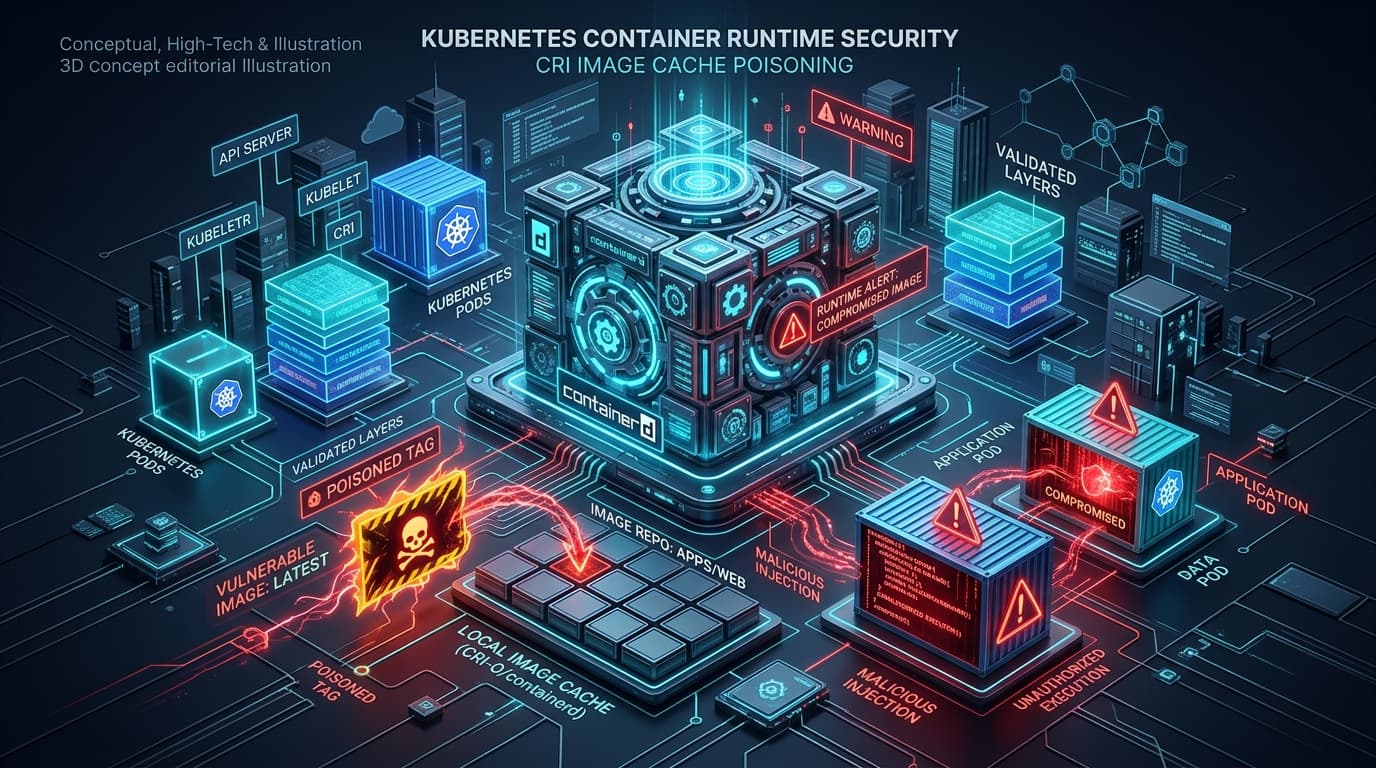
Executive Lead: Breaking Container Isolation via Runtime Image Cache Poisoning
The containerd project—the foundational container runtime engine underpinning Kubernetes deployments globally, including managed cloud services such as Amazon Elastic Kubernetes Service (EKS), Google Kubernetes Engine (GKE), and Microsoft Azure Kubernetes Service (AKS)—has disclosed a high-severity vulnerability tracked as CVE-2026-50195 (GitHub Advisory ID GHSA-365q-w579-pq94).
The vulnerability, rated CVSS 8.8 High, resides in containerd's implementation of the Kubernetes Container Runtime Interface (CRI) CheckpointContainer API. By manipulating tar archive layer extraction during container checkpointing and export operations, an adversary with elevated privileges inside a container can break filesystem confinement and overwrite cached container image layers stored in the host node's local containerd image store.
Because Kubernetes worker nodes cache common base images—such as alpine:latest, ubuntu:24.04, node:current, or critical infrastructure pods like kube-proxy and service mesh sidecars—poisoning an image layer blob compromises all subsequent containers that pull or instantiate that image on the same physical host. This allows an attacker to achieve cross-namespace privilege escalation and persistent host execution without requiring a kernel exploit.
Anatomy of the Flaw: Tar Symlink Extraction in CRI Checkpoint Processing
The CRI CheckpointContainer API, introduced to support forensic memory dumping, live debugging, and container migration, serializes a container's filesystem diffs, memory pages, and metadata into a standardized checkpoint tar archive.
When containerd receives a checkpoint request, the CRI service unpacks the generated archive to register snapshot diffs with the configured snapshotter (such as overlayfs) and content store (/var/lib/containerd/io.containerd.content.v1.content/data/). During this unpacking sequence, containerd failed to validate the destination boundaries of symbolic links and hard links contained inside the archive:
// Simplified excerpt of containerd CRI archive extraction logic
func unpackCheckpointArchive(ctx context.Context, reader io.Reader, root string) error {
    tr := tar.NewReader(reader)
    for {
        hdr, err := tr.Next()
        if err == io.EOF {
            break
        }
        // Insecure path joining: target resolves outside root if symlink precedes file
        target := filepath.Join(root, hdr.Name)
        if hdr.Typeflag == tar.TypeSymlink {
            os.Symlink(hdr.Linkname, target)
        } else if hdr.Typeflag == tar.TypeReg {
            // Writes directly to symlink target, escaping the staging root
            outFile, _ := os.OpenFile(target, os.O_CREATE|os.O_WRONLY|os.O_TRUNC, hdr.FileInfo().Mode())
            io.Copy(outFile, tr)
            outFile.Close()
        }
    }
    return nil
}
A malicious actor with container administrator privileges (or CAP_CHECKPOINT_RESTORE) can structure a tar archive where a leading directory entry creates a symlink pointing to the containerd content store (e.g., link -> /var/lib/containerd/io.containerd.content.v1.content/data/). Subsequent file writes inside the archive traverse through this link, directly overwriting sha256 content-addressable blobs that correspond to cached image layers of other container images on the node.
Exploitation Walkthrough & Blast Radius
The attack unfolds across four synchronized stages:
| Phase | Technical Operation | Target Component | Outcome |
|---|---|---|---|
| 1. Container Access | Attacker obtains root access or CAP_SYS_ADMIN in a low-trust pod (e.g., developer sandbox or compromised workload). |
Pod Namespace | Prepares crafted checkpoint payload in local container filesystem. |
| 2. Archive Crafting | Constructs checkpoint archive containing directory symlink pointing to /var/lib/containerd/io.containerd.content.v1.content/data/. |
Tar Decompressor | Symlink evasion evades canonical path checks. |
| 3. Checkpoint Execution | Invokes CRI Checkpoint API via kubelet proxy or local container runtime socket. | containerd CRI Service | Unpacker writes malicious binary over cached SHA256 layer blob (e.g., /bin/sh or /usr/bin/python3). |
| 4. Cache Poisoning | High-privilege pod (e.g., payment service, kube-system agent) starts on the same node using cached image. | Kubelet Scheduler | Pod boots using backdoored binary; attacker executes payload in high-privilege namespace. |
Vulnerability Matrix: Affected vs. Patched Versions
The vulnerability impacts the following release branches of containerd:
| containerd Release Branch | Vulnerable Versions | Remediation Release | Release Status |
|---|---|---|---|
| containerd 1.7.x | v1.7.0 through v1.7.27 | v1.7.28 | Patched |
| containerd 2.0.x | v2.0.0 through v2.0.3 | v2.0.4 | Patched |
Remediation Playbook for Cloud Engineers and SREs
1. Runtime Package Update
Update containerd packages on all Kubernetes worker nodes and restart the service:
# Ubuntu / Debian node upgrade
sudo apt-get update && sudo apt-get install --only-upgrade containerd.io>=1.7.28

# Verify active version
containerd --version

# Restart runtime service
sudo systemctl restart containerd
2. Purge and Revalidate Host Image Cache
To ensure no previously poisoned image layers persist in local node stores, flush the local container image cache on existing nodes:
# Remove unused image layers using nerdctl or crictl
sudo crictl rmi --prune

# Or drain node, remove content store, and reboot
kubectl drain  --delete-emptydir-data --ignore-daemonsets
ssh node "sudo systemctl stop containerd && sudo rm -rf /var/lib/containerd/io.containerd.content.v1.content/data/* && sudo systemctl start containerd"
kubectl uncordon
3. Restrict Kubelet Checkpoint API RBAC Access
The Kubernetes Checkpoint API is reached via the kubelet subresource nodes/proxy. Audit ClusterRoles and ensure untrusted service accounts cannot trigger container checkpoints:
# Audit ClusterRole bindings granting nodes/proxy access
kubectl get clusterroles -o json | jq -r '
  .items[] | select(.rules[]? | select(.resources[]? == "nodes/proxy" and .verbs[]? == "create")) | .metadata.name'